
Fastest Visa Pathway NZ: Comparing Skilled Routes to New Zealand Residence
by | August 31, 2026 | Info Article
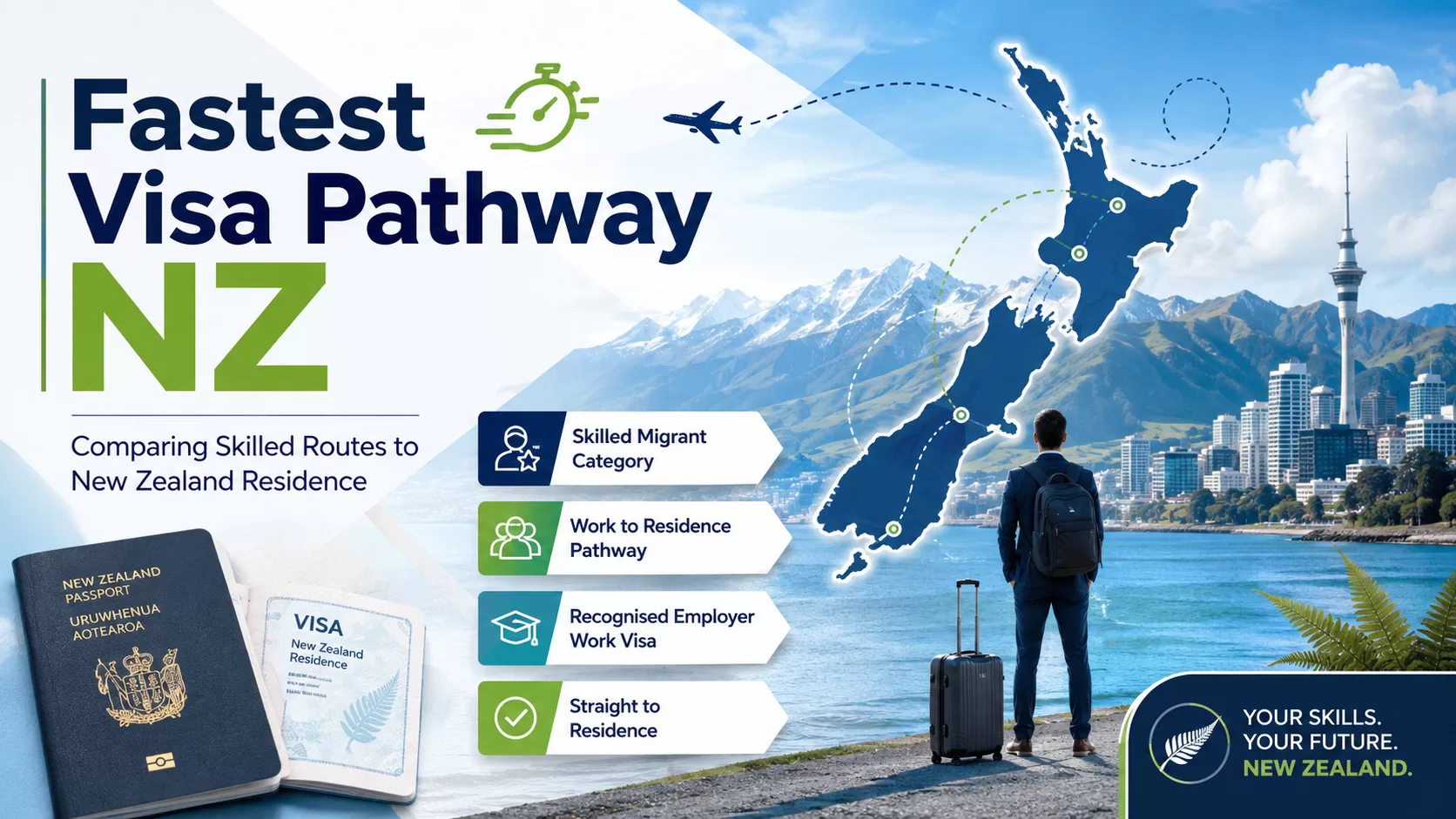
Finding the fastest visa pathway NZ applicants can use depends on what “fastest” means. The quickest way to enter New Zealand may be a temporary work visa, while the quickest route to New Zealand residence may be a direct Green List residence application. There is no universal shortcut, which is why consulting experienced Immigration Advisers Auckland can help applicants understand which pathway best matches their circumstances. The suitable pathway depends on your occupation, qualifications, occupational registration, salary, employer, work history, health, character, English ability, and whether you already have a qualifying job offer.
For skilled workers, the main routes to compare are the Green List pathway, the Skilled Migrant Category Resident Visa, and sector-based Work to Residence options. Immigration New Zealand (INZ) currently describes Green List Tier 1 roles as eligible for the Straight to Residence Visa, while Tier 2 roles generally lead to the Work to Residence Visa after the required New Zealand work period . The Skilled Migrant Category (SMC) also has a points-based pathway, a Skilled Work Experience pathway, and a Trades and Technician pathway .
This guide explains how those routes work, what evidence is required, and how to identify the most realistic pathway to residence. Because immigration instructions, occupation lists, and pay requirements can change, applicants should verify current rules directly with INZ before submitting a visa application or residence application.
What Makes a Visa Pathway the Fastest?
The fastest route is not necessarily the visa with the shortest online processing time. It is usually the route that allows you to meet all legal requirements with the fewest additional steps. Someone with a Tier 1 Green List job, the required registration, and an accredited employer may qualify for residence immediately. Another applicant in a Tier 2 job may first need a New Zealand work visa and 24 months of eligible work experience.
Entry Speed Versus Residence Speed
A temporary work visa may allow a skilled migrant to enter New Zealand and begin employment sooner than a residence application can be finalized. However, a temporary visa does not itself create permanent residence. The applicant must continue to comply with visa conditions, maintain the required job and pay, and later submit a separate residence application if the pathway requires it.
By contrast, a Straight to Residence Visa can be a faster route to residence for an eligible Tier 1 applicant because the person does not generally need to complete a preliminary 24-month New Zealand work period. The applicant must still satisfy the full visa requirements, including the correct job, accredited employer, qualifications or professional registration, pay, health, character, and English requirements .
Personal Circumstances Determine the Best Route
The right immigration pathway depends on the applicant’s individual profile. A person with a recognized qualification, such as a Bachelor’s Degree, Master’s Degree, or PhD, may be well positioned for the SMC Points-Based Pathway. A person without a degree but with a strong trade qualification and post-qualification experience may fit the Trades and Technician Pathway. A healthcare or care worker may qualify through the Care Workforce route, while a person in an approved transport role may need to use the Transport Sector pathway.
A useful first step is to compare the occupation list, skill level, salary requirements, qualification requirements, registration requirements, and work experience requirements side by side. A pathway is only “fast” if the applicant can prove every requirement with reliable evidence.
Green List Pathway to Residence
The Green List is designed for jobs New Zealand needs and divides eligible occupations into Tier 1 and Tier 2. The Green List pathway is often considered the fastest skilled residence route because Tier 1 may permit a direct application for residence, while Tier 2 provides a structured route after relevant New Zealand experience .
Tier 1 and the Straight to Residence Visa
A Green List Tier 1 occupation can lead to the Straight to Residence Visa. To use this route, the applicant generally needs to be working for, or holding a skilled job offer from, an accredited employer. The position must match the relevant Green List occupation and satisfy its specific requirements for skill level, pay, qualifications, and occupational registration.
The applicant must not rely solely on a job title. INZ may examine the job description, duties, workplace, employment agreement, hours, salary, and evidence that the position genuinely matches the listed occupation. Applicants in engineering, education, health, information technology, construction, or other in-demand jobs should check the exact Green List entry rather than assuming that every role in the industry qualifies.
A Tier 1 applicant may apply from outside New Zealand or enter on a suitable work visa and then apply for residence. Partner inclusion and dependent children depend on the specific visa rules and the evidence provided. The route may be fast, but professional registration or qualification assessment can add time before the application is ready.
Tier 2 and the Work to Residence Visa
A Green List Tier 2 occupation generally leads to the Work to Residence Visa. The applicant normally needs a qualifying job or job offer from an accredited employer, must meet the occupation’s qualification, registration, and pay rules, and must complete 24 months of relevant work experience in New Zealand on an acceptable visa .
The 24-month requirement means Tier 2 is not usually the fastest direct residence route for a person who has not yet worked in New Zealand. Nevertheless, it can be a predictable Skilled Residence pathway for applicants who have a genuine job offer and can maintain lawful employment. They should preserve payslips, employment agreements, tax records, job descriptions, and evidence of the exact pay rate throughout the qualifying period.
Skilled Migrant Category Pathways
The Skilled Migrant Category Resident Visa is a broad skilled migration route for people with a skilled New Zealand job or job offer. INZ currently identifies three SMC pathways: the Points-Based Pathway, the Skilled Work Experience Pathway, and the Trades and Technician Pathway . Only one pathway needs to be satisfied, but all applicants must generally meet health, character, English, job, and pay requirements.
Points-Based Pathway and the Six-Point System
The SMC Points-Based Pathway requires six skilled resident points. Points may be available through a recognized qualification, occupational registration, or income. Applicants may be able to combine points from one skill category with eligible New Zealand skilled work experience, but they cannot freely mix points from different skill categories .
For example, a person with a recognized doctoral qualification, a qualifying New Zealand Master’s Degree, substantial occupational registration, or a sufficiently highly paid job may be able to claim six points from one category. Another applicant with a Bachelor’s Degree may need New Zealand work experience to reach six points. The official points calculator should be used because the result depends on the qualification, registration, pay, study location, and other details.
Skilled Work Experience and Trades Pathways
The SMC Skilled Work Experience Pathway is designed for people who have built a career through employment. The official requirements include a job or job offer in an ANZSCO skill level 1 to 3 occupation, pay of at least 1.1 times the applicable SMC wage threshold, at least three years of relevant work experience, and an additional two years of skilled work experience in New Zealand . Amber List occupations may have higher requirements, and Red List occupations cannot use this pathway.
The Trades and Technician Pathway may suit people in eligible construction jobs, engineering jobs, manufacturing, automotive trades, and technical support roles. It requires an eligible occupation, pay at least the applicable SMC wage threshold, a relevant qualification at NZQCF Level 4 or comparable level, at least 2.5 years of relevant post-qualification experience, and an additional 1.5 years of post-qualification skilled work experience in New Zealand . Work completed before the relevant qualification or registration may not count.
Wage, Qualification, and Registration Requirements
Pay requirements are central to skilled residence. A job may be in a desirable industry but still fail the residence test if its pay is below the applicable wage threshold. Applicants should calculate their hourly rate using the maximum contracted hours in the employment agreement, not an informal estimate of annual income .
Current SMC Wage Threshold Framework
The SMC wage threshold is based on the median wage and is updated periodically. INZ’s current wage table lists, from 9 March 2026, a standard threshold of NZD $35.00 per hour for relevant SMC pathways. The same table lists higher rates, including NZD $38.50 at 1.1 times, NZD $42.00 at 1.2 times, NZD $52.50 at 1.5 times, NZD $70.00 at 2 times, and NZD $105.00 at 3 times where the pathway requires those levels .
The applicable threshold can depend on the pathway, ANZSCO skill level, income points, and the date skilled work experience in New Zealand began. An applicant should retain evidence of pay from the beginning of the qualifying period. If the threshold was not met when work started, that earlier period may not count even if the salary later increases.
Qualifications, Registration, and Evidence
A recognized qualification may be a Bachelor’s Degree, Master’s Degree, PhD, trade qualification, or another approved credential. Some applicants may need an International Qualification Assessment or evidence that their qualification is comparable to the required New Zealand level. Regulated professions may instead require occupational registration or professional registration from the relevant New Zealand authority.
Evidence should be consistent across the application. Useful material can include qualification certificates, academic transcripts, registration certificates, employment agreements, employer letters, position descriptions, payslips, tax records, and reference letters. A job offer alone is not enough if the occupation, duties, pay, or employer status does not meet the selected pathway.
Care Workforce and Transport Sector Routes
New Zealand also has dedicated pathways for certain care workforce jobs and transport sector jobs. These routes can be suitable for applicants who do not fit the main Green List or SMC route but have approved sector experience and a qualifying employer .
Care Workforce Work to Residence
The Care Workforce Work to Residence Visa generally requires at least 24 months of relevant work in an approved care workforce job during the 30 months before application. Listed roles include Disabilities Services Officer, Residential Care Officer, Aged or Disabled Carer, Nursing Support Worker, Personal Care Assistant, Therapy Aide, Child or Youth Residential Care Assistant, and Diversional Therapist .
The applicant must work in the approved role, meet the relevant care workforce wage rate, hold the appropriate visa status, and have a current approved job or job offer with an accredited employer when applying. A person should keep detailed evidence of duties and pay because a similar-sounding care role may not automatically qualify.
Transport Work to Residence
The Transport Work to Residence Visa is designed for approved transport sector jobs. The current pathway information identifies roles such as ship’s master and deck hand, while historical rules may apply to certain other jobs. Applicants must check the exact job, wage, qualification, age, work experience, and employer requirements on the current visa page .
As with the care route, applicants generally need 24 months of qualifying New Zealand work experience in the relevant period and must be working in, or have an offer for, an approved role when applying. Because transport rules have changed over time, old online advice may be inaccurate.
Building the Fastest Realistic Immigration Strategy
A strong strategy begins with occupation verification, not with a promise that a particular visa is always fastest. Confirm whether the role appears on the Green List, whether the employer is accredited, which ANZSCO skill level applies, and whether the salary is high enough. Then check qualifications, professional registration, English, health, character, and work experience.
EOI, Residence Application, and Family Planning
For the SMC, an Expression of Interest (EOI) is the first step. If the EOI shows that the applicant meets the requirements, INZ may issue an Invitation to Apply. The applicant should not claim points without documentary evidence. The residence application must reflect the same job, qualification, registration, and work history stated in the EOI.
An eligible applicant may be able to include a partner and dependent children, but family members can have their own health, character, and English requirements. Planning family inclusion at the beginning prevents delays and helps the applicant understand the full cost, documentation, and timing of the residence application.
Avoiding Delays and Choosing a Pathway
The fastest route is usually the one with the clearest evidence and fewest unresolved conditions. Delays may result from incomplete documents, qualification recognition, professional registration, employer verification, wage uncertainty, medical issues, police checks, or a mismatch between the job title and actual duties. Applicants should also budget for application charges, medical examinations, police certificates, translations, and other costs. The broader Visa Application Cost NZ should be included in financial planning rather than treated as an afterthought.
In conclusion, the fastest visa pathway NZ applicants can use may be the Straight to Residence route for an eligible Green List Tier 1 role. For others, the SMC Points-Based Pathway, SMC Skilled Work Experience Pathway, Trades and Technician Pathway, Green List Tier 2 route, Care Workforce pathway, or Transport Sector pathway may be more realistic. The best choice is determined by evidence, not marketing language. Verify current INZ instructions, wage thresholds, occupation lists, and residence requirements before applying.