
Skilled Migrant Points System NZ: How the SMC Points Work in 2026
by | October 2, 2026 | Info Article
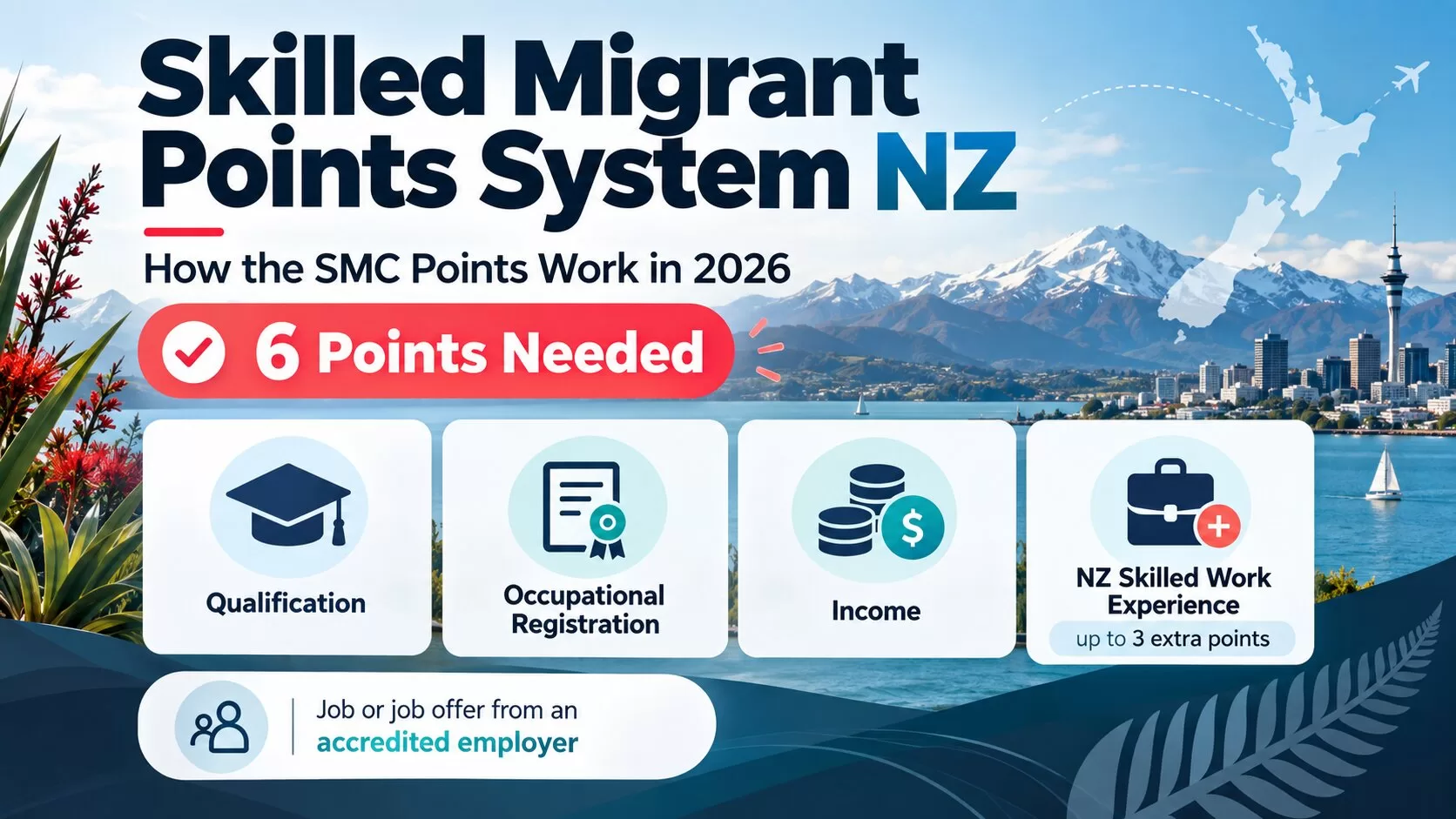
The Skilled Migrant Points system is the points-based route within New Zealand’s Skilled Migrant Category Resident Visa program. It allows eligible applicants to claim Migrant Points from a qualification, occupational registration, or income and then add qualifying New Zealand skilled work experience when necessary. A person needs six skilled resident Migrant Points to qualify under the points-based pathway.
The Skilled Migrant Category is not limited to one points route. The current SMC Resident Visa has three Skilled Migrant pathways: the Points-based pathway, the Skilled Work Experience pathway, and the Trades and Technician pathway. Applicants need to meet only one pathway, but they must also have a skilled job or job offer with an accredited employer and meet English, health, character, and other requirements .
This guide explains the Skilled Migrant Points rules, qualification points, income points, occupational registration, New Zealand work experience, the Expression of Interest process, wage thresholds, evidence, and family inclusion. Immigration requirements can change, so applicants should confirm the current rules with Immigration New Zealand before submitting an EOI or Residence application.
How Skilled Migrant Points Work
The SMC points-based pathway is designed to recognize different forms of skilled contribution. A successful application can lead to a New Zealand Residence Visa, subject to the complete eligibility requirements. A person may qualify through a high-level qualification, a recognized professional registration, or a sufficiently high income from a skilled job. If the selected category gives fewer than six points, eligible New Zealand skilled work experience can provide the balance.
Six Points from One Skill Category
To claim skilled resident points, an applicant chooses one primary skill category: qualification, occupational registration, or income. The applicant can claim between three and six points from that category. The applicant may then claim up to three additional points from skilled work experience in New Zealand, if needed to reach six.
For example, a person may claim five qualification points for a bachelor’s degree and add one point for one year of eligible New Zealand skilled work experience. Another person may claim four income points and add two points for 1.5 years of skilled work experience. A person cannot combine qualification points and income points as though they were interchangeable. The applicant selects one skill category and can combine it only with qualifying New Zealand work experience.
The six-point requirement is not a ranking competition. An applicant does not need to score more than six points, and additional credentials do not automatically compensate for a missing job, wage, English evidence, health evidence, or character evidence. The points calculation must be supported by documents at the residence stage.
Job, Employer, and Skilled Employment Requirements
The applicant must be working in, or have a job offer for, a skilled job with an accredited employer. The role must satisfy the relevant SMC skill and wage rules. A job title alone does not prove skilled employment. Immigration New Zealand can examine the actual duties, job description, employment agreement, hours, pay, employer, and work location.
The employment must be genuine and generally available and ongoing. The job should have a genuine need to be based in New Zealand. A fabricated job offer, inflated title, or employment arrangement that exists only to obtain a visa can create serious immigration problems.
The skilled job or job offer also needs to meet the applicable wage threshold and the relevant Pay requirements. The employment should be Permanent employment or another permitted arrangement and normally involve Full-time employment where the pathway requires it. The threshold can depend on the occupation’s ANZSCO skill level, the points category selected, and when New Zealand skilled work experience began. Applicants should keep records from the first day of qualifying work because the applicable threshold can affect both eligibility and the number of points that can be claimed.
Qualification and Registration Points
A recognized qualification or occupational registration can provide the foundation for an SMC Migrant Points application. The applicant must show that the qualification or registration is recognized for immigration purposes and that the evidence supports the Migrant Points claimed. Understanding how these Migrant Points are awarded can help applicants prepare stronger supporting documentation for their residence application.
Qualification Points and Assessment
An applicant may use a Recognised qualification to claim points when it is a New Zealand qualification recognized on the appropriate framework, has an International Qualification Assessment, or appears on the List of Qualifications Exempt from Assessment. A foreign degree is not automatically treated as equivalent to a New Zealand qualification.
The current settings provide different points for different qualification levels and for some qualifications completed in New Zealand or overseas. A doctoral degree can provide six points. A qualifying New Zealand master’s degree studied full-time for at least 30 weeks can also provide six points, subject to the supporting bachelor’s degree rule. A New Zealand bachelor’s degree can provide five points under the current settings. Other Level 8 or Level 9 qualifications may have different point values and may require a supporting bachelor’s degree .
A Qualification assessment may be required for an overseas qualification. The International Qualification Assessment, or IQA, is carried out through the New Zealand Qualifications Authority. Some qualifications are exempt, including qualifications on the relevant exemption list and certain engineering degrees accredited under the Washington Accord or Sydney Accord. Applicants should check the exemption status before assuming that an IQA is unnecessary.
Evidence may include the qualification certificate, academic transcript, IQA result, evidence of the awarding institution, and documents showing the duration and level of study. For Level 8 and Level 9 claims, the applicant may need to provide both the postgraduate qualification and the supporting bachelor’s degree. A qualification certificate without a transcript may not answer all questions about level, credits, or study duration.
Occupational Registration Points
Occupational registration can provide between three and six points, depending on the registration and the training or experience required to obtain it. Examples may include registration as a chartered accountant, electrician, plumber, or another regulated professional. The registration must be recognized under the SMC instructions and must be current or otherwise acceptable when the applicant claims points.
Registration is not the same as holding a degree. A worker may have a qualification but still need professional registration to practice in New Zealand. Conversely, an applicant may rely on registration for points but must still hold a skilled job or job offer and meet the wage requirement.
The registration authority may have its own assessment process. It can require verified education, supervised practice, examinations, competence evidence, English language evidence, or professional history. Applicants should start the registration process early because an immigration application cannot usually replace a professional authority’s registration decision.
The residence application should include the registration certificate, membership record, registration number, conditions, scope of practice, and any letter explaining the level of training or experience required. If the registration is provisional, restricted, expired, or unrelated to the offered job, the applicant should check whether it can be used for skilled resident points.
Income and Work Experience Points
Income can be used as the primary points category when the current New Zealand job or job offer pays sufficiently above the SMC wage threshold. New Zealand work experience can then supplement qualification, registration, or income points when the applicant needs additional points.
Income Points and the Median Wage
An applicant may claim Income points at three, four, or six points, depending on the hourly pay rate. Under the current SMC settings, a job paying at least 1.5 times the SMC wage threshold can provide three points, a job paying at least twice the threshold can provide four points, and a job paying at least three times the threshold can provide six points .
The published rate table uses the median wage as the reference point. For ANZSCO skill levels 1 to 3, the SMC threshold shown for work beginning from 9 March 2026 is NZD $35.00 per hour. This means the illustrative income thresholds are NZD $52.50 per hour for three points, NZD $70.00 per hour for four points, and NZD $105.00 per hour for six points. These amounts are policy settings at the time of writing and should be checked against the current INZ wage threshold tool before applying.
If the applicant is paid an annual salary, the hourly rate must be calculated using the maximum contracted hours stated in the employment agreement. A salary can appear high while falling below the required hourly rate if the contract requires many hours. Applicants should provide the employment agreement, pay records, payslips, bank evidence, tax documents, and employer confirmation.
Income points are not a substitute for genuine employment. The job must be skilled, the employer must be accredited, the role must be available and ongoing, and the pay must be legally and genuinely available to the worker. Unclear deductions, unpaid overtime, or a salary that is not actually paid can undermine the claim.
Work Experience Points in New Zealand
An applicant can claim Work experience points for eligible skilled work experience in New Zealand, up to a maximum of three points. The current table provides one point for one year, two points for 1.5 years, and three points for two years of qualifying New Zealand skilled work experience .
The work must be directly relevant to the skilled job or job offer and must meet the applicable wage threshold. Relevant work experience is not simply any job in the same industry. Immigration New Zealand may compare the duties, skill level, employer, pay, hours, and employment dates with the occupation used in the SMC application.
The wage threshold that applies to work experience can depend on when the work began and which points category is used. If an applicant claims four points for income, the work experience used to add the remaining two points may need to be paid at the higher two-times threshold. An applicant claiming three points for income may have different wage requirements for the work experience period.
Applicants should record the start and end date of every job, the visa held, hours worked, pay rate, employer accreditation, position, duties, and periods of leave. Employment agreements, payslips, tax records, bank statements, employer letters, rosters, and job descriptions can help establish the period and character of the work.
The Three Skilled Migrant Pathways
The points-based pathway is only one route to Skilled Residence. The 2026 SMC framework also recognizes people whose main evidence is extensive work experience or a combination of an eligible trade qualification and post-qualification employment.
Skilled Work Experience Pathway
The Skilled Work Experience pathway may suit a person who has developed skills through work rather than through a university degree or formal qualification. The applicant generally needs a skilled job or job offer in an ANZSCO skill level 1 to 3 occupation, pay of at least 1.1 times the SMC wage threshold, at least three years of directly relevant work experience, and an additional two years of skilled work experience in New Zealand .
An applicant in an amber occupation may face higher requirements, while a red-list occupation cannot use this pathway. Self-employment cannot be used to meet the directly relevant experience requirement. INZ expects independently verifiable evidence, not merely tax records or a personal statement.
This route does not use qualification points, income points, or work experience points in the same way as the points-based pathway. It is a separate residence route. An applicant should compare both options instead of trying to force a work-experience profile into the six-point calculation.
Trades and Technician Pathway
The Trades and Technician pathway is for people working in eligible trade occupations and Technician occupations who have a relevant qualification and post-qualification experience. The applicant must generally have a relevant qualification at Level 4 or higher, at least 2.5 years of relevant post-qualification work experience, and an additional 1.5 years of post-qualification skilled work experience in New Zealand paid at least the SMC wage threshold .
The eligible roles include selected occupations in construction, engineering, manufacturing, automotive trades, telecommunications, technical support, and related fields. The official list uses occupation codes. A person should check the specific occupation rather than assume that every trade, mechanic, builder, or technician qualifies.
This pathway also does not use the ordinary six-point calculation. The relevant qualification, occupation, wage, and post-qualification work history must all fit the route. Self-employment cannot be counted as the required directly relevant work experience.
Expression of Interest and Invitation to Apply
Applicants for the SMC Resident Visa must first submit an Expression of Interest, commonly called an EOI. The EOI is an official submission to Immigration New Zealand. The applicant declares information about the job, employer, pathway, points, qualifications, registration, income, work experience, English, and family members.
EOI, ITA, and Residence Application Steps
The EOI form is used to express interest in applying for the SMC Resident Visa. If the applicant’s declarations indicate eligibility, INZ may issue an Invitation to Apply, or ITA. The applicant can then complete the residence application and provide evidence of the claims made in the EOI .
The EOI itself has no fee according to the official form guidance. If invited, the applicant must submit the residence application and pay the applicable fee within four months of the ITA. If the applicant does not apply within that period, a new EOI and ITA may be required.
The applicant should not claim points speculatively. An EOI is an official record, and the information may affect current or future applications. Before submitting, check the points calculation, occupation, wage, dates, qualification assessment, registration, and work experience evidence. A claim that cannot be proved later can delay or undermine the residence application.
Supporting Documents and Evidence
The residence application should include the documents needed to prove the selected pathway. Common evidence includes a passport, birth certificate or identity document, employment agreement, job description, employer accreditation information, pay records, qualifications, transcripts, IQA, registration records, English evidence, police certificate, medical evidence, and immigration history.
For an applicant using work experience, the file should explain why each job is directly relevant and show the period, hours, wage, employer, and visa status. For a qualification claim, it should identify the qualification level, points value, New Zealand or overseas location, IQA or exemption, and supporting bachelor’s degree if required. For an income claim, it should establish the hourly pay rate and the hours used in the calculation.
Documents not in English may need certified translations. Employment records should be consistent with tax documents and bank payments. A job description should describe the actual work rather than copy a generic occupation label. A strong application connects each document to a specific SMC requirement.
Family Inclusion and Final Eligibility Checks
The SMC Resident Visa can support long-term residence for a family as well as the principal applicant. The principal applicant must still qualify independently under one of the SMC pathways, and included family members must meet their own relationship, health, character, and English requirements when applicable.
Partner and Dependent Children
The visa can generally include a partner and Dependent children aged 24 or younger. The applicant must provide evidence of the relationship, such as marriage documents, civil union documents, birth certificates, shared residence evidence, financial interdependence, and other partnership evidence when relevant.
Partner inclusion is not automatic merely because the names appear on a form. Immigration New Zealand may assess whether the relationship is genuine and stable. A dependent child’s age, dependency, identity, custody, and other circumstances can also matter. Each family member may need health and character documents.
Health, Character, and Residence Approval
All applicants must meet the English language requirement and the general Health requirements and Character requirements. Applicants aged 17 or older may need a current Police certificate from countries of citizenship and countries where they have spent the required period. Medical examinations and chest X-rays may also be required, depending on age, nationality, residence history, and previous medical evidence.
The SMC Resident Visa permits the holder to live, work, and study in New Zealand indefinitely. A successful applicant may later seek a Permanent Resident Visa, subject to the separate permanent residence requirements. Residence approval is not the same as citizenship and does not remove the need to comply with visa conditions.
The most reliable points strategy is to choose the pathway that matches the evidence rather than the pathway that appears easiest. A degree holder may use qualification points. A highly paid worker may use income points. A registered professional may use occupational registration. A person with extensive experience but limited formal education may fit the Skilled Work Experience pathway, while a qualified trade or technician may fit the Trades and Technician pathway.
The related guide Green List Occupations NZ explains how Tier 1 and Tier 2 Green List roles can provide other routes to New Zealand residence. A person should compare the SMC points-based pathway with the Green List, Straight to Residence, Work to Residence, and other skilled residence options before accepting a job or submitting an EOI.