
AI in Immigration Processing: The Future of New Zealand Visa and Advisory Work
by | October 14, 2026 | Info Article
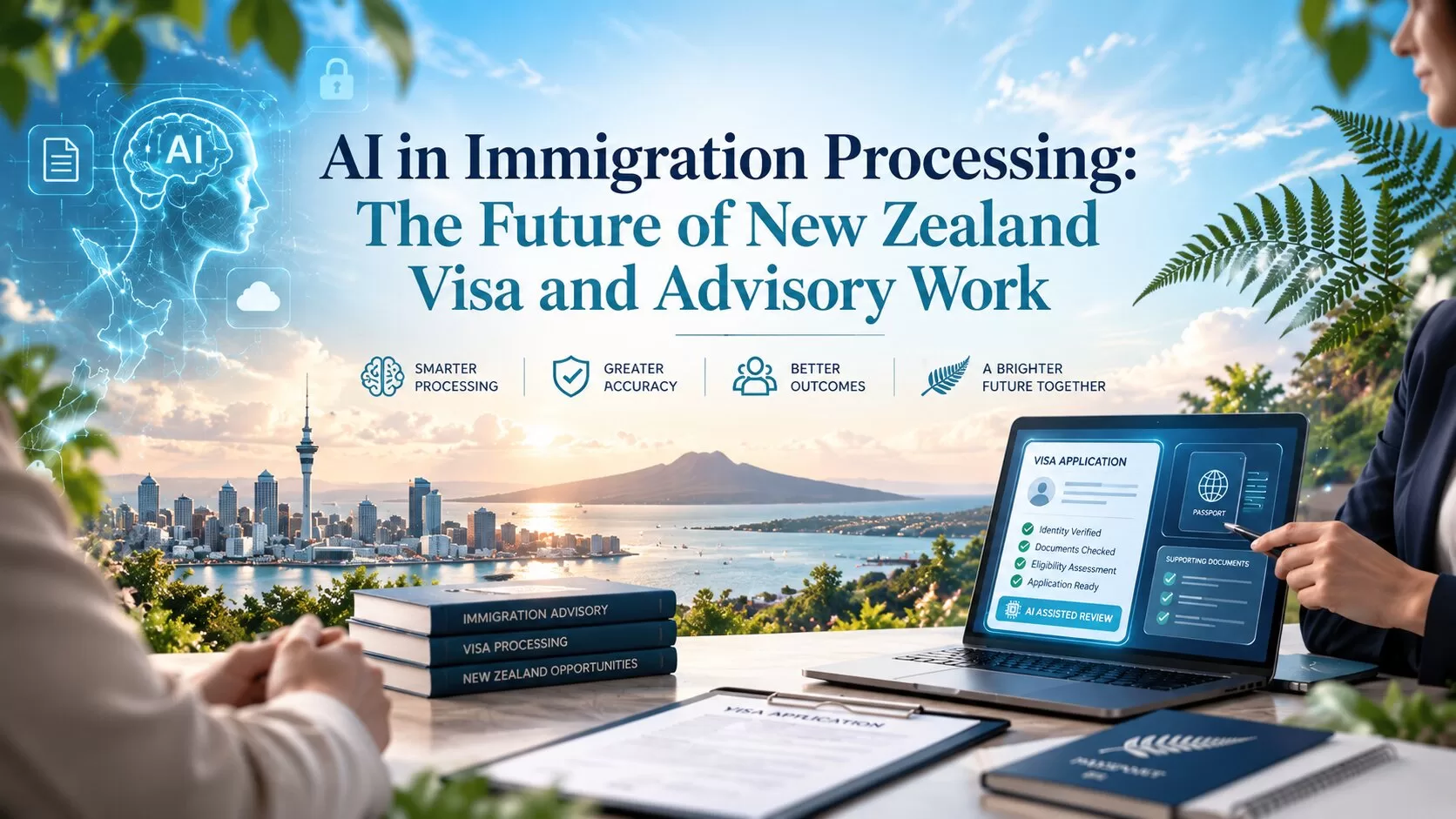
AI in Immigration Processing is likely to expand the use of automation, document review, research tools, and workflow systems across New Zealand’s immigration ecosystem. Immigration New Zealand is already building a more digital application and processing environment through its enhanced Immigration Online system, known as ADEPT. The system is intended to make visa submissions simpler, provide more self-service features, support risk management, and improve processing efficiency.
That digital transformation does not mean that every visa decision will be made by an algorithm. Immigration decisions, including those involving a Parental Residence Visa, remain controlled by the Immigration Act 2009, immigration instructions, regulations, evidence requirements, and authorized decision-makers. AI may help organize information, review supporting documents, or identify potential issues in visa applications, but it should not replace legal analysis, professional accountability, or a fair opportunity for applicants to explain their individual circumstances.
For Immigration Practitioners, AI creates both an efficiency opportunity and a governance challenge. AI in Immigration Practices can support research, drafting, file organization, and client communication. It can also generate inaccurate legal references, reproduce bias, expose confidential information, or create false confidence in an immigration case. The quality of the future system will therefore depend on how carefully people combine human intelligence and artificial intelligence.
How Artificial Intelligence Fits into New Zealand Immigration
The phrase Artificial Intelligence in Immigration covers several different technologies. A rules-based form checker, a machine-learning risk model, a document-classification tool, and a generative AI drafting assistant do not carry the same risks. Their purpose, data, level of autonomy, and impact on an applicant must be examined separately.
From Digital Immigration to AI-Powered Services
New Zealand Immigration is moving toward a more integrated digital service. Under the Our Future Services program, enhanced Immigration Online is intended to become a single customer submission channel and visa application processing system. The planned benefits include smart forms that ask questions relevant to a customer’s situation, real-time application status information, and more efficient processing.
This foundation can support AI-Powered Immigration Services, but digital processing and AI are not identical. A digital portal may route an application, check whether a field is empty, or display a status without making a predictive decision. An AI tool may classify documents, detect unusual patterns, summarize evidence, or suggest that a file needs additional review.
The distinction matters because the impact of a tool depends on what it does. A spelling assistant used by a visa applicant has a different risk profile from a system that influences whether an immigration officer looks more closely at an application. Immigration Technology should be evaluated according to the decision it supports and the consequences of an error.
AI Integration with Legal Authority
The legal authority for a visa decision does not come from the software. It comes from the Immigration Act 2009, regulations, immigration instructions, and the officer’s lawful authority. The Immigration Operational Manual explains the criteria applicants must meet, the evidence they must provide, and the processes used to assess applications.
AI Integration should therefore operate within existing law rather than silently change the law. A model cannot create a new visa requirement, redefine a statutory term, or decide that a document is irrelevant merely because its training data reflects older practice. Any AI output must be checked against current instructions and the facts of the individual application.
The same principle applies to AI-Assisted Immigration Advice and Onshore Student Visa Services, where accurate legal guidance and professional oversight are essential. It also applies to Online Visa Applications, where a digital form may collect information but cannot replace legal review. An adviser may use a tool to locate relevant policy, compare visa categories, or produce a first draft. The adviser must still verify the current rule, identify exceptions, understand the evidence, and explain the advice to the client. AI can support professional work, but it cannot hold an immigration adviser licence or accept responsibility for a client’s case.
AI Tools for Immigration Advisers and Practitioners
AI tools may change how advisers manage work from the first consultation to the final submission. The most useful applications are likely to be those that reduce repetitive administration while leaving legal interpretation and client judgment with a qualified person.
Research, Drafting, and Document Review
AI-Powered Research can help an adviser search a large policy library, identify potentially relevant immigration instructions, and create a list of questions for a client consultation. AI Drafting Tools can help prepare a document request, a chronology, a cover letter, or a first version of immigration submissions. Immigration Document Review tools may classify passports, employment records, bank statements, qualification certificates, and relationship evidence.
These uses can improve Immigration Practice Efficiency and support Immigration Workflow Optimization. A case-management system may identify missing documents before submission. A document tool may compare dates across an employment agreement, payslips, and a visa application. A research assistant may help an adviser locate the correct rule before a detailed review. Immigration Legal Opinions still require careful Legal Accuracy and Legal Referencing against current primary sources.
The output still requires verification. A generative system may cite an obsolete policy, confuse a temporary visa with a residence visa, invent a case, or treat a general website as an authoritative source. AI-Generated Content Verification must include checking the actual source, the effective date, the applicant’s facts, and any relevant exception.
Note-Taking, Consultations, and Case Management
AI-Powered Note-Taking may transcribe or summarize Client Consultations. In an Immigration Case Management system, AI may convert the discussion into an action list, identify unanswered questions, or create a timeline of travel, employment, study, and previous applications. These tools can reduce administrative time and improve consistency between meetings.
They also create risks. A transcription may misunderstand a name, date, visa category, or country. A summary may omit an important disclosure. A tool may store audio or text on a platform outside the adviser’s approved environment. Before using such a tool, the adviser should consider consent, data location, retention, access controls, accuracy, and whether the client understands the technology.
A summary is not the official client record unless the adviser checks and adopts it. The adviser should correct errors, record material instructions, and preserve the reasoning behind important decisions. This is particularly important when the file may later involve an immigration appeal, an investigation, or a complaint about advice.
Responsible AI Adoption and Client Protection
Responsible AI Adoption requires more than purchasing a secure application. AI Ethics should be integrated into Immigration Compliance, privacy review, and client protection rather than treated as an optional technology policy. This is particularly important when handling complex immigration applications, such as the Parent Retirement Visa New Zealand, where sensitive personal and financial information must be managed carefully. A responsible AI policy should clearly explain what tools may be used, what information may be entered, who reviews outputs, how errors are corrected, and when a client must be informed that AI assisted the work.
Privacy, Confidentiality, and Data Security
Immigration files contain identity information, health information, police records, financial records, employment details, family history, and sometimes protection claims. An adviser should not paste a client’s complete file into a public chatbot simply because it is convenient. Client Confidentiality, Data Protection, and Data Security must be treated as core professional obligations.
The Immigration Advisers Authority Code of Conduct sets the required professional and ethical standards for licensed advisers. It includes duties concerning professional responsibility and confidentiality. The IAA also explains that information received during the professional relationship belongs to the client and that confidential information should be protected except in permitted circumstances.
An AI Platform Security review should ask where the service stores data, whether prompts are used to train a model, how access is authenticated, whether information is encrypted, how long records are retained, and whether a supplier can disclose data to another provider. A secure enterprise tool may be suitable where a free public tool is not. Redaction and pseudonymization can reduce risk, but they do not remove it if a person can still be reidentified.
Transparency, Consent, and Fair Treatment
Client Transparency means telling a client in understandable language when AI materially assists research, drafting, transcription, or document review. An adviser should explain that an AI tool is an assistant and not a decision-maker. The client should know how confidential information will be protected and how to raise a concern.
An Ethical AI Framework should include client consent, access control, human review, quality testing, incident reporting, and a way to correct inaccurate outputs. It should also address the risk that language style, nationality, disability, ethnicity, or unfamiliar documents may cause an AI tool to produce a misleading result.
New Zealand’s Public Service AI Framework identifies human-centered values, transparency and explainability, safety and security, accountability, and inclusive sustainable development as key principles. Its generative AI guidance also addresses governance, privacy, misinformation, hallucinations, bias, fairness, accessibility, and Māori, Pacific, and ethnic communities. These principles provide a useful benchmark for private Immigration Advisory Practices, even where a particular adviser is not a public agency.
AI-Assisted Visa Processing and Human Decision-Making
The most sensitive question is not whether AI can process information. It is how an AI system may influence an immigration decision that affects a person’s right to enter, work, study, remain, or reunite with family.
Triage, Risk Models, and Immigration Case Assessment
AI may assist with Immigration Process Automation by checking completeness, classifying visa applications, routing cases, detecting duplicate information, or identifying records that require verification. Visa Processing Tools may help an agency manage workloads and identify patterns across large volumes of applications. A tool may also assist Immigration Case Assessment by highlighting inconsistencies for an officer to examine.
There are potential benefits. Automation can reduce repetitive work and help officers access relevant information. It may support more consistent processing and allow staff to focus on complex cases. Integrated systems can also help identify missing evidence before an application reaches a later stage.
The risks are equally serious. Historical data may contain bias. A proxy variable may reflect nationality, location, language, income, or past enforcement rather than the legal criterion being assessed. A model may treat a normal variation in an overseas document as suspicious. It may rank an application as high risk without giving the applicant a meaningful explanation.
New Zealand’s Algorithm Charter says government agencies should explain how algorithms inform decisions, use fit-for-purpose data, manage bias, safeguard privacy and human rights, and retain human oversight. It also calls for a channel through which people can challenge or appeal decisions informed by algorithms. These safeguards are especially important in immigration, where applicants may have limited ability to understand or correct an unseen risk score.
Human Oversight and Immigration Decisions
Human Oversight must mean more than a person clicking “approve” after an algorithm produces a recommendation. The immigration officer should understand the tool’s role, be able to access the relevant evidence, recognize uncertainty, and depart from the recommendation when the facts justify it. The officer should remain responsible for applying the legal criteria.
The same principle applies to Immigration Decision-Making by advisers. A tool can identify a possible Skilled Migrant Assessment issue, but it cannot decide whether a job fits the New Zealand Job Classification or the relevant occupation code. An adviser must examine the actual duties, evidence, and current policy. A model’s confidence score is not a legal opinion.
The operational approach to verification is also important. INZ instructions state that applicants must provide information and evidence showing that they meet the applicable requirements, and that officers may verify relevant documents and information. Officers must be satisfied that material information and documents are genuine. AI can help organize verification, but it must not convert a prediction into proof.
AI, Skills Assessment, and Immigration Strategy
AI may influence how New Zealand assesses labor-market information and how advisers plan cases. This does not mean that a model can award a visa or invent a pathway. It means that technology may help connect a candidate’s experience, qualification, occupation, and proposed job to current policy requirements.
Skilled Migrant and Occupation Classification
A Skilled Migrant Assessment may involve comparing a person’s job duties with the New Zealand Job Classification, an occupation code, a qualification, pay evidence, and an employer’s documentation. An AI tool could assist by extracting duties from an employment agreement, identifying possible occupation matches, or flagging differences between a job description and the claimed role.
That assistance must be cautious. Occupation Classification is not determined by job title alone. A worker called “manager” may perform technical duties, while a person called “consultant” may perform administrative work. A machine-generated match should be treated as a research lead, not a final conclusion.
The phrase National Occupation List may also be used loosely in online immigration content, even when the relevant current classification is a different official list or occupation framework. Advisers must identify the list that actually applies to the visa category and effective date. An AI system trained on mixed sources may combine historical occupations, overseas classification codes, and current New Zealand rules.
Strategy Development and Client Service
AI may support Immigration Strategy Development by comparing possible visa categories, mapping evidence gaps, and creating a timeline for qualifications, registration, employment, and residence. It may help an adviser explain why a client should consider a work visa before a residence application, or why a course choice does not necessarily create a post-study pathway.
That does not turn AI into an immigration lawyer. A tool cannot guarantee a visa, predict an officer’s decision, or replace a detailed Immigration Legal Opinion. It may also misunderstand a client’s goals, family circumstances, or tolerance for risk. A responsible strategy must be discussed with the client and recorded in plain language.
The strongest benefit may be Immigration Service Scalability. Smaller practices could use secure systems to organize files, prepare document checklists, and deliver faster client updates. Cost Reduction may make basic support more accessible. However, scale should not mean standardized advice that ignores individual circumstances. Client Service Improvement and Immigration Advocacy should be measured by accuracy, clarity, responsiveness, and outcomes, not only by the number of applications processed.
Professional Accountability and the Future of AI
The future of AI in Immigration Processing will depend on governance. Technology can improve access and efficiency, but the immigration industry must protect the legitimacy of decisions and the trust of applicants.
AI Usage Policies and Professional Judgment
An adviser’s AI Usage Policies should identify approved tools, prohibited data, required consent, review steps, source-checking rules, recordkeeping, and incident response. A written Client Engagement Agreements may explain whether AI is used for transcription, research, drafting, translation, or document organization. Where relevant, an adviser may provide AI-Assisted Work Disclosure rather than leaving the client to guess how the work was produced.
Professional Legal Due Diligence remains necessary. Before relying on AI, the adviser should confirm the current Immigration Act 2009, immigration instructions, operational guidance, case law where relevant, official forms, and effective dates. Professional Judgment is required when evidence is incomplete, a policy is ambiguous, or a client’s circumstances do not fit a standard pathway.
The IAA Code of Conduct is approved under section 37(4). These duties form part of Immigration Advisory Standards and interact with Immigration Adviser Regulations. of the Immigration Advisers Licensing Act 2007 and sets standards for licensed immigration advisers. AI adoption cannot reduce those standards. An adviser remains accountable for advice given to a client, submissions filed on the client’s behalf, and representations made to Immigration New Zealand.
Innovation with Trust and Accountability
Immigration Industry Innovation should be guided by public value. The Public Service AI Framework encourages agencies to use AI responsibly while maintaining public trust. Its work program emphasizes governance, guardrails, capability, innovation, social license, and a global voice.
For advisers, that means treating AI as controlled infrastructure rather than a shortcut. For applicants, it means asking who made a decision, what information was used, whether a person reviewed the result, and how an error can be challenged. For immigration authorities, it means publishing enough information to explain the role of automated tools without exposing security-sensitive details.
The likely Future of Immigration Practices is not a choice between humans and machines. It is a regulated partnership in which AI handles repetitive information work and trained people handle legal interpretation, credibility, fairness, communication, and responsibility. The related guide Future of Immigration NZ provides broader context on the direction of digital services, skilled migration, compliance, and visa pathways.
AI should make a visa system more accessible and consistent, not more mysterious. New Zealand’s future approach will be strongest when every AI-Assisted Immigration Advice product and every public-sector processing tool is tested for accuracy, security, fairness, explainability, and impact on vulnerable people. Human intelligence and artificial intelligence can work together, but only when law, ethics, and professional accountability remain in control.