
Straight to Residence vs Work to Residence NZ: Which Skilled Pathway Is Better?
by | October 24, 2026 | Info Article
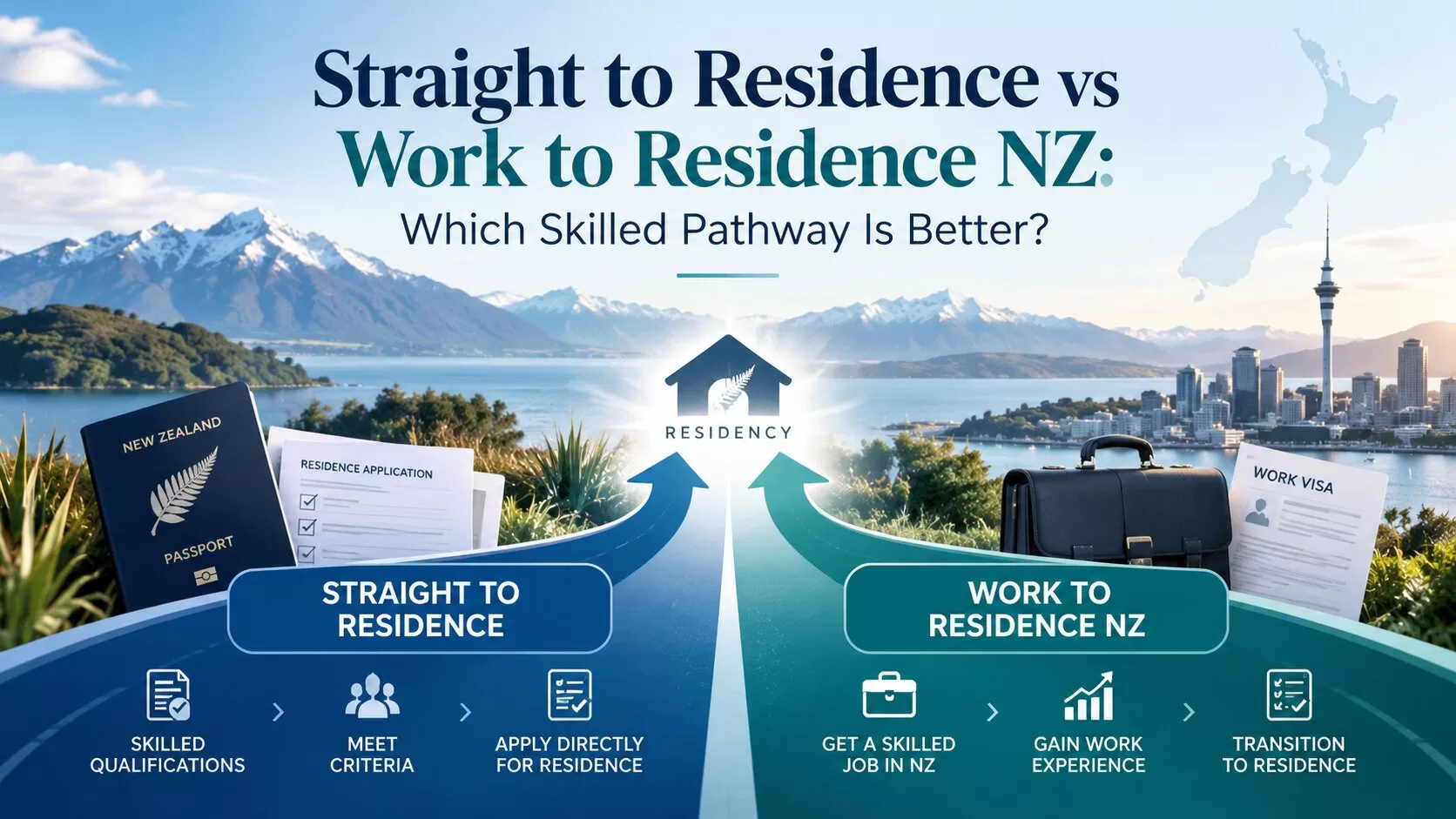
The main difference in Straight to Residence vs Work to Residence NZ is timing and eligibility requirements. Both routes are part of New Zealand Immigration Pathways and can contribute to New Zealand Permanent Residency when additional requirements are met. Understanding the differences in Residence vs Work to Residence NZ helps skilled migrants choose the most suitable pathway based on their occupation, qualifications, and employment status.
A person with an eligible Tier 1 Green List role may apply for the Straight to Residence Visa NZ when they have the required job or job offer and meet the relevant criteria. In comparison, an applicant with an eligible Tier 2 role normally needs 24 months of qualifying work in New Zealand before applying for the Work to Residence Visa. This makes the timing of Residence vs Work to Residence NZ an important consideration for skilled professionals planning their immigration journey.
Both options are skilled residence pathways, not automatic approvals. Understanding the eligibility criteria, employment requirements, and application process for Residence vs Work to Residence NZ can help applicants make informed decisions about their long-term residence goals.
The two routes lead to an indefinite New Zealand Residence Visa and can allow the main applicant to include a partner and dependent children aged 24 or younger. Both also require the applicant to be Age 55 or Younger, which is the Residence Visa Age Limit, work for an accredited employer, meet the role-specific Green List requirements, satisfy English, health, and character standards, and submit convincing evidence. The correct choice depends first on the job and its tier, the applicant’s Residence Visa Eligibility, and the evidence available., not simply on personal preference.
Straight to Residence and Work to Residence Explained
New Zealand separates many in-demand roles into Tier 1 and Tier 2 on the Green List. Understanding the differences in Residence vs Work to Residence NZ is essential for skilled migrants exploring their immigration options. Tier 1 includes eligible occupations that offer a direct residence pathway, while Tier 2 generally supports a work-first residence route requiring qualifying employment experience in New Zealand.
The Green List is therefore a central part of Skilled Residence Visa planning. It identifies Green List Occupations and In-Demand Jobs in New Zealand for eligible Skilled Migrant Workers. When comparing Residence vs Work to Residence NZ, applicants should carefully review their occupation’s tier, qualification requirements, professional registration, employment conditions, and eligibility criteria.
Choosing between these skilled immigration pathways depends on individual circumstances, including job offers, relevant work experience, and long-term settlement goals. Understanding how Residence vs Work to Residence NZ relates to Green List Tier 1 and Tier 2 occupations can help applicants identify the appropriate residence pathway and prepare for the application process. Applicants planning to settle in New Zealand with their partners may also explore the Partnership Residence Visa NZ as a separate immigration pathway, depending on their relationship circumstances and eligibility requirements.
Straight to Residence Visa NZ
The Straight to Residence Visa NZ is intended for a person who has an offer of, or is already working in, a qualifying Green List Tier 1 Jobs role for an accredited employer. The applicant can apply for residence from outside New Zealand or enter on a work visa and apply after starting the role. The role must meet the listed Green List Requirements, including any pay, registration, qualification, or experience condition.
A Tier 1 applicant does not normally need to complete a separate two-year work period before submitting the Residence Visa Application. That is the defining advantage of this pathway. It does not remove the need for a genuine Accredited Employer Job Offer, a compliant employment arrangement, or proof that the applicant actually meets the occupation’s requirements.
The current Straight to Residence Visa page lists a cost from NZD $6,450. Applicants should confirm the current Residence Visa Application Fee and Residence Visa Processing Time before applying. and says 80% of applications are processed within 3.5 months. These figures are subject to change, so applicants should check the official fee and processing pages before payment. A successful applicant can live, work, and study indefinitely, subject to resident-visa travel conditions.
Work to Residence Visa
The Work to Residence Visa is for an applicant with an eligible Green List Tier 2 role. The applicant must normally have worked full-time in New Zealand in a qualifying Tier 2 role for at least 24 months during the 30 months immediately before applying. The work must have been performed on an acceptable visa, and the applicant must have met the applicable wage requirement during the qualifying period. Applicants who previously held a Seasonal Work Visa should carefully review whether their visa type and employment experience meet the qualifying work requirements, as seasonal employment does not automatically count towards the Work to Residence pathway.
This route is not simply a delayed version of the Tier 1 route. The applicant must document the period carefully. Employment may be completed in separate stretches within the 30-month window, but the role, hours, wage, visa status, and employer must satisfy the current rules. The current visa page lists a cost from NZD $6,450 and indefinite length of stay, but applicants should verify the live figures before submission.
A Tier 2 worker may use a temporary work visa as part of Skilled Worker Immigration to gain the required experience, then apply for residence when the evidence is complete. If the job is removed from the Green List after qualifying work has started, special rules may allow earlier work to continue counting, but the applicant should not assume this without checking the current instructions.
Job Offer and Employment Requirements
Both pathways depend on skilled employment rather than a broad promise that a person may find work later. The role, employer, pay, duration, and evidence must line up with the relevant residence visa requirements.
Accredited Employer Job Offer and Contracts
The Accredited Employer must be accredited under the relevant Immigration New Zealand policy. The job must be genuine and must match the occupation listed on the Green List. A New Zealand Job Offer should identify the employer, position, duties, place of work, hours, pay, and start date.
The applicant should examine the Employment Agreement and Employment Contract carefully. The arrangement may be Permanent Employment or Fixed-Term Employment, depending on what the visa permits and what the Green List role requires. A Contract for Services can involve additional requirements, including a higher pay threshold and relevant experience for some Tier 1 roles. It should not be treated as interchangeable with ordinary employment.
For Straight to Residence, the job must generally be full-time and permanent or fixed-term for at least 12 months from the application date, or meet the applicable minimum contract duration. For Work to Residence, the current role or offer must generally be full-time and permanent or fixed-term for at least 12 months, while the earlier qualifying work must satisfy the 24-month rules.
Salary and Work Experience Rules
The role must meet the specified Minimum Wage Threshold, the applicable Median Wage Requirements, or another rate stated for that Green List occupation. The applicant’s Salary Requirements are not proved by a verbal promise. The employment agreement, offer letter, payslips, bank statements, and tax evidence should show what the worker was actually paid.
A Straight to Residence applicant must usually be paid at least the rate specified for the Tier 1 role. If the Green List does not specify a rate, the visa page currently refers to NZD $35 per hour, described as the 2025 median wage. A Work to Residence applicant must meet the wage rate applying to the relevant Tier 2 role when the qualifying work began and during the countable period. Some roles have their own wage rules, so a generic hourly figure may be misleading.
For Work to Residence, Employment Duration matters as much as the job title. The applicant needs evidence of Relevant Work Experience in a qualifying role and must show that the work was full-time and performed on an acceptable visa. Annual and other legally entitled leave may count, but unpaid gaps or work outside the eligible role can affect the calculation.
Qualifications, English, Health, and Character
A job offer alone is not enough. The applicant must meet the exact Green List requirements for the occupation and provide the documents Immigration New Zealand needs to assess them.
Qualifications and Professional Registration
Some roles require Professional Qualifications, Occupational Registration, or Professional Membership. A regulated profession may require New Zealand registration before the residence application can be approved. Other roles may require a particular qualification level, subject, or amount of experience.
Overseas Qualifications may need an International Qualification Assessment from NZQA. Not every qualification requires an IQA. Qualifications covered by certain international accords or listed exemptions may be treated differently. The applicant should check the occupation entry rather than obtain an assessment unnecessarily or omit one when it is required.
The Qualification Recognition question is separate from whether a person has studied at a reputable institution. Immigration New Zealand assesses the evidence against the specified role requirements. The file may need award certificates, academic transcripts, registration evidence, professional letters, and certified translations.
English, Medical, and Character Evidence
Both routes include English Language Requirements. An applicant may show English Language Proficiency through citizenship, study, qualifications, or approved English Language Test Results. Where a test is required, the applicant must meet the Minimum English Language Score and provide valid English Language Evidence in the form accepted by INZ.
The applicant and included family members must meet the relevant Health Requirements. A Medical Examination, Chest X-Ray Certificate, or Medical Certificate may be required. The exact evidence depends on age, visa history, prior medical submissions, and residence history. Medical results must also be recent when INZ receives them.
The Character Requirements normally include a Police Clearance Certificate for applicants who meet the age and residence-history rules. A Criminal Record Check may be needed from countries of citizenship and countries where the applicant spent the required period. The applicant must also provide reliable Proof of Identity, a Valid Passport, and any required Passport Photograph. An undisclosed conviction or identity inconsistency can delay or undermine either route.
Application Evidence and Family Inclusion
The strongest application is organized around the eligibility test. Applicants should not upload a large collection of unrelated documents and expect the officer to reconstruct the case.
Supporting Documents and Online Submission
Important Immigration Application Documents and Supporting Documents may include the job offer, employment agreement, position description, registration certificate, qualification records, IQA outcome, English evidence, medical documents, police certificates, passport, and proof of salary. Certified English Translations should accompany documents that are not in English when the instructions require them.
An Employment Offer Letter should be consistent with the contract and the Green List role. Proof of Salary can include payslips and bank statements, but the evidence should also show the pay period, employer, hours, and deposits. A mismatch between a contract and actual payments should be explained before submission.
The applicant can complete an Online Visa Application using a Visa Application Checklist through the official Immigration New Zealand platform. After Visa Application Submission, the applicant should save the confirmation, application number, uploaded documents, and correspondence. The Visa Application Status can be monitored through the relevant online account, but a status update does not mean the application is approved.
Partners and Dependent Children
Both resident visas can include a partner through Partner Visa Inclusion and Dependent Children aged 24 or younger, provided the family members meet the relevant requirements. A Family Residence Application should include Relationship Evidence, such as a Marriage Certificate, civil-union evidence, shared-address records, and other material demonstrating a genuine relationship.
A child’s Birth Certificate may establish the parent-child relationship. The applicant should check the rules for Dependent Children Under 25, including dependency, age, custody, and previous visa history. Family evidence must be consistent across passports, birth records, school documents, and earlier applications.
Family inclusion is not automatic merely because the principal applicant qualifies. The applicant must satisfy the relevant Family Immigration Requirements. Each person may need health and character evidence. If a partner or child already holds or has applied for a temporary visa based on the principal applicant, the family member may need to be included in the residence application under the applicable instructions.
Residence, Travel, and Long-Term Status
Both pathways can lead to the same broad settlement outcome, but applicants should distinguish a resident visa from permanent residence and citizenship.
Living and Working After Approval
A successful applicant can continue Living in New Zealand, Working in New Zealand, or Studying in New Zealand without the ordinary conditions attached to a temporary work or student visa. The resident visa allows indefinite residence, but it normally includes travel conditions. A resident may leave and return only until the stated travel expiry date unless those conditions are extended or replaced.
A resident visa is not the same as Indefinite Residence for international travel. Applicants should read the visa label or electronic visa carefully, keep their passport details current, and apply to Visa Transfer to New Passport when necessary. A Permanent Resident Visa has no travel conditions and permits indefinite travel in and out of New Zealand.
The residence application also does not guarantee an immediate New Zealand Citizenship outcome. Citizenship has its own Citizenship Eligibility rules. For most people, the relevant residence period is usually a Five-Year Residence Period, along with presence, character, language, and other requirements determined by the Department of Internal Affairs.
Two-Year Residence Period and Travel Conditions
After holding a resident visa for at least a Two-Year Residence Period, an applicant may be able to apply for a Permanent Resident Visa if the other requirements are met, including showing a commitment to New Zealand. This is separate from the 24 months of Tier 2 work required before a Work to Residence application.
A resident visa may carry a Resident Visa Travel Conditions expiry date. The Travel Conditions Expiry must be checked before international travel. If the holder remains outside New Zealand after the travel conditions expire, the visa may not allow re-entry. Multiple Entry Travel Rights continue indefinitely only after the holder obtains a Permanent Resident Visa or otherwise secures valid travel permission. Applicants should not confuse the resident visa’s indefinite ability to live in New Zealand with the expiry of its travel conditions.
The visa conditions can also affect the timing of family travel, employment changes, and a future passport update. Before leaving New Zealand, the resident should check the travel expiry, visa conditions, and passport validity.
Choosing Between the Two Pathways
The practical choice depends on whether the applicant already has a qualifying Tier 1 role, has a Tier 2 job with a realistic two-year plan, or needs another temporary route before becoming eligible.
Direct Residence Pathway or Skilled Worker Residence Pathway?
The Direct Residence Pathway is generally faster for an applicant who meets Green List Tier 1 Eligibility for an applicant who already meets the Tier 1 role, pay, registration, qualification, English, health, and character rules. It may reduce the uncertainty of spending two years in a temporary job before residence. It can also be useful for a skilled worker who wants the security of residence before relocating with family.
The Skilled Worker Residence Pathway through Tier 2 can still be attractive when the occupation is in demand but not eligible for immediate residence. The applicant should confirm that the employer is accredited, the job remains eligible, the wage is sufficient, and the temporary visa will allow the full period of qualifying work. A written plan should account for job changes, leave, visa expiry, employer accreditation, and possible Green List amendments.
The result is not simply “Straight to Residence is better.” Tier 1 eligibility can be difficult, while a Tier 2 role may offer a more realistic job opportunity. The best pathway is the one the applicant can prove with a genuine job, lawful employment, and complete evidence.
Decision Checklist and Common Delays
Before starting either Straight to Residence vs Work to Residence, check the occupation’s current tier, the Job Offer Requirements, employer accreditation, contract type, pay rate, work hours, and required qualifications. Review Contract Employment Requirements carefully if the proposed work is not ordinary employment. Confirm whether the applicant needs an Immigration Medical Assessment, police certificates, an IQA, or professional registration.
A complete file should include Family Member Eligibility evidence and Proof of Genuine Relationship when family members are included. Common Immigration Processing Delays arise from missing police certificates, expired medical results, unexplained salary differences, incomplete registration evidence, inconsistent job duties, untranslated documents, or unclear work history.
After the Visa Application Decision, an applicant may receive Visa Approval, a request for more information, or a decline. If approved, the applicant will generally receive an Electronic Visa record rather than a physical sticker. Keep the eVisa letter, passport, employment evidence, and future visa correspondence together.
The comparison can be summarized simply: Tier 1 normally supports direct residence, while Tier 2 normally requires 24 months of qualifying New Zealand work first. Both routes can lead to Residence Visa Benefits, family inclusion, and eventually permanent residence, but neither bypasses the need to meet current immigration instructions. Applicants should use the official Green List and visa pages immediately before applying because roles, wages, fees, and processing times can change.
The related guide Common Immigration Scams in New Zealand is useful when checking an employer, adviser, job offer, payment request, or supposed residence guarantee. Use official Immigration New Zealand information, verify the accredited employer, protect your identity documents, and seek qualified advice where the case involves complex employment, family, qualification, or character issues