
Immigration New Zealand Document Checklist: Commonly Required Evidence
by | November 17, 2026 | Info Article
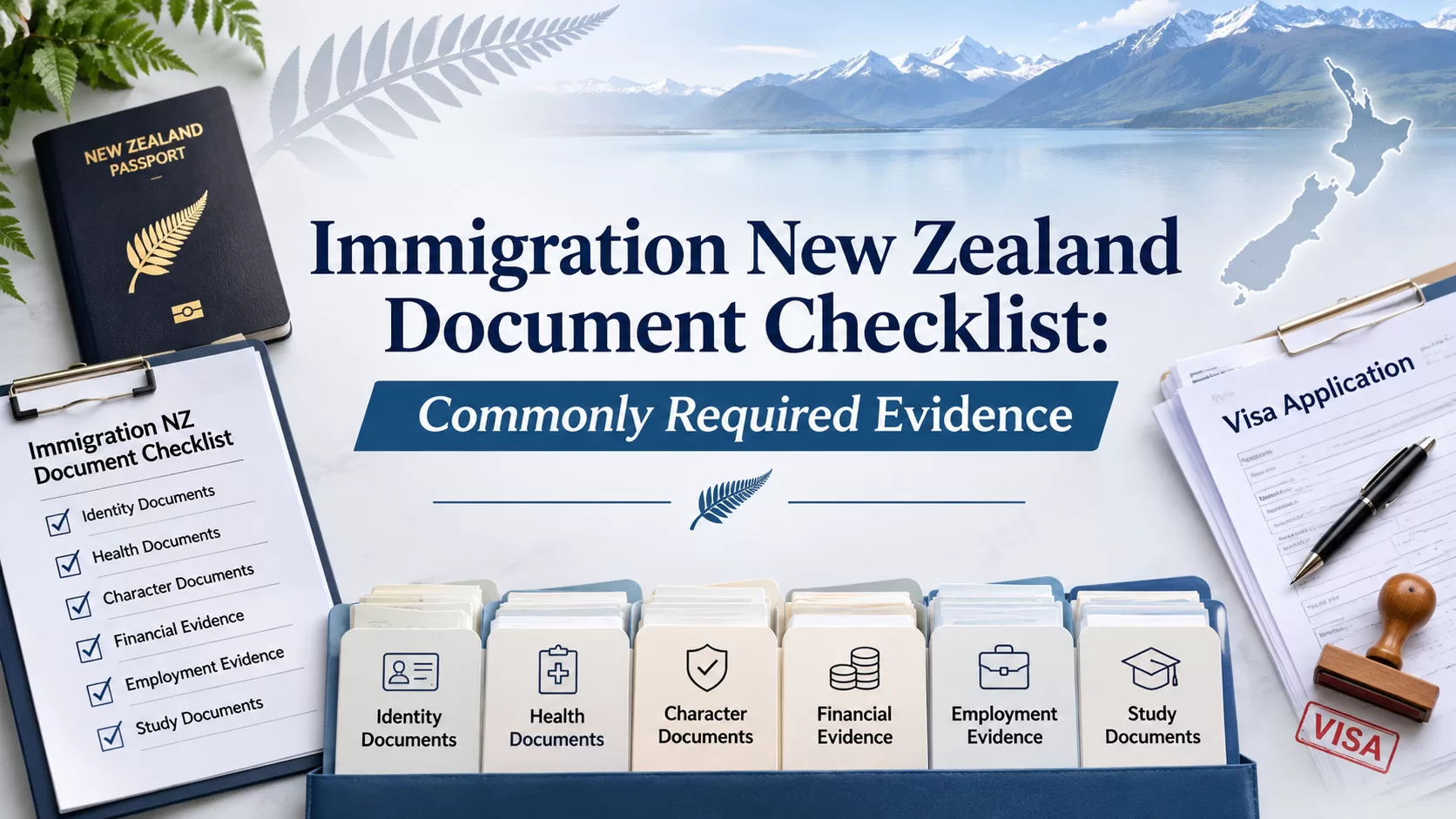
An Immigration New Zealand Document Checklist should be tailored to the specific visa you are applying for rather than copied from a generic internet list. A comprehensive Immigration New Zealand Document Checklist may include evidence of identity, health, character, financial stability, employment, education, relationships, investments, travel plans, and genuine intentions. The exact supporting documents depend on whether you are submitting a Visitor Visa Application, Work Visa Application, Student Visa Application, or Residence Visa Application. Preparing an accurate Immigration New Zealand Document Checklist helps applicants organise the required evidence, avoid missing documents, and reduce the risk of unnecessary visa application delays.
A useful master checklist helps you organize Visa Supporting Documents, but it does not replace the requirements for your particular visa. INZ may request further information during Visa Application Processing, and missing or inconsistent evidence can cause Visa Application Delays or a refusal. This guide explains the most common Immigration Application Documents, how to prepare them, and what to check before submission.
Start With the Correct Visa Document Checklist
Match Evidence to the Visa Category
The first step in preparing an Immigration New Zealand Document Checklist is to identify the correct visa category and carefully review its current application requirements. New Zealand Visa Requirements vary depending on the type of visa, as visitors must demonstrate genuine temporary intentions, workers must provide evidence of employment and relevant qualifications, students must show enrolment and sufficient funds, and residence applicants must meet specific eligibility criteria. A well-prepared Immigration New Zealand Document Checklist helps applicants understand which supporting documents are necessary for their visa category. Following an accurate Immigration New Zealand Document Checklist also ensures that essential evidence is organised correctly, reducing the risk of missing information and unnecessary application delays.
The Visa Application Process usually asks for a completed form, passport information, photographs, supporting evidence, and payment. Some applications are online and require readable uploads. Others may require original documents, certified copies, or a passport sent to a Visa Application Centre. Follow the instructions for the exact application channel.
A strong checklist also distinguishes between mandatory evidence and documents that may be requested later. For example, a police certificate may be required because of age and intended stay, while a specialist medical report may be requested after an initial medical examination. Keep both the required documents and likely follow-up documents ready.
Check File Quality and Consistency
Your Visa Application Evidence should be clear, complete, and consistent. Check that names, dates of birth, passport numbers, addresses, employment dates, travel history, and relationship details match across the application and supporting documents. If a translated document uses a different spelling of your name, declare it in the “other names” section as required by INZ.
For online applications, use acceptable file formats and ensure every scan is readable. Do not upload a photograph of a document with cut-off edges, glare, missing pages, or illegible stamps. Keep the original foreign-language document together with its translation. A tidy file name, such as ApplicantName_PoliceCertificate_2026.pdf, can also make review easier.
Supporting Documentation should answer the immigration officer’s questions directly. A short cover letter can explain an unusual gap, a name change, a large bank deposit, a previous refusal, or a period of unemployment. The letter should clarify the evidence rather than replace it.
Identity, Passport, and Translation Evidence
Identity evidence is a fundamental part of the Immigration New Zealand Document Checklist, as it helps verify an applicant’s identity and eligibility for a visa. Immigration New Zealand (INZ) uses identity documents, biometric information, and information matching to assess applications and confirm personal details. A properly prepared Immigration New Zealand Document Checklist should include valid passports, identification records, and any additional identity evidence required for the specific visa category. Following the Immigration New Zealand Document Checklist carefully helps applicants provide accurate information, meet identity verification requirements, and minimise unnecessary visa application delays.
Passport and Identity Documents
The usual Evidence of Identity includes a valid passport or certificate of identity, a recent acceptable photograph, and any additional identity documents requested by the visa application. Your Passport and Identity Documents should clearly show the biographical page, passport number, nationality, date of birth, and expiry date. Previous passports or travel documents may also be required to verify travel history, previous visas, or name changes. Alongside identity verification, applicants should understand health requirements, including Medical Waiver NZ provisions for those who may not meet standard immigration health criteria. A Medical Waiver NZ may be considered in certain circumstances, depending on the visa category and individual eligibility. Understanding Medical Waiver NZ requirements can help applicants prepare relevant medical evidence and supporting documentation when a waiver assessment is applicable.
Some applications also require a full birth certificate. This can help confirm parents, children, age, or a claimed family relationship. Marriage certificates, divorce orders, adoption papers, national identity cards, household registration documents, and name-change certificates may be needed depending on the case.
INZ may collect Biometric Information, including photographs and fingerprints, to establish and verify identity and support immigration decisions. An applicant may also be asked for additional identity information or a voluntary DNA test where a relationship needs confirmation. A DNA test is not a substitute for ordinary relationship documentation and should be considered only when INZ requests or permits it.
English Translations and Certification
English Translations of Documents are essential when evidence is not written in English. For residence applications, supporting documents must be in English or include a certified English translation. For visitor applications, all non-English documents must have full English translations, although translations other than medical and police certificates do not generally need to be certified. For other visa types, medical and police certificates must have certified English translations.
Certified Document Translations should be completed by an accepted translator or reputable translation business. The translation should be on official letterhead where possible and certified as accurate, with the translator’s stamp or signature. The translator generally cannot be the applicant, a family member, or the immigration adviser who assisted with the application.
These are important Visa Document Translation Requirements. Submit the original foreign-language document and the English translation unless INZ’s instructions say otherwise. The translation should preserve names, dates, document numbers, stamps, and relevant annotations. Partial translations may not be enough for bank statements or other evidence where the surrounding context matters.
A practical New Zealand Immigration Guidelines review should confirm Identity Verification, current Medical Certificates, and any English Language Requirements. Where a visa requires English Language Proficiency, attach accepted English Language Test Results rather than assuming that previous study is enough. Keep Supporting Financial Documents together with the application because they form part of the Visa Application Supporting Evidence and may be checked against the claimed source of funds. Immigration Compliance applies after approval as well as during assessment, and the full Immigration Evidence Requirements should be reviewed before submission.
Health and Character Documents
Health and character evidence are important components of the Immigration New Zealand Document Checklist, although specific requirements vary depending on the visa category and applicant’s circumstances. Factors such as visa duration, age, country of residence, previous time spent in New Zealand, and application type can determine which medical certificates, health assessments, or police certificates are required. A comprehensive Immigration New Zealand Document Checklist helps applicants identify the necessary health and character documents before submitting their applications. Following the Immigration New Zealand Document Checklist carefully can help ensure supporting evidence meets Immigration New Zealand requirements and minimise unnecessary processing delays.
Health Requirements and Medical Evidence
Health Requirements are designed to establish an Acceptable Standard of Health. INZ may assess whether the applicant is a public-health risk, likely to impose significant costs or demands on health services, likely to be unable to work or study for the visa purpose, or likely to qualify for certain special-education funding.
Depending on the visa, you may need a Medical Examination, chest X-ray, medical certificate, or other medical evidence from an approved panel physician. The checklist should include the doctor’s forms, identification used at the appointment, medical results, X-ray information if required, and any specialist report requested by INZ. A medical certificate can expire, so check the date rules before applying.
Immigration Medical Requirements are not identical for every visa. A short visitor may not need the same examination as a residence applicant. A person who has spent time in a country with a higher tuberculosis incidence may need a chest X-ray. Children and pregnant applicants may have different requirements. If INZ asks for a health case reference number or eMedical information, enter it exactly as provided by the clinic.
Do not omit a diagnosis, previous treatment, or medical examination requested in an earlier application. If a medical condition may affect the assessment, provide up-to-date medical evidence and a clear explanation. Applicants applying for a Workforce Work to Residence Visa should also ensure they meet the applicable health requirements. A medical waiver, where available, is assessed as part of the visa application process and is not guaranteed.
Character, Police, and Third-Party Checks
To meet Character Requirements, an applicant must provide complete and correct information and may need a Police Clearance Certificate. INZ can conduct Third-Party Checks with other organizations or countries to verify identity, background, character, and eligibility.
Police Certificates must be valid and complete when required. A receipt showing that a certificate has been requested may not be accepted as the certificate itself. Check which countries require certificates, the age threshold, validity period, and whether a certificate must be translated or certified.
The Good Character Requirements also include truthful disclosure. Explain convictions, deportation, visa breaches, previous refusals, and other relevant events instead of assuming that an omission will not be discovered. Character Assessment may consider information from previous applications and external checks. False or withheld information can affect the current application and future applications.
Purpose, Travel, Work, and Relationship Evidence
A document checklist must show why the applicant is coming to New Zealand and why the chosen visa matches that purpose.
Genuine Intentions for Visitors, Workers, and Students
For a visitor, evidence should support Genuine Intentions to Visit New Zealand. This may include an itinerary, accommodation bookings, travel history, onward ticket or funds for departure, employment and leave evidence, family ties, assets, and details of New Zealand hosts. INZ considers whether the person plans to stay temporarily, comply with visa conditions, and leave when required.
For a worker, Genuine Intentions to Work in New Zealand may be supported by a written job offer, employment agreement, job description, qualifications, occupational registration, work references, and evidence that the proposed work matches the visa. A worker must comply with the employer, job, location, and other conditions stated in the visa unless the conditions are changed lawfully.
For a student, Genuine Intentions to Study in New Zealand may be shown through an offer of place, evidence of course selection, academic history, explanations of study progression, and a realistic plan for the course. INZ may consider whether the student understands the study plan and will comply with student visa conditions. A statement of purpose should be accurate and consistent with the academic documents.
The Genuine Visitor Requirements are not satisfied merely by buying an air ticket. The overall evidence should tell a coherent story about the purpose, finances, accommodation, travel plans, and circumstances at home and in New Zealand.
Employment, Relationships, and Family Evidence
Evidence of Employment can include an employment letter, contract, pay records, tax documents, approved leave, business registration, or evidence of self-employment. Use documents that show the employer, role, salary, dates, contact details, and whether the job continues after the proposed travel.
Proof of Relationship may be required for a partner, child, parent, or other family member. Common documents include birth certificates, marriage or civil union certificates, adoption records, custody orders, joint tenancy evidence, utility bills, joint finances, correspondence, photographs, and communication records. The correct evidence depends on whether the relationship is being used for a visitor, work, student, or residence pathway.
A relationship document should be supported by a timeline where appropriate. Explain name changes, previous marriages, periods of separation, different addresses, or custody arrangements. Relationship evidence must be genuine and should not be manufactured to satisfy a checklist.
Funds, Study, and Investment Evidence
Financial evidence must show that money is genuinely available and comes from a source INZ can verify. The document type depends on the visa and the purpose of the funds.
Student Funds and Financial Support
Student Fund Requirements can include tuition, living costs, outward travel, and maternity costs where applicable. For tertiary or English-language study of one year or more, the current INZ guidance requires NZD $20,000 for each year of living costs, or NZD $1,667 per month for shorter study. For a school student, the stated amount is NZD $17,000 per year or NZD $1,417 per month for shorter study.
Student Visa Requirements may therefore include an offer of place, tuition-fee evidence, bank statements, fixed-term deposit certificates, scholarship letters, education-loan documents, provident-fund evidence, sponsorship forms, or a financial undertaking. Student Visa Financial Requirements are separate from proof that the student has paid tuition.
Proof of Funds should show account ownership and transaction history. INZ’s guidance identifies bank statements with the account holder’s name and the last three months of transactions as a type of primary evidence. Large deposits, a recently opened account, a loan, or funds transferred from another person may require secondary evidence explaining the source.
Financial Support Evidence can include a sponsor’s bank statements, pay slips, employment agreement, accommodation ownership papers, or rent receipts. The sponsor may have legal responsibilities for the student’s costs. The relationship between the sponsor and applicant should be credible and documented.
Investor and Retirement Evidence
Investor Visa Requirements are different from ordinary visitor or student funds requirements. An investor applicant must show the source and ownership of investment funds, transfer them legally and transparently, and place them into approved investments under the applicable category.
Acceptable Investments depend on the visa. INZ provides separate guidance for Active Investor Plus, Business Investor, Parent Retirement, and legacy investor categories. The checklist may include ownership records, bank statements, tax records, business documents, share or fund statements, transfer evidence, and documents showing the investment meets the category’s rules.
A Parent Retirement Visa application should use the current category instructions rather than an old investor checklist. Investment Evidence must demonstrate both the amount and the nature of the investment. Money that cannot be traced to the applicant, is borrowed without disclosure, or is not transferred as required may not satisfy the category.
Visa-Specific Checks and Final Submission
The final checklist should be divided into documents shared by most applicants and evidence specific to the selected visa.
Visitor, Work, Student, and Residence Applications
For a Visitor Visa Application, check the passport, photograph, purpose of travel, funds, accommodation, onward travel, travel history, home-country commitments, host details, and translations. Evidence may also include employment, family relationships, and previous immigration decisions.
For a Work Visa Application, check the job offer, employment agreement, employer details, qualifications, relevant work experience, occupational registration, English evidence where required, health and character documents, and proof that the job and location match the visa conditions.
For a Student Visa Application, check the offer of place, tuition evidence, course and academic history, funds, accommodation, outward travel, health and character evidence, and a coherent study plan. The applicant should also explain any change in academic direction or gap in education.
For a Residence Visa Application, check identity, certified translations, health and police certificates, relationship or skilled-work evidence, qualifications, registration, English evidence where required, family information, and any documents required by the residence category. A residence file often requires more extensive New Zealand Immigration Documentation than a short visitor application.
Final Accuracy and Compliance Review
Before submitting, compare every upload with the application form. Confirm that all Immigration Document Requirements have been met, names are consistent, translations are attached, and all pages are included. Check the Visa Eligibility Criteria rather than assuming that document volume equals eligibility.
Do not submit documents that are altered, incomplete, or misleading. False or Misleading Information can lead to refusal and future immigration consequences. Incorrect Information in Visa Applications includes wrong dates, omitted refusals, undisclosed names, inconsistent employment history, and inaccurate answers supplied by an agent. The applicant remains responsible for the accuracy of the application even when another person prepared it.
A final Visa Application Verification should ask four questions: does each document support a requirement, is it current, is it readable, and does it agree with the rest of the file? If a document is unavailable, explain why and provide alternative evidence rather than silently leaving a gap.
A complete application does not guarantee approval. INZ may still conduct an Immigration Identity Checks, Visa Application Assessment, or further verification. However, a clear and truthful file can reduce avoidable questions and help prevent Missing Visa Documents, Visa Application Rejection, and processing delays.
The goal is Complete and Accurate Information, not the largest possible upload. Build the New Zealand Visa Documentation Checklist around the visa category, then add evidence that explains identity, purpose, health, character, funds, employment, study, relationships, and immigration history. Keep copies of the submitted application and monitor messages from INZ throughout Visa Application Processing.
Applicants should also review the related guide New Zealand on a Work Visa, which explains family visas, partner work rights, dependent-child options, income thresholds, and restrictions for workers bringing family members to New Zealand.