
New Zealand Visa Fraud: Fake Job Offers and Immigration Scams to Avoid
by | November 6, 2026 | Info Article
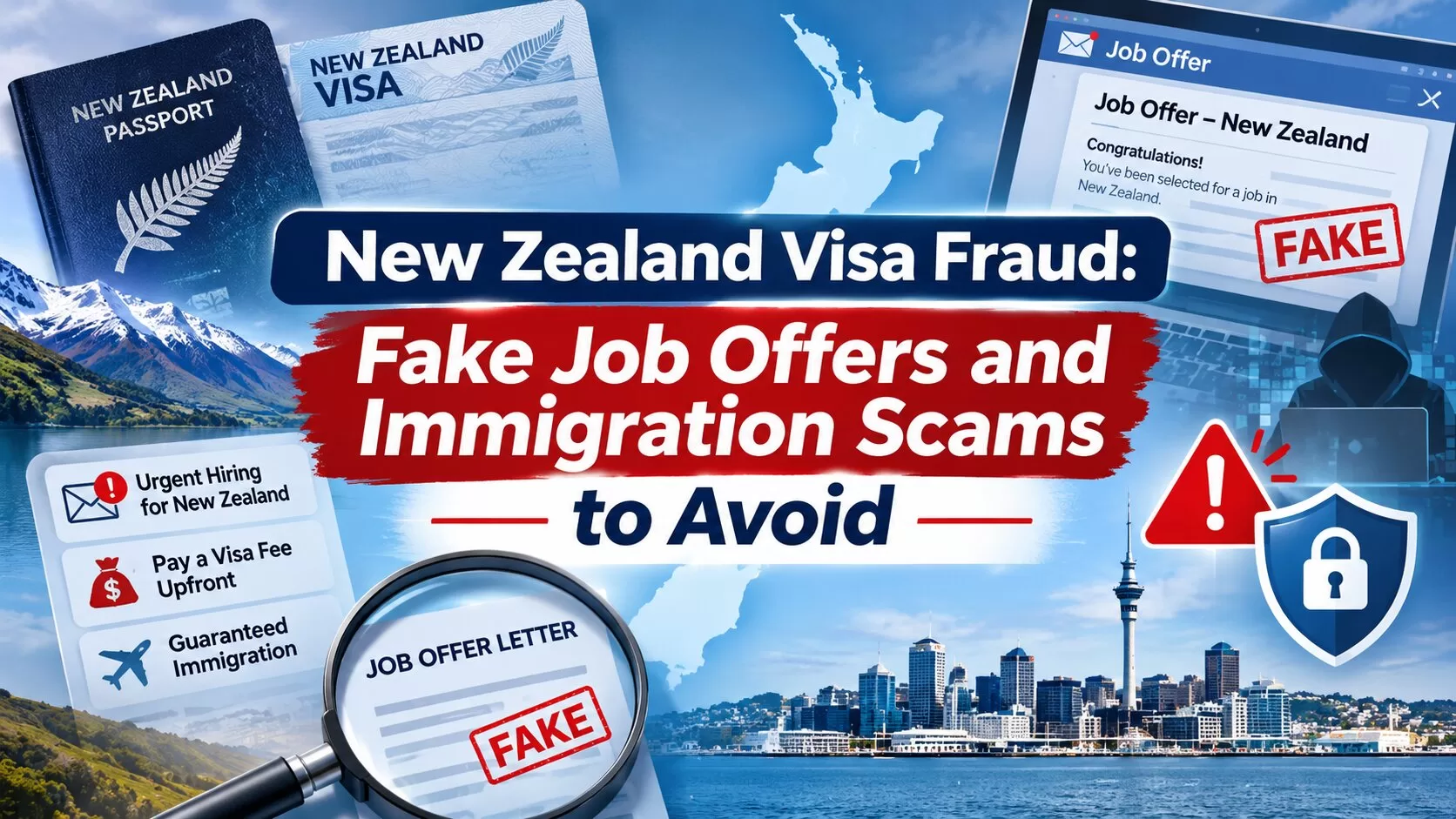
New Zealand Visa Fraud can cost applicants money, damage their immigration history, and expose migrant workers to exploitation. Scammers may promise a job, a visa, permanent residence, or faster processing in exchange for an upfront payment. Some copy government branding, create fake immigration websites, or send convincing emails that ask for personal information and bank transfers.
The safest approach is to verify every important claim through an official government source. New Zealand employers cannot charge workers for a job or pass their recruitment costs to them. Immigration New Zealand (INZ) does not guarantee approval, sell priority decisions through private agents, or ask applicants to deposit visa fees into a personal bank account.
This guide explains common Immigration scams in New Zealand, how to check a job and adviser, what to do if you have already paid or submitted false information, and where Immigration scam victims can seek help.
Common New Zealand Immigration Scams
Scams often work because they combine a real immigration product with a false promise. A genuine visa category, such as an Accredited Employer Work Visa, may be used to make a fake offer appear credible. Fraudsters may advertise employment opportunities across various industries, including gardening, landscaping, and Section Clearing and Overgrown Property Clean Up services, to attract unsuspecting applicants. The applicant is then asked to pay a large amount for a job, submit documents through a non-government website, or keep the arrangement secret.
Fake Job Offers and Recruitment Charges
Fake job offers are among the most serious forms of New Zealand immigration scams. A recruiter may promise a high-paying position, an immediate work visa, or a New Zealand work visa without a proper interview. The offer may use the name of a real company but provide a different email address, phone number, or bank account.
A legitimate employer should be able to explain the job title, duties, location, hours, pay, employment agreement, and reporting manager. Be cautious when an intermediary refuses a direct interview or says that the employer cannot speak with you. Legitimate job offers are based on real work and should be supported by an identifiable employer and a written agreement.
New Zealand employers cannot charge a worker for the job or make the worker pay the employer’s recruitment costs. That prohibition also covers indirect demands through a third-party recruiter. A demand for Recruitment fees, Job placement fees, Illegal recruitment charges, or unexplained Processing fees is a major warning sign.
Some Recruitment agency scams describe a payment as a refundable deposit, security bond, training fee, or “visa token.” Changing the label does not make the demand lawful. Keep the advertisement, messages, receipts, names, phone numbers, and bank details. They may be important for an Immigration fraud investigation.
Guaranteed Visa and Residency Promises
No consultant can honestly promise Guaranteed visa approval scams will succeed. A person who claims to control an immigration officer, guarantee a visa, or arrange a decision within hours is offering a false immigration promise. Similarly, Guaranteed residency scams may describe a residence pathway as automatic when the applicant still has to meet occupation, pay, health, character, qualification, and evidence rules.
A genuine New Zealand residence visa application is decided against the relevant immigration instructions. An Immigration application priority claim is suspicious if it depends only on paying an agent. INZ says it will not prioritize an application because the applicant uses an adviser, and advisers cannot guarantee an outcome or faster decision.
A Temporary visa or Pathways to residence route may eventually support residence, but it does not eliminate eligibility requirements. An applicant should independently check Visa eligibility requirements, Immigration qualifications, and Work experience requirements rather than relying on a sales presentation.
Fake Advisers, Websites, and Documents
Many Immigration adviser scams depend on authority and urgency. The scammer may call themselves an immigration consultant, use a copied logo, or claim to have inside access to INZ. The person may complete a form but refuse to provide a written service agreement, invoice, or explanation of what they are doing.
Adviser Licensing and Legal Advice
In New Zealand, most people who provide immigration advice must be licensed by the Immigration Advisers Authority (IAA), unless they fall within an exemption. Providing immigration advice without a license or exemption is a criminal offense.
Before paying for immigration advice, search the IAA public register and check that the person’s name, licence status, and business contact details match the information they gave you. A licensed immigration adviser should be willing to provide their licence details and explain legitimate visa pathways, including eligibility requirements for a Green List Job in New Zealand. Immigration adviser verification should happen before you sign documents, share sensitive personal information, or transfer money to avoid potential immigration scams and fraudulent visa offers.
A Fraudulent immigration consultant may use another person’s license number or claim that a receptionist, recruiter, or unlicensed assistant is giving advice on the licensed adviser’s behalf. Ask who is responsible for the advice and who will communicate with INZ. If you need legal representation, a Certified New Zealand lawyer or other person legally able to provide immigration advice may be appropriate. An Immigration lawyer should also provide clear details about the legal practice and service being offered.
You are not required to use an adviser. Compare prices and services, request a written agreement, ask what is included, and keep copies of all forms. If an adviser advises you to hide a refusal, invent work experience, or make False statements in visa applications, stop and obtain independent advice. A client remains responsible for information submitted on their behalf.
Fake Websites, Emails, and Visa Documents
Use the Official immigration website by typing the address into your browser or reaching it through the New Zealand Government website. Check that the address is exactly an official domain, such as immigration.govt.nz. A Fake immigration website may have similar spelling, copied colors, or a false “application tracking” page.
Suspicious immigration emails often create panic. They may say that a visa will be canceled today unless the applicant pays, or that a passport has been blocked. Phishing scams ask for passwords, passport scans, card numbers, or one-time codes. Do not click a suspicious link. Instead, open the official website separately and use its contact channel.
Government impersonation scams may claim to come from an immigration officer, embassy, police unit, or Visa Application Centre. INZ warns that official email addresses end in immigration.govt.nz or mbie.govt.nz, but an address alone is not enough proof. Verify the message through an official contact method.
Scammers may also issue Fake visa documents, including an eVisa letter, approval letter, or document with a false visa number. Use the official Visa Verification Service to Verify New Zealand visa information. A message from an agent saying “your visa has been approved” is not reliable evidence until the visa appears in the official system.
Checking a Job, Employer, and AEWV
The Accredited Employer Work Visa process has genuine checks, but a scammer can still misuse the AEWV name. A person may show a copied employer certificate, a fake job token, or a real company name without having authority to recruit for that company.
Employer Accreditation and Employment Contracts
For an AEWV, the employer must be an approved Accredited employers and must send the worker the link to the official online application. Applicants should use the INZ Accredited employer list or official employer search tool to complete Check employer accreditation. Accreditation is not proof that every recruiter representing the company is genuine, so contact the employer directly using independently sourced details.
Employer accreditation verification should include checking the exact legal business name, location, job title, and whether the offer is for the same employer listed in the visa documents. Ask why the company is hiring overseas and request a direct interview. Do not rely only on a WhatsApp profile, social media page, or agent-created email.
The offer should include an Employment contract verification process. Read the employment agreement carefully. It should identify the employer and worker, job title, place of work, duties, hours, duration, pay, and job conditions that comply with New Zealand employment law. The AEWV application requires the employment agreement, job description, and signed job offer.
Do not sign an agreement with unlawful deductions, an unacceptable bonding clause, or a requirement to repay the employer’s recruitment or accreditation costs. A job that exists only on paper is not a safe New Zealand job offer scams alternative to real recruitment.
AEWV Conditions and Job Scams
The AEWV normally links the worker to the employer, job, and location stated on the visa. The worker generally cannot take a second job and may need a Job Change or variation of conditions before changing the employer, position, or work location. Check the visa conditions in the official eVisa rather than accepting an agent’s verbal explanation.
The employer must offer at least 30 hours of work a week and must continue paying the amount stated in the offer. A scam becomes an employment problem when a worker arrives and discovers there is no work, the job is different, the pay is lower, or wages are returned to the employer. Preserve rosters, payslips, bank statements, texts, and photographs of the workplace.
An AEWV can lead to a resident visa in some circumstances, but it is not an automatic residence permit. The route depends on the job, pay, qualifications, registration, and applicable Immigration and employment laws. A role on the Green List may be relevant to some residence pathways, but no recruiter can guarantee that a worker will qualify simply because the job sounds skilled.
Payment, Medical, and Accommodation Fraud
Some Visa fraud is designed to steal money before an applicant has even submitted a valid application. The safest rule is to make payments only through the official channel for the particular service and to keep receipts.
Visa Fees, Medical Checks, and Application Payments
Immigration application fees should be paid through the official INZ online or paper application process. INZ states that it does not ask applicants to pay visa fees by depositing money into a bank account. A Fake visa payment request that directs money to a personal account, cryptocurrency wallet, or unrelated company should be treated as a scam.
A real Visa application payment may be made by card through the official online form or at an approved Visa Application Centre outside New Zealand, depending on the application. Confirm the fee on the current INZ page. A private person cannot sell an “approval fee” or an Immigration application priority slot.
Medical examination fees are normally paid to the clinic that performs the examination. Approved panel doctors and radiologists are listed by INZ. A scammer may invent an Immigration medical checks payment and ask the applicant to transfer the money to an agent. Verify the clinic through the official panel physician list and ask for a clinic receipt.
A medical appointment does not guarantee Visa approval. It is only one part of the application process. Applicants should also check official Visa processing times and understand that a real application can take longer when information is incomplete or further checks are needed.
Accommodation Packages and Living-Cost Claims
Job and accommodation scams combine a fake job with a room, transport, or airport pickup. The recruiter may demand several months of rent before arrival and describe the payment as mandatory for the visa. Accommodation package deals can be legitimate only when the housing arrangement is clearly documented and priced reasonably.
Ask for the address, photos, room details, tenancy terms, bond amount, utilities, and cancellation rules. Compare the price with Rental market rates on Tenancy Services. Be cautious about Excessive accommodation charges, overcrowded rooms, deductions from wages, or a condition that the worker must live with the employer.
Learn your Tenant rights in New Zealand and budget realistically for the New Zealand cost of living. A recruiter who promises free housing, guaranteed government benefits, or immediate Government financial support is not necessarily describing the law. Immigration status and access to public services depend on the visa and personal circumstances.
Worker Rights and Scam Warning Signs
Arriving in New Zealand does not remove employment protection. Migrant worker rights apply even when a worker is vulnerable, has limited English, or is worried about their visa.
Exploitation and Employment Rights
Migrant workers have the same minimum employment rights as New Zealand workers. These include legal pay and protections relating to leave and workplace conditions. Paid holidays and sick leave should not be taken away because a worker holds a temporary visa.
Possible exploitation includes paying money to obtain a job, having wages returned to the employer, working unpaid hours, losing promised leave, being forced to work excessive hours, receiving unsafe accommodation, or being threatened with immigration consequences. Unsafe work practices and Additional employment restrictions should be recorded and reported.
Employment New Zealand describes Migrant worker exploitation as conduct that causes economic, social, physical, or emotional harm. If there is immediate physical danger, call 111. Workers can report exploitation online or call 0800 200 088; interpreters are available. Reporting exploitation does not automatically affect a worker’s visa.
Do not allow an employer, recruiter, or adviser to keep your passport. Keep access to your email, immigration account, bank account, and identity documents. Ask INZ about Work visa conditions if an employer says you must continue unlawful work or threatens to cancel your visa.
Red Flags and Safe Application Practices
Common Immigration scam warning signs include pressure to pay immediately, secrecy, no genuine interview, an unusually high salary, a personal bank account, a promise of guaranteed approval, refusal to provide a contract, a copied website, inconsistent names, or advice to lie. These are practical ways to How to identify immigration scams before money or documents are lost.
To learn How to avoid visa scams, independently verify the employer, adviser, website, visa category, fee, medical clinic, and application status. Use the official INZ site for the Visa application process, and compare every document against the information in your online account. Do not share a password or verification code with a recruiter.
Before submission, check that your information is complete and truthful. Misleading immigration information, altered documents, false employment evidence, and Fraudulent visa applications can cause refusal and future immigration problems. Immigration application verification is not a formality: INZ checks documents and can investigate suspected fraud.
For clear Immigration scam prevention, compare the message with official guidance about Fake immigration advisers, New Zealand visa scams, and Employment scams. Check Employment rights in New Zealand before accepting work, and reject False immigration promises such as Faster visa processing scams. Keep copies of Immigration application updates and report Fraudulent immigration consultants or Unlicensed immigration advisers.
If a message contains Fake visa payment requests or Bank account payment scams, do not pay. Use the official register to Verify immigration adviser, and treat Immigration scam red flags, Overseas recruitment scams, and claims that a recruiter can guarantee protection for every Migrant protection issue as reasons to stop and verify. Official Immigration scam awareness, Immigration application assistance, and Immigration scam complaints channels are safer than a private contact supplied by the sender.
Reporting Visa Fraud and Getting Help
Act quickly if you suspect fraud. Do not send more money merely because the scammer says a refund or visa approval depends on another payment. Save evidence before deleting messages or blocking the contact.
Reporting Scams and Exploitation
For Immigration scam reporting, report suspected immigration fraud to Crime Stoppers on 0800 555 111. INZ states that immigration fraud can include false or altered documents, false or misleading information, or helping someone enter or remain in New Zealand without the correct visa. People convicted of immigration fraud can face imprisonment and fines; immigration fraud can also lead to deportation or loss of citizenship.
To Report immigration fraud, keep the scammer’s name, phone number, email, website, payment instructions, receipts, advertisements, contract, passport request, and relevant visa documents. If the matter involves an employer, also Report migrant exploitation to Employment New Zealand through its online service or by calling 0800 200 088.
If you are in immediate danger, call 111. If money was transferred, contact your bank immediately and ask whether the payment can be stopped or recalled. Report cyber or online fraud to the appropriate local authority. Changing passwords and securing email and social-media accounts can reduce further harm.
If an adviser is unlicensed or has acted improperly, make an IAA complaint. The IAA can receive complaints about licensed advisers and people who unlawfully provide immigration advice, but it does not decide your visa application. Contact INZ about your immigration status and application separately.
Correcting an Application and Protecting Your Record
If you submitted inaccurate information because of an agent, do not ignore it. Get professional advice from a licensed adviser or qualified lawyer, collect the original documents, and explain what happened to INZ as soon as possible. The application remains your responsibility even if another person prepared it.
A person who is an Immigration scam victim may need help with immigration status, employment, safety, debt, or accommodation at the same time. Ask INZ and Employment New Zealand what support is available. Do not let a scammer threaten you with deportation or claim that reporting exploitation automatically cancels a visa.
Use official visa information for future applications. A lawful application may involve an application fee, evidence, a medical examination, police certificates, and normal processing time. It should not require a cash payment for a guaranteed result. Immigration fraud protection begins with verification, realistic expectations, and careful record keeping.
The most reliable Safe immigration practices are simple: verify the domain, check the adviser, confirm the employer, read the contract, pay only through official channels, protect your identity documents, understand your rights, and report suspicious conduct. Those steps cannot eliminate every risk, but they make it much harder for fake job offers and online immigration scams to succeed.
The related guide Green List Job explains how Green List roles, Tier 1 and Tier 2 pathways, accredited employers, pay, qualifications, and work experience can affect New Zealand residence. It should be read alongside current INZ requirements rather than replaced by a recruiter’s promise.