
Student Visa Requirements NZ
by | May 13, 2026 | Info Article
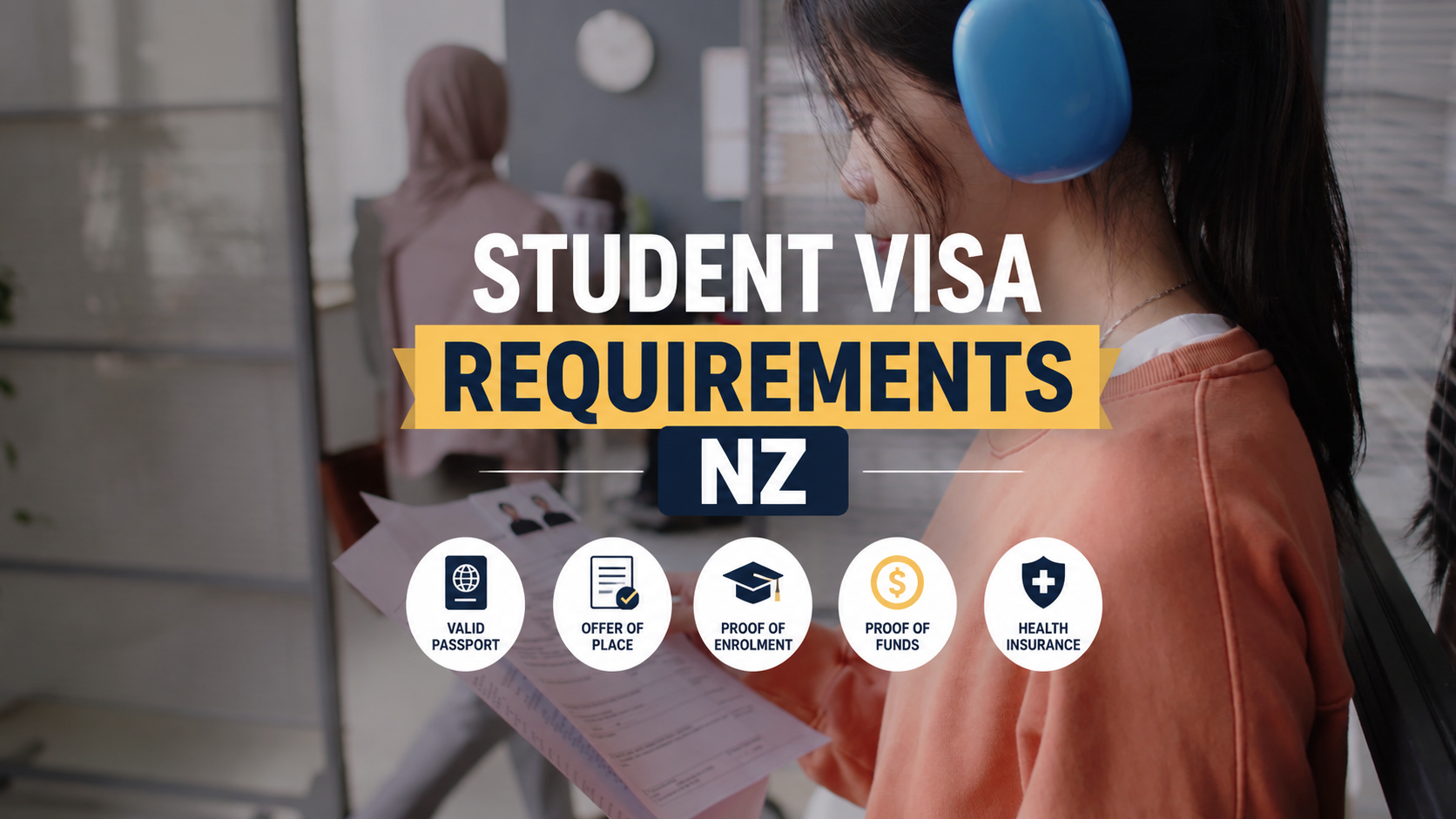
This Student Visa Guide explains the main NZ Student Visa Requirements for a New Zealand Student Visa, with emphasis on the Fee Paying Student Visa NZ, online lodgement, evidence, work conditions and future options. It is written for International Students in New Zealand, applicants planning Study Abroad New Zealand, families checking dependent child student visa NZ eligibility, and students considering NZ Study Opportunities 2026. It also explains why a Student Visa is different from a Partner Visa, even though family members may sometimes apply for visas based on their relationship to a student.1
Student Visa Requirements NZ: Who Can Apply
The official Fee Paying Student Visa is for students who are paying international tuition fees themselves or with support from family, a loan or a partial scholarship. Immigration New Zealand states that applicants must have an offer of place from an approved education provider, have enough money for tuition and living costs, declare acceptable insurance, and meet the other requirements of the visa.1 This category can allow study for up to 4 years, and the current official page shows a Student Visa Processing Time of 80% within 10 weeks.1
New Zealand Student Visa and eligibility basics
Student Visa Eligibility begins with a genuine study purpose. Applicants must be offered a place on a course by an approved education provider, be in good health and of good character, have a genuine reason for coming to New Zealand, and show they can leave New Zealand at the end of their stay.1 These requirements apply whether the applicant is choosing New Zealand Universities, private training establishments, schools, institutes of technology, polytechnics or other NZ Education Providers.
A strong application connects the course to the student’s background. For example, a learner choosing Vocational Programs New Zealand should explain how the programme fits previous study, employment history or realistic Graduate Career Pathways. Similarly, a university applicant should show how the qualification supports Overseas Career Growth, Career Opportunities in New Zealand where lawful, or longer-term Global Education Opportunities.
Fee Paying Student Visa NZ and approved providers
The Fee Paying Student Visa NZ route requires an Offer of Place from an approved education provider. Immigration New Zealand says offer evidence should include the course name, course duration, whether study is full-time or part-time, relevant distance-learning details and scheduled holiday dates for longer courses.1 A returning student may provide Confirmation of Enrolment where appropriate.1
The provider also needs to declare that the course is suitable and that the student has the academic capability and English ability to pass.1 This is why Course Selection Guidance and University Selection Assistance should be practical, not promotional. A course should match the student’s academic level, career plan, financial capacity and likely visa conditions. Recognised Educational Institutions that are signatories to the pastoral care code are important because international learners need both academic quality and appropriate support.1
Student Visa Application Process and Documents
The Student Visa Application Process is now primarily digital for the Fee Paying Student Visa. Immigration New Zealand notes that paper applications are no longer accepted for this visa and that applications must be submitted online.1 Students are also strongly encouraged to apply 3 months before their intended travel date, which gives time for evidence checking, medical or police requests, fee payment confirmation and possible follow-up questions.1
Online Visa Application NZ and document preparation
An Online Visa Application NZ should be organised before lodgement. Student Visa Documents usually include a valid passport, acceptable photo, Offer of Place or Confirmation of Enrolment, tuition fee evidence or scholarship evidence, living cost evidence, insurance declaration, health information, character documents where required, and evidence of genuine study intentions. Valid Passport Requirements matter because a visa may be issued only up to the passport expiry date if that date is earlier than the paid study period.1
Good Document Preparation Services or Student Visa Support Services should focus on accuracy. Academic Transcripts should be complete and consistent with the course level. Financial evidence should be clear, traceable and aligned with the required study period. If documents are not in English, the applicant should follow official translation instructions. The result is a cleaner Study Visa Approval Process, fewer avoidable questions, and a more credible pathway to Student Visa Approval.
Offer of Place, tuition fees and proof of funds
The Offer of Place is the academic anchor of the application, while Proof of Funds is the financial anchor. Immigration New Zealand says applicants must show they have paid tuition fees for one course or one year of study, whichever is shorter, unless exempt.1 Evidence may include provider receipts, confirmation that fees are not required, scholarship evidence or other accepted financial documents.1
For Tuition Fees New Zealand, students should budget beyond the first invoice. If the course runs for more than one year, Immigration New Zealand says a credible plan for funding later years can strengthen the application, even if the money for later years is not yet available.1 This is where Financial Planning for Students becomes a visa issue, not just a personal budgeting matter. A realistic plan can show that the applicant is likely to meet visa conditions and maintain lawful study.
English, Health, Character and Insurance Requirements
A Study Visa New Zealand application is not assessed only on admission. It also looks at personal eligibility. Applicants must satisfy health, character, financial and genuine intention requirements. Some students will need medical checks, and some will need police certificates depending on their circumstances, travel history and length of stay. These checks help Immigration New Zealand assess whether the applicant meets temporary entry requirements.1
English proficiency test, IELTS and TOEFL requirements
Many students ask whether a visa requires an English Proficiency Test, IELTS Requirements or TOEFL Requirements. In practice, English evidence is often driven by the education provider’s admission requirements, and the provider’s offer must include a declaration that it is satisfied the student has the English language ability and academic capability to pass the course.1 This means the visa file should align with the provider’s admission decision.
Students should still keep copies of IELTS, TOEFL, PTE, school results or other accepted English evidence where those documents were used for admission. International Education Consultants, an Education Consultancy NZ firm or a Student Visa Consultant should avoid overstating English results. The safer approach is to present genuine academic evidence, explain any study gaps, and connect the course to a realistic education plan.
Health insurance, police clearance and passport evidence should be treated as core Student Visa Documentation, not as an afterthought. Immigration New Zealand requires Fee Paying Student Visa applicants to declare that they will have insurance acceptable to their education provider.1 Health Insurance for Students is therefore a core compliance issue, not an optional extra. Students also need to consider public healthcare eligibility, medical checks, and the cost of unexpected treatment in New Zealand.
A Police Clearance Certificate may be required depending on the applicant’s situation, and health or character concerns can slow processing. Immigration Advice NZ from a licensed adviser may be helpful where there are previous refusals, complex travel histories, medical issues or criminal matters. In ordinary cases, accurate disclosure, consistent documents and a clear explanation are the foundation of sound Visa Application Support.
Study and Work Rights for International Students
A major reason students choose Study Destination New Zealand is the balance between High-Quality Education, a Safe and Welcoming Lifestyle, and limited work rights. The Fee Paying Student Visa can let students study full-time on an approved course, work part-time up to 25 hours a week while studying and full-time during holidays, depending on visa conditions.1 These conditions should be read carefully because not every student has identical work rights.
|
Topic
|
Practical meaning for students
|
|
Part-Time Work While Studying
|
Work may be allowed up to 25 hours per week if the visa conditions permit it.1
|
|
Full-Time Work During Breaks
|
Full-time work may be allowed during scheduled holidays, depending on the visa conditions.1
|
|
Student Visa Conditions
|
Conditions can include course, provider, work rights, insurance and expiry limits.
|
|
Work Experience for Students
|
Work should support, not replace, the main purpose of full-time study.
|
Part-time work while studying and full-time breaks
Work Rights for International Students should be treated as a permission attached to the visa, not a guarantee of employment. Students should check their eVisa and conditions before starting a job. Employers may ask for evidence of work rights, and students should keep records of hours worked to avoid breaching their Student Visa Conditions.
Study and Work in New Zealand can be valuable when managed carefully. Part-time work can help students gain confidence, local references and professional exposure, but it should not undermine attendance or academic progress. Immigration New Zealand says applicants who already hold a student visa may need to show they are passing their course and meeting attendance requirements.1 This makes academic performance part of future onshore student visa NZ extension planning.
Post-study work and skilled graduate pathways are important for students comparing International Student Visas NZ, Overseas Education and International Education NZ options. The Post-Study Work Visa New Zealand is a separate pathway for eligible graduates who want to work after completing study in New Zealand. Immigration New Zealand says this visa can allow a person to stay and work for up to 3 years, depending on what they studied, and the official page currently shows 80% of applications processed within 5 weeks.2
Students interested in Residency Pathways NZ, Future Residency Options, Skilled Graduate Pathways, Long-Term Residency Opportunities or broader NZ Immigration Pathways should plan early. Not every qualification leads to the same outcome, and post-study rights depend on qualification level, study length and other policy settings.2 Good Education and Immigration Services should help students understand the difference between a study decision, a work visa decision and a future residence strategy.
Student Visa Checklist, Family Options and Success Tips
A practical Student Visa Checklist should confirm the course, provider, funds, passport, health, character, insurance, academic history and genuine intention evidence before lodgement. Students should also prepare for arrival by researching Student Accommodation New Zealand, cost of living, transport, banking, healthcare access and Student Support Services. These details make the Overseas Student Experience more stable, strengthen International Student Support, and reduce pressure after arrival.
Dependent child student visa NZ eligibility and family visas
Families should not assume that every family member can be added to a student application. Immigration New Zealand states that partners and dependent children cannot be included in a Fee Paying Student Visa application, although they may be able to apply for visas based on their relationship to the student.1 A Partner Visa is therefore a separate application type and should be assessed on its own requirements.
For children, dependent child student visa NZ eligibility may be relevant. The official Dependent Child Student Visa is for dependent children aged 19 or younger who will study at primary or secondary school while the parent has an appropriate work or student visa.3 Immigration New Zealand currently shows this visa as valid for the same duration as the parent’s visa, with 80% processed within 7 weeks.3 If the supporting parent has a student visa, eligibility is limited to specific situations, such as a government-approved student exchange scheme, a PhD programme at a New Zealand university, or a Manaaki New Zealand Scholarship.3
Common student visa mistakes and approval tips
The most common Common Student Visa Mistakes include weak financial evidence, choosing a course that does not match the applicant’s history, ignoring insurance, submitting inconsistent academic records, relying on vague statements, and applying too close to the travel date. A stronger Student Visa Application Guide explains why the student chose New Zealand, why the course is suitable, how the study will be funded, and what the student plans to do after completion.
Student Visa Success Tips are usually practical rather than dramatic. Students should select credible Study Opportunities in NZ, compare Overseas Study Opportunities, keep evidence organised, avoid false documents, disclose previous visa issues, and seek help from a New Zealand Immigration Adviser where advice is needed. A good Student Visa Consultation should also explain Student Visa Assistance boundaries, because only licensed or exempt people can provide regulated immigration advice in New Zealand. Students using Education Abroad Services should check whether the service is giving education-only support or regulated immigration advice.
The wider New Zealand Education System offers many New Zealand Study Pathways, from schools and English language study to certificates, diplomas, degrees and postgraduate research. Top Universities in New Zealand and vocational providers can both create strong outcomes when the course is matched to the student’s goals. For Student Visa for Indian Students, or for applicants from any other country, the core rule is the same: the application must show genuine study, credible funds, suitable documents and compliance with immigration instructions.