
Translation Requirements NZ Visa: The Complete Document Translation Guide
by | June 19, 2026 | Info Article
Applying for a New Zealand visa requires presenting a clear, credible, and legally compliant profile to Immigration New Zealand (INZ). For applicants from non-English-speaking countries, Translation Requirements NZ Visa documents are one of the most critical steps in the online visa application process. Any document submitted that is not written in English must be accompanied by an accurate translation to avoid severe visa processing delays.
On May 26, 2025, INZ introduced major policy changes that aligned New Zealand’s certified translation requirements with Australia’s, significantly altering the landscape for a visitor visa application while maintaining strict rules for a residence visa application. This comprehensive Translation Requirements NZ Visa guide outlines official INZ document requirements, detailing which documents must be translated, who can translate them, and how to format your submission correctly.
1. The Legal Framework for Document Translation in New Zealand
Why Translations are Mandatory
When an immigration officer reviews a visa application, they must be able to verify every piece of supporting evidence without ambiguity . Documents written in a foreign language cannot be assessed legally or factually without a corresponding English translation . Submitting untranslated or partially translated documents is one of the leading causes of visa processing delays and can even result in application rejection .
The 2025 Policy Alignment with Australia
On May 26, 2025, INZ implemented a significant update that removed the requirement for certified English translations on supporting documents for visitor visas . This change was designed to streamline the visitor visa application process and reduce costs for tourists, bringing New Zealand’s rules into alignment with those of Australia . However, as detailed below, the requirements for a residence visa application and specific high-risk documents remain unchanged .
2. Certified vs. Uncertified Translations: Key Distinctions
Understanding the difference between a certified English translation and an uncertified translation is vital, as using the wrong type can jeopardize your application .
Requirements for Residence and Temporary Visas
The level of certification required depends entirely on the visa category you are applying for .
| Visa Category | Translation Certification Requirement | Approved Translators |
| Residence Visa Application | Full English Translation with formal certification is mandatory for all non-English documents . | Official translation business or certified professional translator . |
| Visitor Visa Application | Uncertified translations are accepted for standard supporting documents . | Anyone other than the applicant, family members, or the advising immigration advisor . |
| Temporary Entry Visa | Certified translations are mandatory for medical and police certificates; uncertified is accepted for other files . | Professional translation services for certificates; qualified individuals for others . |
The Certification Standard
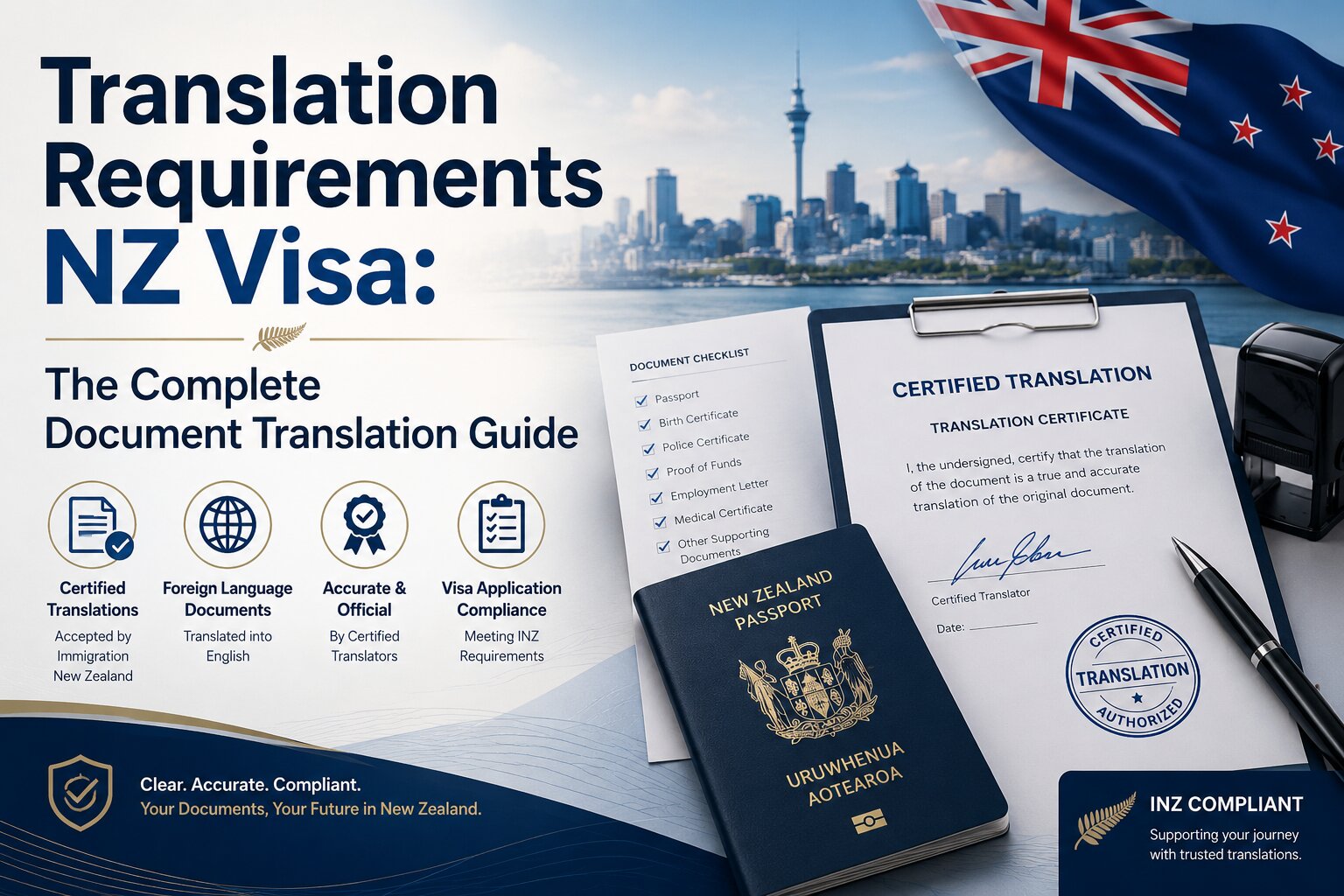
A certified English translation must be completed by a recognized professional translator . The translation must be presented on the translation business letterhead, featuring the translator stamp, translator signature, and a formal statement certifying that the translation is a true and accurate representation of the original foreign language documents .
3. Which Visa Application Documents Require Translation?
Every non-English document submitted as part of your supporting documents must have a corresponding English translation .
Proof of Funds and Financial Records
To satisfy the financial criteria for any visa, you must provide clear proof of funds . This includes bank statements, pay records, tax certificates, and business registration documents . INZ does not accept partial translations of financial records; a full English translation of all transactions and account details is required to verify the source and availability of your funds .
Identity, Employment, and Travel Documents
Your personal history and travel intent must be fully documented in English .
- Identity Documents: National identity cards, birth certificates, marriage certificates, and household registers (such as the Chinese Hukou) must be translated .
- Proof of Employment: Employment contracts, proof of employment letters, and leave of absence documentation must be provided with translations .
- Flight Itineraries: Flight itineraries and return tickets must be translated to confirm your onward travel arrangements and genuine temporary stay intentions .
4. Who is Authorised to Translate Your Documents?
INZ maintains strict conflict-of-interest rules regarding who can perform translations for visa application documents .
Disqualified Individuals
Under no circumstances will INZ accept translations completed by:
- The visa applicant themselves .
- Any family member of the applicant .
- The licensed immigration adviser or immigration advisor who is assisting with the application .
Approved Professional Translators
For residence applications and certified documents, you must use an official translation business . INZ accepts translations from reputable private translation firms, community organizations known for accurate translations, and licensed immigration advisers who are not involved in the application itself . The translator must provide their full name, address, phone number, and a detailed description of their qualifications and experience to prove their language proficiency .
5. Formatting, Scanning, and Submitting Translated Documents
When submitting an online visa application, the physical presentation of your scanned copies is just as important as the translation itself .
Managing Name Spellings and Other Names
One of the most common errors in translation is the inconsistent spelling of names .
- Passport Name Spelling: Ensure your translator uses the exact spelling of your name as it appears in the English section of your passport .
- Other Names Section: If your translated documents contain different spellings, historical names, or names from marriage, you must list these in the other names section of the visa application form to ensure identity confirmation .
Scanning Standards for Online Applications
All scanned copies uploaded to the online portal must be clear and readable documents . You must upload both the original foreign language documents and the corresponding English translations together . Low-resolution scans, cropped margins, or illegible translator stamps will trigger a request for information, leading to immediate visa processing delays .
6. Comparing Translation and Declaration Requirements
It is important to understand how translation requirements interact with other formal legal documents, such as a statutory declaration nz immigration .
Translations vs. Statutory Declarations
While a translation converts a foreign document into English, a statutory declaration nz immigration is a legally binding statement used to provide primary evidence when official documents are unavailable, such as in family violence or partnership cases . If a statutory declaration is executed in a foreign language, it must undergo the same certified translation requirements as any other official document before being submitted to INZ . Both documents must be executed with the highest level of accuracy and integrity to ensure visa success .
By securing a certified English translation from a reputable official translation business and ensuring all scanned copies are clear, you can satisfy Immigration New Zealand requirements and position your visa application for a swift approval .