
Work Rights for Students NZ: Student Visa Rules, Hours and Compliance
by | May 18, 2026 | Info Article
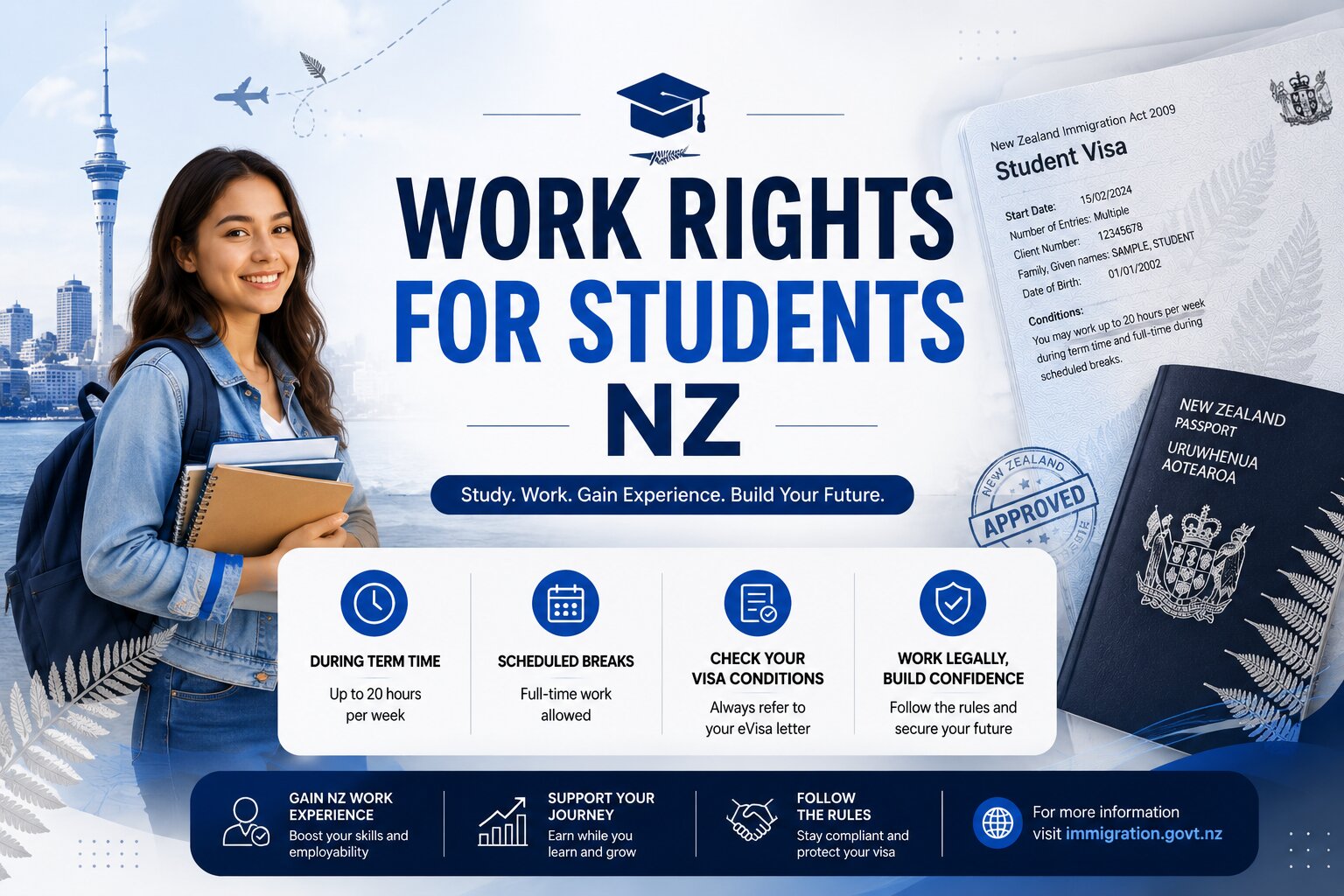
Work Rights for Students in New Zealand depend on the exact wording of a student’s visa conditions, not on informal advice from friends, employers, or education agents. Immigration New Zealand explains that a student visa may include conditions about studying, working and travelling, and students can check these conditions in their eVisa, their visa letter, or through the Visa Verification Service.1 For international students, this means that the first compliance step is always to read the visa grant information carefully before starting any student employment.
New Zealand is a popular study destination because it combines high-quality education, international education options, and practical work experience in New Zealand. However, work rights are not automatic for every New Zealand Student Visa. Some visas allow part-time work while studying; others may allow full-time work during scheduled breaks; and some visas do not allow work at all. The rules may differ for tertiary students, PhD students, students in a Masters research programme, English language students, secondary school students, and exchange students.
Student work rights are a visa condition. A student should not assume they can work simply because they are enrolled with an education provider; they must confirm the work conditions stated on the eVisa or visa letter before accepting employment
This guide explains how working on a student visa usually operates, how students can protect their legal status, and how pathways such as the Post Study Work Visa, Pathway Student Visa, Exchange Student Visa and foreign government supported student visa may fit into longer-term plans.
Student Visa Conditions and Legal Work Permission
Student Visa Conditions are the legal rules attached to a visa. They may cover the education provider, course, full-time study requirement, expiry date, travel permission, and work hours limit. Immigration New Zealand states that if a student visa allows work, the student must only work under the conditions specified in that visa, including how many hours they can work each week and when they can work.1
This point is important because New Zealand work rights for students are not one-size-fits-all. A Fee Paying Student Visa can allow full-time study on an approved course and, depending on conditions, part-time work up to 25 hours per week while studying and full-time work in holidays.2 A Pathway Student Visa can cover up to three consecutive courses and may include work rights if the student provides required course and holiday information and written permission where necessary.3 An Exchange Student Visa can also include work rights, but only according to age, study length, and the conditions granted.4
Checking the eVisa Letter and Visa Letter
The eVisa letter and visa letter are the practical starting points for a visa conditions check. Immigration New Zealand says students can find conditions in their eVisa, the letter sent when the visa was granted, or through the Visa Verification Service.1 These documents should be kept with employment records because an employer may ask to confirm whether the student can work.
Students should check whether the visa refers to part-time work rights, full-time work rights in scheduled study breaks, or no work permission. They should also check whether any practical experience requirement is part of the approved programme. Practical work required by a course may be treated differently from general paid employment, but it still needs to match the visa and course conditions.
When a Variation of Conditions Is Needed
A Variation of Conditions may be needed when the student wants to change a visa condition rather than apply for a new visa. Immigration New Zealand states that students can apply to change visa conditions to allow part-time work or full-time work during holidays if their current visa does not already allow this and they are eligible.1 The same page also states that a variation cannot change the visa expiry date, so students who need longer stay must apply for another temporary visa before the current visa expires.1
For a renew student visa NZ process, students should understand that Immigration New Zealand does not describe this as simply “renewing” the same visa. If the student wants to remain in New Zealand after the expiry date, they must apply for another temporary visa before the existing visa expires, and INZ recommends applying at least one month before expiry.1 Students who change education provider, move to a lower-level course, or need a much longer visa may need a new student visa rather than a variation.
Part-Time Work Rights During Study
Part-Time Work Rights are usually the most relevant rules for international students during an academic semester. Immigration New Zealand’s current student work guidance states that students may be able to work part-time up to 25 hours a week while studying, depending on the visa conditions and the type of study.5 This reflects the increase from 20 to 25 hours a week for eligible student visas from 3 November 2025, with separate variation options for some students whose older visa still states 20 hours.1
The work hours limit should be treated as a strict weekly cap. If a student works multiple jobs, the hours from all jobs count together. The employer may monitor one roster, but the student remains responsible for overall visa compliance. Students should keep copies of rosters, payslips, and employment agreements so they can show they stayed within their visa conditions if asked.
Tertiary Students, PhD Students and Masters Research Programme Rules
Tertiary students commonly hold work rights when their programme meets the relevant student visa requirements. The rules can be more favourable for some higher-level research students. Immigration New Zealand’s work-rights guidance distinguishes different student groups, including tertiary students, PhD students, and Masters research programme students, because the nature and level of the qualification can affect work permission.5
Students should not rely only on the name of the programme. The New Zealand Qualifications and Credentials Framework, often referred to as NZQCF, the education provider’s approval status, and the offer of place can all influence the assessment. Where the course includes a practical experience requirement, the education provider should confirm that the work experience is compulsory for the qualification.
English Language Students and Category 1 Education Provider Requirements
English language students may have work rights only where their programme and provider meet the rules. Terms such as Category 1 Education Provider, NZQA, IELTS Certificate, and English Language Test Result may become relevant because English language study is assessed differently from many tertiary qualifications. Students should make sure their offer of place clearly states the course duration, study load, and scheduled holidays.
This is also where study and work balance matters. A student visa is primarily for study in New Zealand, not for full-time labour-market participation. A student who repeatedly misses class, fails attendance requirements, or works beyond their conditions may create problems for a future Student Visa Application, Visa Extension, Post Study Work Visa, Work Visa, Skilled Migrant Category application, Resident Visa pathway, or other New Zealand immigration policy assessment.
Full-Time Work Rights and Scheduled Breaks
Full-Time Work Rights usually apply only in specific periods, such as scheduled study breaks or the Christmas and New Year holiday period, and only when the visa conditions allow them. Immigration New Zealand’s Fee Paying Student Visa page states that the visa can allow full-time work in holidays, depending on conditions.2 The Exchange Student Visa page similarly states that some exchange students may work part-time while studying or full-time in holidays, depending on age and study length.4
Scheduled breaks should be supported by education provider documents. For example, an offer of place may state the dates of the course and scheduled holidays. If the course is more than one academic year, Immigration New Zealand expects holiday information to be included in the offer of place or provided separately for some student visas.3 Students should retain these documents because an employer may not know whether a break is officially scheduled.
Secondary School Students, Age Limits and Permission
Secondary school students must be especially careful. Immigration New Zealand states that students aged 16 or 17 in years 12 or 13 of secondary school, or studying at a tertiary education provider under an exchange visa, may need written permission from parents or a legal guardian, the approved education provider, and the exchange programme organisation for work rights.4 Students aged 15 or younger cannot work on a student visa under the Exchange Student Visa rules.4
These rules matter for families planning a New Zealand study pathway. A younger student may hold a Visitor Visa, student visa, or dependent child visa depending on their circumstances, but work rights are not automatically attached to age, school enrolment, or living in New Zealand. The student’s visa letter remains the controlling document.
Practical Experience, Internships and Course Requirements
Some courses include practical experience as a compulsory part of the qualification. Immigration New Zealand states that where practical work experience is required, students must provide evidence that it is a requirement of their studies, such as a letter from the approved education provider or a course outline.4 Time spent on required practical experience may be treated separately from general paid-work hours, but students should still ensure that the practical placement is documented and consistent with the visa.
This distinction is important for internships, clinical placements, hospitality training, teaching practice, aviation training, and other vocational programmes. If the work is optional or mainly paid employment, it may count toward the work hours limit. If it is a compulsory course component, the evidence should be clear before the placement starts.
Visa Types That Affect Student Work Rights
Different student visa categories have different settings. A New Zealand Student Visa may be a Fee Paying Student Visa, Pathway Student Visa, Exchange Student Visa, Foreign Government Supported Student Visa, or another category. Each visa type has its own documents, eligibility rules, and work conditions. The phrase student visa requirements should therefore be read with the specific visa type in mind, not as a single universal checklist.
The Fee Paying Student Visa is the most common route for many international students who pay tuition fees directly, through family support, a loan, or a partial scholarship.2 The Pathway Student Visa is designed for students taking up to three courses in sequence on one visa.3 The Exchange Student Visa is for students accepted into an approved exchange scheme and applying from outside New Zealand.4 The Foreign Government Supported Student Visa is for students whose foreign government scholarship supports tuition and living costs under an education agreement with New Zealand.6
Exchange, Pathway and Foreign Government Supported Student Visa NZ
The exchange student visa NZ requirements include acceptance into an approved student exchange scheme, an offer of place from an approved education provider unless the student is coming through an exchange programme organisation, sufficient living funds or an acceptable sponsor, and being outside New Zealand when applying.4 The visa may allow part-time work up to 25 hours a week while studying or full-time work in holidays depending on the student’s age and course length.4
The pathway student visa NZ requirements include a pathway offer of place from an approved education provider, enough money for tuition and living costs or an acceptable sponsor, insurance, genuine reasons for coming, and evidence of course progress and attendance if the student already has a student visa.3 The foreign government supported student visa NZ category requires a government support letter, confirmation that tuition and living expenses will be paid by the government, and an offer of place from an approved education provider.6
| Visa type | Common work-rights context | Key compliance point |
| Fee Paying Student Visa | May allow 25 hours per week and holiday work | Check the eVisa and course holiday dates |
| Pathway Student Visa | May include work rights across linked courses | Keep pathway offer and progress evidence |
| Exchange Student Visa | Work depends on age, exchange type and study length | Some younger students need written permission |
| Foreign Government Supported Student Visa | May allow 25 hours per week and holiday work | Government support must cover tuition and living expenses |
Employment Compliance and Future Pathways
Work Rights for Students should be managed as part of a wider immigration plan. A student who breaches work restrictions may face visa problems, and this can affect future Visa Eligibility, Visa Processing, or an application for a Post Study Work Visa. Immigration New Zealand states that the Post Study Work Visa allows eligible graduates to work in New Zealand for up to three years depending on what they studied, and it can lead to a resident visa.7
Employment compliance also protects the student in the workplace. International students are employees when they work, which means they should understand employee rights, obtain an IRD Number from Inland Revenue, and sign a written Employment Agreement. If an employer asks a student to work more hours than allowed, the student should refuse and seek Immigration Advice from a licensed Immigration Adviser or appropriate official source.
IRD Number, Employment Agreement and Employee Rights
Before starting paid work, students should apply for an IRD Number, confirm tax obligations, and keep payslips. A written employment agreement helps define pay, hours, duties, leave, and workplace expectations. It also makes it easier to prove that work stayed within the allowed student work hours.
Students should be cautious about cash work, unpaid work that is really employment, and “trial” shifts that are not properly documented. Visa compliance is not separate from employment law; both matter. A student who wants to study abroad successfully in New Zealand should plan rosters around classes, assessments, attendance requirements, and health, rather than allowing employment to undermine the study purpose of the visa.
From Student Employment to Post Study Work Visa and Residence Options
Student employment can help with living in New Zealand, confidence, local references, and career awareness, but it should not be confused with a guaranteed residence pathway. A Post Study Work Visa may be available only where the student completes an eligible New Zealand qualification and applies within the required timeframe.7 After that, some graduates may later explore a Work Visa, Skilled Migrant Category pathway, or Resident Visa option if they meet the relevant criteria at that time.
The safest strategy is to align New Zealand study opportunities with educational qualifications, realistic employment goals, and lawful work conditions from the start. Students should review their visa conditions whenever they receive a new visa, change course, change provider, change work pattern, or prepare a new visa application. In this way, international students can benefit from the New Zealand education system while protecting their immigration record.
Conclusion: Staying Lawful While Working and Studying
A strong Student Visa Application is built on accurate documents, a clear offer of place, genuine study intentions, and realistic plans for work and study balance. This is why a Study Visa New Zealand plan should match the student’s course, budget, work expectations, and long-term goals before lodgement. Whether the student is on a Fee Paying Student Visa, Exchange Student Visa, Pathway Student Visa, or Foreign Government Supported Student Visa, the safest approach is the same: read the conditions, keep evidence, work lawfully, and ask for professional support when unsure. With careful planning, students can gain meaningful work experience in New Zealand while maintaining compliance and protecting future immigration options.