Future of Immigration NZ: What Migrants, Students, and Employers Can Expect

Future of Immigration NZ: What Migrants, Students, and Employers Can Expect

The Future of Immigration NZ will likely be shaped by four connected priorities: attracting the skills New Zealand needs, making visa services more digital, improving processing and risk management, and strengthening immigration compliance. As the Future of Immigration NZ continues to evolve, the system is not moving toward one simple visa for everyone. Instead, the direction is toward more targeted visa pathways, clearer evidence requirements, faster digital submission, and closer assessment of whether an applicant, employer, job, study program, or investment genuinely meets the policy purpose. Overall, the Future of Immigration NZ is expected to focus more heavily on skilled migration, compliance, digital efficiency, and pathways that directly support the country’s economic and workforce needs.

Some changes are already in force. The Skilled Migrant Category has new routes for skilled work experience and trades and technicians. New post-study options are scheduled for 16 November 2026. Immigration New Zealand is also transitioning more applications to its enhanced Immigration Online platform, known as ADEPT. Other changes remain proposals, including measures in the Immigration (Enhanced Risk Management) Amendment Bill. The distinction matters: an announced intention is not the same as an enacted immigration regulation.

For people planning to work in New Zealand, study in New Zealand, visit family, establish a business, invest, or pursue New Zealand residence, the practical lesson is clear. A successful visa application will depend increasingly on accurate information, complete visa documentation, genuine purpose, consistent supporting documents, and a pathway that matches the applicant’s circumstances.

The Main Direction of New Zealand Immigration Policy

New Zealand immigration policy is trying to balance economic needs with public confidence and system integrity. The government wants skilled workers, international students, investors, and genuine visitors to contribute to New Zealand while limiting exploitation, fraud, non-genuine employment, and avoidable pressure on immigration services.

From Broad Access to Targeted Migration

The Future of Immigration NZ is likely to give greater weight to the relationship between each visa category and a clearly defined national need. Skilled workers may be assessed through a skilled worker visa, a New Zealand work visa, a Green List route, an Accredited Employer Work Visa, or a Skilled Migrant Category pathway. As the Future of Immigration NZ develops, the relevant question will not simply be whether a person has a degree or overseas experience. It will also be whether the person has a genuine skilled job, an accredited employer, the required pay, an acceptable qualification assessment, and a realistic work and residence plan. This means the Future of Immigration NZ may increasingly favour applicants whose skills, employment, and long-term plans align closely with New Zealand’s workforce and economic priorities.

The 2026 Skilled Migrant Category reforms show this direction. The SMC now includes the Points-based pathway, the Skilled Work Experience pathway, and the Trades and Technician pathway. The new routes recognize people whose skills are demonstrated through work experience or practical qualifications, while red and amber occupation lists target roles with higher immigration risk or additional evidence needs .

This approach may make skilled migration more predictable for applicants who fit a defined route. It may also make it harder to succeed with a vague job description, an inflated occupation title, an unverified overseas qualification, or an employment arrangement that is not genuinely based in New Zealand.

A More Evidence-Based Visa Process

The future visa process will likely involve more integrated verification. Immigration New Zealand’s systems are being designed to make more information available to staff and to improve risk management. That can help a genuine applicant when employment, identity, travel, study, and qualification records are consistent. It can create problems when an applicant’s visa documentation conflicts with tax records, education records, previous applications, or employer information.

Applicants should expect the immigration assessment to focus on the full story. A visa application will need to show the purpose of travel, the chosen visa category, the applicant’s immigration eligibility, and the evidence supporting the claim. For a residence application, this may include skilled employment, family relationships, health, character, qualifications, and work history. For a student visa, it may include the course, funds, education progression, and genuine intention to study.

Professional immigration advice may become more valuable for complex cases, but an immigration adviser or licensed immigration adviser cannot replace the applicant’s responsibility to provide truthful information. An immigration consultant can help with case preparation and immigration application support, but the applicant remains responsible for the accuracy of the information submitted.

Digital Immigration Services and Faster Processing

One of the clearest parts of the Future of Immigration NZ is digital transformation. Immigration New Zealand’s Our Future Services program aims to build a customer-centered, modern immigration system that is more efficient, better at managing risk, and easier for customers and staff to use. As the Future of Immigration NZ becomes increasingly digital, applicants may see more streamlined online processes, clearer document requirements, and faster communication throughout the visa journey. This digital shift is likely to remain a major part of the Future of Immigration NZ as the system focuses on efficiency, transparency, and stronger risk management.

ADEPT and a Single Online Submission Channel

The enhanced Immigration Online system, known as ADEPT, is intended to become the single customer submission channel and visa application processing system. Immigration New Zealand says customers can expect simpler forms, questions tailored to their circumstances, more self-service tools, real-time status information in an online dashboard, and reduced average processing times. This digital approach could also make applications under pathways such as the Care Workforce Work process easier to manage by providing clearer submission requirements and more transparent application tracking.

The transition is happening in stages. International student visas, family applications connected to temporary visa holders, group and tour escort visitor visas, and other products are moving through the enhanced system. Immigration New Zealand has also announced planned outages while older systems are decommissioned. These changes suggest that the future immigration application will increasingly begin, progress, and be tracked online.

Digital processing does not mean every application will be decided automatically. Complex applications may still require an immigration officer to assess evidence, request further information, verify documents, or examine credibility. The likely change is that the system will organize information earlier and help officers identify routine applications and higher-risk cases more efficiently.

What Digital Processing Means for Applicants

Applicants should prepare clear electronic copies of passports, civil documents, visa letters, employment contracts, qualification evidence, bank records, medical documents, police certificates, and relationship evidence. File names should make sense, scans should be readable, and translated documents should be complete. Uploading a document without explaining its relevance may not solve an evidence gap.

Applicants should also monitor their Immigration Online account and email. A request for further information may have a deadline. A technical issue, incorrect email address, or failure to check the dashboard can delay an application. Applicants linked to an accredited employer should also make sure any employment-related information remains accurate and up to date throughout the process. Immigration advisers and representatives should keep accurate records of who receives notifications and who is responsible for responding.

The future digital system may reduce routine processing time, but it will not remove the need for careful application documentation. A complete application is still different from a large application. The best file gives the decision-maker the relevant information in a logical form and avoids contradictory statements.

Skilled Migration, Study, and Work Pathways

The future of New Zealand immigration is likely to remain closely connected to the labor market. Immigration settings will continue to change as New Zealand considers shortages, employer demand, wage levels, education outcomes, and retention of people already in the country.

Skilled Workers and Residence Pathways

New Zealand is likely to keep refining routes for skilled workers, including the New Zealand work visa, Green List pathways, Accredited Employer Work Visa, Skilled Migrant Category, and sector-specific residence routes. The policy objective is not only to bring people to New Zealand but also to retain workers who are genuinely contributing over time.

The SMC reforms are an example. Applicants can qualify through skilled resident points, skilled work experience, or the Trades and Technician pathway. The system recognizes qualifications, occupational registration, income, relevant work experience, and post-qualification work experience. It also uses wage thresholds, occupation lists, and employer requirements to distinguish genuine skilled employment from an unsupported claim .

Future changes may continue to give employers a larger role in demonstrating that a position is genuine, ongoing, and needed in New Zealand. Employer accreditation and job-check obligations may therefore remain central to a work permit or work visa application. Employers may need stronger payroll, time, recruitment, and employment records to show compliance.

For an individual, this means a migration pathway should be planned from the job backward. The worker should check the occupation code, qualification assessment, registration, wage, visa duration, employer status, and possible residency pathway before accepting an offer. A job that provides temporary work may not provide work and residence.

International Students and Graduate Retention

International education will remain important, but the future student visa system is likely to focus more on course quality, genuine study, financial capacity, and the connection between qualifications and New Zealand’s skills needs. Students should choose a course for a credible academic and career reason, not only because they expect a later work visa.

From 16 November 2026, eligible graduates will be able to apply for a new Short-Term Graduate Work Visa. It will provide six months of open work rights for graduates who meet the conditions, allowing time to look for work and, where appropriate, transition to an Accredited Employer Work Visa. Applicants must generally hold an NZQCF Level 5 to 7 qualification studied full-time in New Zealand for at least 24 weeks, have at least NZD $5,000 available, and apply within three months of the student visa expiring .

Post-Study Work Visa eligibility will also extend to certain Level 7 graduate diploma holders who studied full-time in New Zealand and hold a bachelor’s degree from New Zealand or overseas. These changes show a future emphasis on connecting study in New Zealand with a realistic transition into skilled work, while preserving education quality and protecting the country’s international education reputation.

Students should not treat a graduate visa as a guaranteed route to residence. A graduate may still need an accredited employer, a suitable job, an appropriate wage, occupational registration, English evidence, and a separate residence application. The future student journey will likely reward informed course selection and early career planning. A student who plans to live in New Zealand after graduation should assess the work and residence conditions before enrolling.

Family, Business, Visitor, and Investor Immigration

The future of New Zealand immigration will not be limited to skilled workers and students. Family immigration, visitor visas, business immigration, and investment routes will continue to serve different policy purposes. Each category has its own evidence and risk profile.

Family Immigration and Visitor Travel

The family category is likely to remain an important part of New Zealand’s migration system, but family relationships must be genuine and properly documented. A partner, dependent child, parent, or other family member may use a temporary or residence pathway depending on the sponsor’s status, the relationship, and the requirements of the visa category.

A visitor visa is not a substitute for a work visa, student visa, or residence visa. Applicants should explain the purpose of the visit, available funds, accommodation, travel plans, and intention to comply with visa conditions. A person who intends to work in New Zealand should not describe the trip as tourism simply because a visitor visa appears easier.

Future digital systems may make family applications easier to submit and track, but they may also make inconsistencies more visible. Marriage records, travel history, addresses, financial transfers, photographs, communication evidence, and previous visa statements should tell a consistent story. Where a family immigration case is complex, professional immigration advice may assist with evidence and representation.

Business Immigration and Investment Routes

New Zealand is also adjusting business and investor settings to attract capital and economic activity. A business visa, investor visa, or other business immigration route requires more than the ability to transfer funds. Applicants may need to show lawful source of funds, investment structure, business experience, genuine commercial activity, and compliance with the relevant conditions.

In September 2026, the government announced that the Growth category of the Active Investor Plus visa would expand in December 2026 to allow Build to Rent investment as part of the applicant’s overall investment in New Zealand . This illustrates how future investment policy may evolve to direct capital toward nationally significant sectors.

Business applicants should distinguish a residence-based investor route from a temporary business visa. They should also consider tax, company law, employment obligations, and the commercial risks of operating in New Zealand. An immigration consultant may explain the visa process, but the applicant should obtain separate professional advice where the plan involves complex financial or legal arrangements.

Compliance, Appeals, and Immigration Risk

A future immigration system will need to remain accessible while protecting the integrity of immigration decisions. Immigration New Zealand is developing stronger risk management, and the government has proposed additional compliance and enforcement measures. Applicants should understand how immigration status, unlawful status, visa conditions, appeal rights, and Section 61 interact.

Immigration Compliance and Section 61

A person must hold a valid visa to stay in New Zealand. If a visa expires, the person becomes unlawful, cannot work or study, may not qualify for publicly funded health services except in limited circumstances, and may face detention, deportation, or a re-entry ban. Immigration New Zealand advises people to apply for a new visa before the current visa expires .

A Section 61 request under the Immigration Act 2009 is a discretionary request for a visa in a special case. It does not automatically stop deportation, guarantee consideration, or guarantee approval. A person who is unlawful remains liable for deportation. A refused Section 61 request cannot be appealed, although judicial review may examine the decision-making process rather than substitute a new immigration decision.

The likely future direction is stronger early intervention. Applicants and visa holders should track expiry dates, comply with work and study conditions, update contact details, and seek immigration advice before a problem becomes an immigration case. Immigration compliance is easier when the person acts while still lawful.

Immigration Appeals and Tribunal Review

Appeal rights depend on the decision and the applicant’s status. A temporary visa applicant in New Zealand may request reconsideration within 14 days if still lawful. A person whose residence application is declined can usually appeal to the Immigration and Protection Tribunal within 42 days. There is no appeal merely because an Expression of Interest does not result in an invitation to apply, and there is no appeal of a refused Section 61 request .

An immigration appeal is not simply a second visa application. The immigration tribunal process is distinct from ordinary visa processing and should be assessed against the decision, evidence, and deadline. It may involve legal grounds, humanitarian circumstances, documentary evidence, credibility, and the correct interpretation of immigration regulations. A visa appeal should be assessed promptly because deadlines can be strict. An immigration adviser, licensed immigration adviser, or immigration lawyer can help determine whether reconsideration, an appeal, a new application, or departure is the more realistic option.

The government has also proposed measures that would change aspects of deportation liability, employer enforcement, migrant exploitation penalties, and humanitarian appeal rights. Because these are proposals until enacted, applicants should not treat them as current law. They do, however, signal that future policy will place greater emphasis on compliance, employer accountability, serious offending, and protection-system integrity .

Preparing for the Future of Immigration NZ

The future system will reward applicants who plan early, use the correct visa category, and maintain a complete record. Applicants should treat immigration matters as an ongoing responsibility. It will be less forgiving of inaccurate information, poor documentation, expired visas, non-genuine jobs, and unexplained changes between applications.

Building a Strong Immigration Application

A strong immigration application begins with a clear objective. The applicant should decide whether the goal is to visit, study, work, establish a business, join family, obtain residence, or eventually seek permanent residence. That goal should be tested against applicant eligibility before documents are prepared. The chosen goal should match the visa pathway and the evidence. That early candidate assessment can prevent an applicant from selecting a visa that does not fit the intended purpose.

The supporting file should usually include a valid passport, identity documents, visa documentation, qualification records, overseas qualification evaluation or qualification assessment where required, employment agreement, job description, bank evidence, police certificates, medical documents, and relationship evidence. The applicant should explain gaps, previous refusals, changes of name, travel history, and any immigration status issue rather than leaving important information unexplained.

An immigration assessment may involve information held by other authorities. Applicants should assume that false or misleading information can affect future visa approval. A successful visa application is not created by adding more documents; it is created by presenting accurate, relevant, and consistent evidence.

When Professional Advice Is Worthwhile

An immigration consultation can be useful when the case involves multiple visa options, an overseas qualification, a complex family relationship, an employer problem, a previous refusal, unlawful status, a Section 61 issue, criminal history, or a potential immigration appeal. A licensed immigration adviser can provide regulated immigration advice within the scope of the person’s licence. An immigration lawyer may be appropriate for litigation, judicial review, deportation, or complex legal interpretation.

Professional immigration advice does not guarantee a visa. An immigration representative can help with application process planning, case preparation, immigration representation, and communication with immigration authorities. The applicant should still read the final application and confirm that all information is accurate.

The Future of Immigration NZ is likely to be more digital, more targeted toward genuine skills and economic contribution, and more sophisticated in risk assessment. Students may receive clearer graduate work options. Skilled workers may have more structured routes through work experience and practical qualifications. Employers will face stronger expectations around accreditation and compliance. Families, visitors, business applicants, and investors will still have opportunities, but each will need to satisfy the purpose and evidence requirements of the correct category.

The related guide Skilled Migrant Points System NZ explains the SMC points route, qualification points, income points, skilled work experience, and the three current Skilled Migrant pathways. Reviewing that guide alongside official INZ instructions can help applicants compare the points-based route with other migration pathways.

The safest long-term approach is to monitor official Immigration New Zealand announcements, keep immigration documentation current, maintain lawful immigration status, and obtain professional help when the case is complex. Policy will continue to evolve, but accurate information, genuine purpose, and strong evidence will remain central to a successful visa application.
Best Country for Immigration 2026: Easiest Options by Applicant Profile

Choosing the Best Country for Immigration in 2026 requires more than ranking passports or repeating social-media claims about easy visas. New Zealand and Australia both offer skilled migration, family migration, employer sponsorship, investor routes, and temporary residency options, but their immigration policies use different eligibility rules. New Zealand often provides a relatively direct residence pathway for a skilled professional with a qualifying New Zealand job, while Australia offers a broader selection of skilled worker programs but may require an Expression of Interest, competitive ranking, state sponsorship, employer nomination, or an invitation to apply.

In 2026, the Best Country for Immigration depends on the applicant’s purpose, nationality, evidence, budget, and preferred level of physical presence. The word “easiest” must also be used carefully. A visa that is accessible for a remote worker may be unsuitable for a retiree, family, investor, entrepreneur, or skilled professional seeking local employment. A temporary resident visa is not permanent residency. A residence permit is not always the same as permanent resident status, and permanent residence is not citizenship. Each route has its own financial requirements, proof of funds, health insurance, police clearance, valid passport, immigration documentation, physical presence requirements, and residency renewal rules.

This 2026 guide compares major immigration pathways and then reviews alternative migration destinations for defined profiles, including remote workers, retirees, investors, families, expats, and skilled professionals. Applicants who need personalised guidance can also consult experienced Immigration Advisers Auckland to better understand which pathway may suit their circumstances. It does not promise predictable approvals. Immigration requirements, processing times, application fees, investment minimums, occupation lists, and visa options can change, so applicants should check the relevant official authority before submitting a visa application.

How to Choose the Best Country for Immigration in 2026

New Zealand and Australia use several legal stages between arrival and citizenship. Understanding the immigration framework prevents applicants from treating a visitor visa, work visa, resident visa, permanent resident visa, and citizenship pathway as interchangeable.

Temporary Residency, Residence, and Permanent Residency

A temporary residency permission allows a foreign national to stay for a defined period and perform only the activities authorized by the visa. Examples include a work visa, student visa, digital nomad visa, retirement visa, or temporary resident visa. A temporary permit may be renewable, but renewal is not guaranteed. The holder must continue meeting the visa eligibility rules and may need to remain within a particular immigration category.

A resident visa or residence permit usually gives a person a stronger right to live in the country, but travel conditions, work conditions, investment obligations, or reporting requirements may still apply. New Zealand explains that a resident visa can allow indefinite living, working, and studying while still carrying an expiry date for travel. A Permanent Resident Visa removes those travel conditions and can generally be sought after the holder has had a resident visa for at least two years and meets the other requirements .

In Australia, a permanent visa allows a person to remain in Australia indefinitely, although the right to re-enter after travel depends on the visa’s travel facility. Permanent resident status is therefore not identical to citizenship. It is a secure immigration status, but the holder must still follow the relevant rules for travel, character, and later citizenship .

Citizenship and the Pathway to Citizenship

A citizenship pathway is a separate legal process. In New Zealand, most applicants need to have lived as a resident for at least five years and meet physical presence and intention requirements. They do not necessarily need to hold a Permanent Resident Visa before applying for citizenship . In Australia, citizenship by conferral generally requires four years of lawful residence immediately before applying, including the final 12 months as a permanent resident or eligible Special Category Visa holder, together with absence limits and other criteria .

Naturalisation rules in other countries differ again. Some countries call the final process naturalisation, while others use citizenship by registration or a presidential approval process. The time spent on a digital nomad visa, Golden Visa, investor visa, or residence permit may not count in the same way as time spent on a qualifying permanent or legal residence status.

Best Immigration Pathways for Skilled Workers and Families

New Zealand offers several immigration pathways for people whose qualifications, work, registration, income, or investment match current policy settings. The strongest route is determined by the applicant’s profile rather than by a general claim that New Zealand has easier immigration.

Skilled Migration Through SMC and Green List Roles

The New Zealand Skilled Migrant Category is a residence route for people with skills New Zealand needs. Under current Immigration New Zealand guidance, applicants may qualify through one of three pathways: a Points-based pathway requiring six skilled resident points, a Skilled Work Experience pathway, or a Trades and Technician pathway. All applicants usually need a skilled job or job offer in New Zealand, the required pay, good health, good character, and English ability .

The Points-based pathway may use a recognized qualification, eligible occupational registration, or pay from the job or job offer. Skilled work experience in New Zealand can supplement one selected skill category when the applicant cannot obtain all six points from that category. A person cannot simply combine unrelated points from several categories. The Skilled Work Experience pathway is designed for an applicant with several years of relevant experience and additional qualifying skilled work in New Zealand. The Trades and Technician pathway may suit eligible construction, engineering, manufacturing, automotive, or technical support occupations.

The Green List occupations create another skilled migration pathway. A Tier 1 Green List role may support Straight to Residence if the worker meets the employer, registration, qualification, pay, age, health, character, and other requirements. A Tier 2 role may lead to Work to Residence after the required qualifying period of New Zealand employment. These are occupation-specific routes, not automatic approvals. An applicant must check the exact job duties and conditions rather than rely only on a job title .

New Zealand Investor, Retirement, Remote Work, and Family Options

New Zealand’s Active Investor Plus Visa is an indefinite resident-visa route for applicants who can meet substantial investment requirements. The official route describes a NZD $5 million Growth category with a minimum three-year investment period or a NZD $10 million Balanced category with a minimum five-year investment period. The applicant must satisfy source-of-funds, transfer, acceptable-investment, and other conditions. A spouse or partner and dependent children aged 24 or younger may be included when the family meets the rules . This is investment immigration, not an instant citizenship by investment program.

New Zealand also has a Temporary Retirement Visitor Visa for people aged 66 or older who can meet the investment, maintenance-fund, and annual-income requirements. It is a temporary route and should not be confused with permanent residency. The Parent Retirement Resident Visa can provide a residence pathway for a parent with an adult New Zealand citizen or resident child, but it has high capital and income requirements, excludes applicants with dependent children, and is not a general low-cost retirement option .

Remote workers should distinguish a Visitor Visa from a Digital Nomad Visa. New Zealand may allow limited remote work for an overseas employer, overseas business, or overseas client while the visitor remains subject to visitor conditions. That permission does not authorize local employment, create New Zealand residence eligibility, or guarantee a later citizenship pathway . Partner, dependent children, parent, and family-stream options are separate applications or route-specific inclusions.

Investment, Retirement, and Remote-Work Immigration Options

Australia has a large skilled migration architecture that includes independent, state-nominated, employer-sponsored, regional, and family-stream programs. This breadth is an advantage, but the immigration process can be more competitive and less predictable for an applicant who depends on an invitation or state selection.

Skilled Independent, State, Employer, and Regional Routes

The Skilled Independent Visa, or Subclass 189 visa, is a permanent visa for invited workers with skills Australia needs. The applicant generally submits an Expression of Interest through SkillSelect after obtaining the appropriate skills assessment and English evidence. An EOI enters the applicant into the EOI pool, but it is not a visa application and does not guarantee an invitation to apply. A points score that meets the legal minimum may still be insufficient in a competitive occupation .

The Skilled Nominated Visa subclass 190 uses state sponsorship, while employer nomination can support the Employer Nomination Scheme subclass 186. Regional migration can create a temporary-to-permanent route through regional provisional visas when the applicant meets the later residence and work requirements. The relevant occupation must appear on the correct skilled occupation list, and the applicant usually needs a positive assessment from the relevant assessing authority.

The Australian points-based immigration system may award points for age, English language proficiency, skilled work experience, overseas work experience, Australian study, recognized qualifications, partner skills, and nomination. Applicants should not rely on a generic points calculator without verifying the occupation, evidence, and current invitation settings. The occupation ceiling, annual planning levels, state priorities, and invitation rounds can affect the practical minimum points requirement.

Family Migration, Remote Work, Investors, and Retirees

Australia has family-stream visas and sponsored parent routes, but family migration is not always a fast or low-cost immigration option. Parent categories may involve a sponsor, balance-of-family requirements, an assurance of support, substantial application fees, health and character checks, and long processing queues. A spouse or partner may qualify under a different category from a dependent child or dependent parent. Family inclusion must therefore be assessed under the specific visa rather than assumed from the principal applicant’s approval.

Australia does not offer a general visitor-based digital nomad pathway. Visitor visas and Electronic Travel Authorities do not authorize work in Australia, even when the work is performed for a foreign employer. A remote worker needs a suitable work permission and should obtain tax and employment-law advice before relocating. Australia’s former Investor Retirement Visa subclass 405 is a repealed visa and should not be presented as an available route for new applicants . Current business, investor, and retirement options must be checked directly with the Australian Department of Home Affairs.

Comparing Immigration Requirements and Long-Term Settlement

The most useful Australia vs New Zealand immigration comparison is profile-based. The following framework shows why a route can be accessible for one person and unsuitable for another.

Which Country Is More Accessible for Each Profile?

Applicant profile New Zealand fit Australia fit Main issue that can change the result
Skilled professional SMC, Green List, Straight to Residence, or Work to Residence may be suitable when the job, pay, registration, and employer match the rules. Subclass 189, 190, 186, and regional pathways offer choices, but invitation, nomination, and skills-assessment competition matter. Occupation code, age requirement, English, qualification assessment, points, and employer evidence.
Remote worker Limited overseas remote work may be permitted on a Visitor Visa, but it is temporary and not a PR route. Visitor visas and ETAs do not permit work. Whether the person needs local work rights, residence, or only a lawful temporary stay.
Retiree Temporary Retirement Visitor and Parent Retirement Resident routes exist, but require substantial funds and strict conditions. The former subclass 405 Investor Retirement route is closed to new applicants. Age, pension or passive income, savings, family ties, health insurance, and physical presence.
Investor Active Investor Plus offers a structured indefinite residence route at high investment levels. Current investor and business programs must be checked because availability and thresholds change. Lawful source of funds, acceptable investment, holding period, risk, and travel obligations.
Family Partner, dependent-child, parent, and parent-retirement routes exist, each with separate requirements. Family-stream and parent programs exist but can involve queues, sponsorship, assurance, and high costs. Relationship definition, dependency, sponsor status, balance of family, and health/character.

This table does not rank countries. It shows that immigration accessibility depends on the applicant’s strongest evidence: a skilled job, family connection, foreign income, investment capital, pension, or genuine intention to live in the country.

Permanent Residence Versus Citizenship Timing

For New Zealand, a person may first obtain a resident visa through skilled migration, Green List, investor, family, or another route. A Permanent Resident Visa may follow after at least two years of resident status and satisfaction of the commitment requirements. Citizenship generally requires at least five years as a resident, together with the required physical presence and intention to continue living in New Zealand .

For Australia, the subclass 189 visa and some other skilled visas grant permanent resident status directly if approved. Citizenship generally uses a four-year lawful-residence calculation, including 12 months as a permanent resident or eligible Special Category Visa holder, with limits on time outside Australia . In both countries, visa processing time, health examinations, police checks, and document verification can delay a residence application. A residence grant is not the same as a passport.

Best Countries for Immigration by Applicant Profile

People searching for the easiest countries to immigrate to often mean one of several different things: low income requirements, a digital nomad visa, a Golden Visa, a retirement visa, an affordable residence permit, or an easier path to permanent residency. These alternatives may have lower barriers at the initial stage, but they are not necessarily easier for local employment, permanent residence, naturalisation, taxation, or citizenship.

Europe, the Mediterranean, and the Indian Ocean

Portugal immigration is frequently considered by remote workers, retirees, expats, families, and investors because the country has residence routes for remote professional activity, passive income, employment, family reunification, and an eligible non-real-estate investment route. Its Portugal D7 Visa is associated with passive income, while its residence route for remote workers requires purpose-specific evidence. Portugal’s current investment program excludes direct real-estate investment, so older articles describing a property-based Portugal Golden Visa are misleading. Ordinary permanent residence generally requires at least five years of temporary residence and additional language, means, address, and compliance evidence. Citizenship timing should be checked against current Justice and IRN guidance rather than promised.

Greece immigration offers a Greece Digital Nomad Visa for certain non-EU remote workers who can show foreign employment or clients and the required monthly resources. The published digital-nomad figure is €3,500 per month, but it is not a universal minimum income for retirees or families. Greece Golden Visa routes can provide investor residence, including qualifying property options, but they do not automatically give local work rights, permanent residency, or citizenship. A naturalisation application requires qualifying legal residence, Greek language and civic knowledge, integration evidence, and a clean record.

Turkey immigration provides employer work permits, family residence, property and investor routes, and a published Turkey Digital Nomad Visa route for qualifying nationalities, education, foreign clients, and income. The published nationality list should be checked carefully because Australia and New Zealand are not included in the list identified during research. Turkey citizenship by investment is not the same as buying a home and receiving an automatic passport; investment certification, holding periods, source-of-funds checks, and official approval apply. Long-term residence and ordinary naturalisation have separate residence and language conditions.

Georgia immigration can be attractive for some property buyers, IT professionals, entrepreneurs, and investors. Georgia residence permit routes include work, family, IT, investment, and property-based short-term residence. The property and investment thresholds are different and should not be confused. Visa-free entry for many nationalities is visitor status, not permanent residence. Georgia citizenship by investment should not be assumed; ordinary naturalisation has language, history, legal-residence, and economic-connection requirements.

Albania immigration may suit a foreign national with a genuine Albanian employment contract or a highly qualified role under a Unique Permit or Blue Card route. The country can also be comparatively accessible for certain visa-free visitors, but a tourist stay is not permission to work. Current official sources do not justify promising an Albania Golden Visa or a dedicated Albania Digital Nomad Visa. Applicants should rely on e-Albania, the Ministry for Europe and Foreign Affairs, and current legislation rather than property-marketing claims.

Mauritius immigration offers a Premium Visa for foreign-income remote workers who do not enter the Mauritian labor market, a Retirement Visa for applicants aged 50 or older, employer-sponsored professional and investor Occupation Permits, and certain property residence routes. The Premium Visa is temporary, while the retirement, professional, investor, and property routes have different renewal and permanent-residence conditions. Mauritius residency by investment is capital-intensive, and citizenship is not automatic. Income, transfer, health insurance, and dependent evidence should be verified with the Passport and Immigration Office and the Economic Development Board.

Mexico, Costa Rica, and Uruguay

Mexico immigration can be practical for retirees, remote workers, expats, families, and financially self-sufficient applicants. The Mexico Temporary Resident Visa can be based on financial solvency, family unity, real estate, or business investment. Mexico has no clearly identified official Digital Nomad Visa in the reviewed sources. A temporary resident may work when paid from abroad under the relevant conditions, while Mexican-paid employment generally requires prior Instituto Nacional de Migración authorization. Mexico Permanent Resident Visa options may be available directly for qualifying retirees or family cases, or after qualifying temporary residence. Naturalisation is a separate process involving residence, records, and examinations.

Costa Rica immigration includes a Costa Rica Digital Nomad Visa-style estancia for foreign-source remote work, pensionado status for pension income, rentista status for passive income, investor residence, professional employment categories, and family routes. The digital-nomad option is temporary and does not itself create permanent residence or citizenship. Investor status may require at least USD $150,000 in qualifying investment, while pension and rentista routes have their own income rules. Costa Rica permanent residency generally follows qualifying temporary residence, and citizenship requires official residence, Spanish and civics evidence, and other formalities. Applicants must check DGME because some public-facing pages show inconsistent income figures.

Uruguay immigration is distinctive because eligible foreign nationals who entered lawfully and intend to remain may be able to apply directly for permanent legal residence, subject to means of life and documentary requirements. Uruguay offers temporary residence for employment, self-employment, study, family, and other purposes, as well as a limited provisional identity document for digital nomads. It does not have a universal points-based skilled-worker system or a confirmed automatic Uruguay permanent residency by investment program in the official sources reviewed. Uruguay citizenship is separate: legal citizenship generally requires three years of habitual residence for a person with a family constituted in Uruguay or five years for a person without one, plus good conduct, means of life, and arraigo.

For a responsible comparison, applicants should also review Visa requirements, Long-term residency, and Residency eligibility rather than relying on a headline ranking. International relocation involves more than an application: Expat communities, freelancers, families, and foreign nationals should plan for accommodation, banking, healthcare, and tax status. Those considering a New Zealand Pathway should also review whether options such as a Seasonal Work Visa are relevant to their profile and long-term goals. A remote worker may use a Passive Income Visa, a Business Visa, a Self-Employment Visa, or another route depending on the country; a freelancer should not assume that a tourist permission covers paid activity.

For retirees, compare retirement income, proof of income, financial stability, pension income, minimum income, savings requirements, and health insurance. For investors, compare property investment, real estate investment, business investment, investment requirements, and investment minimums. A bank balance or proof of funds is only useful when the source and availability of the money are acceptable. A criminal record, missing police clearance, or invalid document can affect eligibility even where the income threshold is met.

Families should check dependent parents, dependent children, spouse eligibility, family inclusion, and the physical presence and minimum stay requirements. Visa-free countries and visa-free entry are not the same as a residence permit. Legal immigration still requires the correct visa, and low-barrier visa options should be assessed for renewal, work rights, and the risk of immigration bureaucracy. Affordable immigration does not always mean minimal bureaucracy, predictable approvals, or transparent requirements.

Readers comparing EU residency, EU citizenship, or European residency should remember that one member state’s permit does not automatically give a right to live and work in every other European country. The same caution applies to a relocation destination advertised as offering a path to citizenship. Easiest countries to get residency, easiest countries to get permanent residency, and easiest countries to get citizenship are search phrases, not legal categories.

Costa Rica Pensionado Visa and an Albania residence permit should be evaluated under their current official rules. Applicants searching for the easiest countries to move to, countries with easy immigration, countries with low visa requirements, countries with low income requirements, countries offering digital nomad visas, or countries offering residency by investment should compare the actual permission granted, not only the marketing label.

These countries may be among the easiest countries for remote workers, easiest countries for retirees, or easiest countries for investors for a particular applicant. They are not automatically the easiest countries for expats, skilled professionals, or families. A low-barrier visa may create an initial legal residence but still provide limited work rights, no direct permanent residency, uncertain tax treatment, and no guarantee of citizenship.

Final Checklist for Relocation and Legal Immigration

The best migration destination is the one where the applicant can prove a lawful purpose and meet the full long-term requirements. First identify whether the goal is local employment, foreign employment, retirement, family reunification, business activity, property ownership, investment immigration, or permanent settlement. Then compare the visa eligibility rules, minimum income, savings requirements, investment requirements, health insurance, police clearance, proof of accommodation, employment contract, freelance contracts, proof of funds, bank balance, pension income, and family inclusion conditions.

Next, separate the immigration approval from practical settlement. Compare quality of life, cost of living, affordable living, healthcare access, safety, political stability, economic stability, tax residency, tax regime, banking access, housing affordability, international schools, family-friendly environment, lifestyle compatibility, Mediterranean lifestyle, remote work, foreign employment, local employment, business environment, entrepreneurial environment, and long-term settlement. A country can have transparent requirements but still be unsuitable if the housing market, tax rules, schooling, or professional licensing does not fit the family.

In conclusion, New Zealand may be more direct for an eligible skilled professional with a qualifying job, Green List role, or SMC profile. Australia may offer more skilled worker programs, state sponsorship, employer nomination, and regional migration options, but invitations, ranking, occupation ceilings, and program settings can make selection less predictable. Portugal, Greece, Turkey, Mexico, Costa Rica, Uruguay, Georgia, Mauritius, and Albania may provide useful alternatives for narrower profiles, but each route must be checked as temporary residency, permanent residence eligibility, or citizenship—not described as guaranteed easy immigration.

Readers comparing permanent residence can also review PR Pathways NZ vs Australia as a separate residence-systems article. The phrase Work Visa NZ vs UK concerns employer-sponsored work routes and is not a substitute for a permanent-residence analysis. Before relocation, verify the current official rules, application processing, visa fees, physical presence requirements, renewal conditions, and citizenship pathway with the relevant immigration authority.

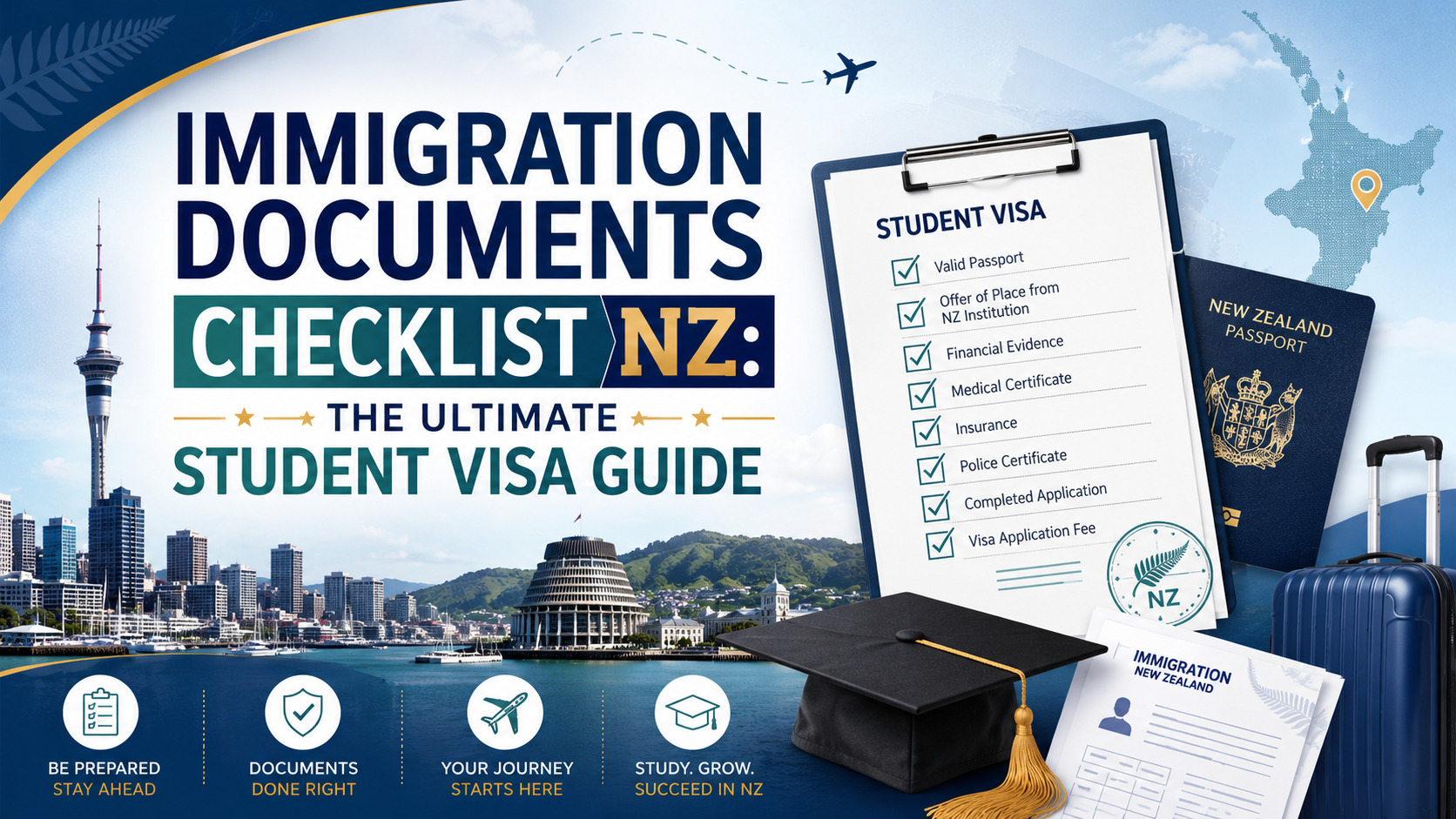
Immigration Documents Checklist NZ: The Ultimate Student Visa Guide

New Zealand, with its world-class education providers, stunning landscapes, and vibrant cities like Auckland and Wellington, remains a premier destination for international students. However, starting your New Zealand study visa documents journey requires meticulous preparation and a clear Immigration Documents Checklist NZ. To transition from an aspiring student to an enrolled scholar, navigating the complex immigration instructions of Immigration New Zealand (INZ) is essential. A single missing document or minor error can lead to a further information request, a stressful student visa interview, or even a declined application. This comprehensive guide provides a detailed Immigration Documents Checklist NZ, ensuring your student visa application is complete, accurate, and positioned for success. Following the right Immigration Documents Checklist NZ also helps reduce delays and gives applicants greater confidence throughout the visa process.

1. Primary Identity and Academic Credentials

The foundation of any New Zealand student visa application lies in establishing your identity and demonstrating your academic readiness  .

Essential Identity Documents

Before you begin uploading files to the online application form, you must compile your primary travel and identity records as part of your Immigration Documents Checklist NZ. Your original passport or a certified attested passport copy is the most critical travel document. You must ensure your passport validity extends for at least three months beyond your intended stay in New Zealand. Additionally, your Immigration Documents Checklist NZ should include recent passport-sized photographs that meet INZ’s strict digital specifications. Preparing these identity documents early helps make your Immigration Documents Checklist NZ more complete, accurate, and ready for smooth visa submission.

Academic and Educational Certificates

Your academic history must demonstrate a clear progression of learning, particularly for positive profile students who possess a good academic record  . You must compile all educational certificates and academic transcripts from your previous studies  .

Qualification Level Required Academic Documents
Secondary School Class 10 certificate and Class 12 certificate showing subjects and grades  .
Tertiary Education Graduation certificate, postgraduate certificate, or diploma certificates  .
Specialized Programs Aviation course documents or marine course documents for technical fields  .

2. Institutional Enrollment and English Language Ability

To secure a student visa, you must first prove that you have been accepted by a recognized institution and possess the language skills to succeed  .

Securing the Offer of Place

Your visa journey officially begins when you receive a formal offer letter from one of the approved New Zealand education providers  . Whether it is a college offer letter or a university offer letter, this document must state the course entry requirement, tuition fee, and course duration  .

  • Offer Letter Processing Time: This varies by institution, so early application is highly recommended .
  • Approved Institutions: The provider must be a signatory to the Education Code of Practice 2021 to ensure international student welfare .
  • Tuition Fee Payment: Once your visa is approved in principle, you must submit the fee receipt as proof of payment before final visa issuance  .

Meeting the English Language Requirement

Demonstrating your English language ability is a core visa lodgement requirement  . Unless you qualify for an exemption—such as having completed prior studies in an English medium teaching environment—you must submit official test scores  .

  • IELTS Score: A common benchmark is a Bachelor IELTS requirement of overall 6.0 (with no band less than 5.5) and a Master IELTS requirement of overall 6.5 (with no band less than 6.0) .
  • TOEFL Score: Equivalent TOEFL score reports are also widely accepted by INZ and education providers .

3. Financial Documentation and Evidence of Funds

Proving you can support yourself financially is often the most scrutinized part of the immigration verification process  .

Demonstrating Living Expenses and Tuition Coverage

You must provide robust evidence of funds to cover your total study expenses, including tuition, living expenses, and travel cost  . Currently, INZ requires students to show they have at least NZD $20,000 per year for living costs, plus funds for a return air ticket cost  .

Acceptable Financial Instruments

INZ accepts a specific range of financial documents to verify your funding  . These must show a regular source of income and a clear source of income for any sponsors  .

  • Bank Statements: Provide active bank statements covering at least the last three to six months  .
  • Fixed Deposits & Savings: Submit certificates for fixed deposits, provident fund accounts, post office accounts, or national saving certificates  .
  • Education Loans: An official education loan sanction letter from a reputable bank is highly regarded  .
  • Guarantor Documents: If family members are funding your studies, you must submit a financial undertaking form, an affidavit of support, and parent income evidence  .

4. Health, Character, and Supporting Evidence

New Zealand maintains strict health and safety standards for all temporary entry visa applicants  .

Meeting Health Requirements

To protect public health, you must undergo a medical examination by approved medical panel doctors  .

  • Chest X-ray: A temporary entry X-ray certificate and radiologist report are required for TB screening if you are from a high-risk country  .
  • Medical Certificate: A full medical certificate and laboratory reports may be required depending on your course duration and country of origin  .

Character and Police Clearances

To satisfy character requirements, applicants aged 17 or older who plan to stay in New Zealand for more than 24 months must provide a police clearance certificate  . These certificates must be original, recently issued, and translated if not in English  .

Statement of Purpose and Bona Fide Intent

An immigration officer assessment focuses heavily on whether you are a bona fide applicant with a genuine temporary stay intent  . You must submit a statement of purpose (SOP), which can be a handwritten SOP  . Your SOP must detail your educational background, your course selection reason, your future study plan, and how this study aligns with your home country commitments  . Proving strong family ties, financial commitments, or employment commitments in your home country helps demonstrate your genuine intent to return after your studies  .

5. The Application Submission and Verification Process

Once your required documents checklist is complete, you can proceed with the formal submission  .

Submitting the Application

You will complete the student visa application form and the supplementary information form online, uploading all study abroad documents in a clear, digital format  . If you receive help from an education agent or adviser, you must declare this using the Student Visa Declaration Form .

  • Visa Application Fees: Pay the required fees via bank draft or online credit card payment .
  • Covering Letter: Include a professional covering letter summarizing your application and attached documents .
  • Work Experience: If you have gaps in your study, submit work experience records, including employment evidence, company address, and company phone number  .

The Verification Phase

During the processing timeframe, INZ will verify your documents  . They may contact your bank, employer, or school for immigration verification  . In some cases, an officer may request a telephonic interview to discuss your application .

  • Approved in Principle (AIP): Once your application is received in principle and assessed positively, you will receive an AIP letter  .
  • Final Visa Issuance: After submitting your tuition fee receipt, your final eVisa will be issued, detailing your student visa validity and student work rights (such as part-time work during study and full-time work during vacation)  .

6. Comparing Family and Temporary Visa Options

While a student visa is a popular pathway, it is important to understand how it fits within the broader spectrum of New Zealand visas  .

Student Visas vs. Other Temporary and Family Pathways

If you are traveling with family, or if your circumstances change (such as entering into an Age Gape Relationship), you may need to explore other family stream visas New Zealand options  .

Visa Type Primary Purpose Key Document Requirement Work Rights
Student Visa  Academic study  Offer of place, evidence of funds   Part-time during study 
Visitor Visa  Tourism or short study  Proof of onward travel, funds  No work rights 
Same Sex Partner Visa  Join a partner in NZ  Relationship evidence, shared life  Full work rights 

By carefully compiling your New Zealand study visa documents, ensuring all translated documents are certified, and applying at least three months in advance, you can navigate the visa processing time with confidence. With guidance from Auckland’s Leading Immigration Consultants, you can begin your educational adventure in New Zealand with greater clarity and peace of mind.