Sponsorship Letter NZ Visa: The Ultimate Guide to Formatting and Templates

Sponsorship Letter NZ Visa: The Ultimate Guide to Formatting and Templates

When applying for a visa to New Zealand, demonstrating financial capacity is one of the most critical steps in securing visa approval. For many applicants, this requirement is met through a financial sponsor who agrees to cover their expenses during their stay. A well-written Sponsorship Letter NZ Visa helps present this financial support clearly by explaining the sponsor’s relationship with the applicant, their ability to cover expenses, and their commitment to supporting the applicant throughout their stay in New Zealand.

Whether you are planning to study abroad, travel abroad, or work abroad, a professionally drafted sponsorship letter for visa is essential to satisfy Immigration New Zealand (INZ). A well-prepared Sponsorship Letter NZ Visa helps clearly explain the sponsor’s financial responsibility, relationship with the applicant, and commitment to supporting the applicant during their stay in New Zealand.

This comprehensive guide provides sponsor-document guidance, details the exact sponsorship letter format, and offers a practical sponsorship letter template to ensure your visa application process is seamless and successful. By following the right Sponsorship Letter NZ Visa structure, applicants can present their financial support details more clearly and reduce the chances of missing important information.

A strong Sponsorship Letter NZ Visa also supports your overall application by showing that your accommodation, living expenses, travel costs, and other financial needs are properly covered.

1. Understanding New Zealand’s Sponsorship Framework

Not everyone can act as a visa sponsor for New Zealand, and understanding the legal framework is crucial before drafting a visa sponsorship letter  .

Who Can Sponsor a Visa Applicant?

INZ maintains strict criteria regarding who is eligible to sponsor a visa applicant . An acceptable sponsor must fall into one of the following categories:

  • Citizen Sponsor: A New Zealand citizen who resides in the country .
  • Permanent Resident Sponsor: A New Zealand resident whose visa has no travel restrictions and who lives in New Zealand .
  • Registered Organisation: A company registered in New Zealand, an incorporated society, or a charitable trust .
  • Government Agency: A tertiary education provider, a school’s board of trustees, or a community organisation .

Legal and Financial Responsibilities

When an individual or organisation agrees to sponsor you, they assume full financial responsibility for your stay  . They must guarantee that you will not rely on New Zealand public funds  . The sponsor is legally obligated to cover all your living expenses, accommodation expenses, travel expenses, medical insurance, and tuition fees if applicable  .

2. Essential Components of a Sponsorship Letter

A sponsorship letter for visa must be a typed letter written in a formal tone . It must be a clear and concise letter in English, containing specific details that visa officers at the embassy, consulate, or immigration officer can verify .

Key Details to Include

Every professional sponsorship letter format must incorporate the following essential elements:

Category Required Information
Sponsor’s Personal Details Full name, residential address, contact information, and New Zealand citizenship/residency status  .
Applicant’s Information Full name, passport number, date of birth, and relationship with sponsor .
Trip Details Purpose of visit, reason for visit, intended travel dates, and duration of stay .
Financial Details A clear declaration of financial support, specifying which expenses are covered (e.g., food expenses, rent expenses, transportation expenses, clothing expenses)  .

3. The Official INZ Sponsorship Forms

While a personal sponsorship letter sample is highly recommended to explain the context of your relationship, INZ also requires official sponsorship forms depending on your visa category .

INZ 1025: Sponsorship Form for Temporary Entry

For temporary visas such as a student visa, tourist visa, or family visit visa, the sponsor must complete the Sponsorship Form for Temporary Entry (INZ 1025) . This form acts as a formal sponsor declaration of financial capacity and commitment to support you during your stay .

  • Online Process: Modern online applications utilize a “Sharing ID” system . Your sponsor logs into Immigration Online using RealMe, finds their sharing ID, and sends it to you . You enter this ID in your application, and INZ emails the sponsor to complete the online form .
  • PDF Process: If applying on paper or via certain portals, the sponsor must physically or electronically sign the INZ 1025 PDF form, which you upload with your application .

4. Drafting the Sponsorship Letter: Format and Templates

A personal sponsorship letter template should accompany the official INZ forms to provide a narrative for your visa application . Below are standard templates for different sponsorship scenarios .

Student Sponsorship Letter Template

This format is ideal for a family member sponsor supporting an international student .

[Sponsor’s Name]

[Sponsor’s New Zealand Address]

[Sponsor’s Phone Number]

[Sponsor’s Email Address]

[Date of Letter]To Whom It May Concern / Respected Sir or Madam,Subject: Financial Sponsorship for [Applicant’s Full Name] – Passport No: [Applicant’s Passport Number]I am writing to confirm my financial sponsorship of my [Relationship, e.g., niece], [Applicant’s Full Name], who has been accepted to study at [Educational Institution] in New Zealand  .As a [New Zealand Citizen / Resident], I am fully aware of my financial responsibility . I guarantee that I have the financial capacity and proof of financial capability to cover all her expenses, including tuition fees, accommodation expenses, living expenses, and transportation expenses, ensuring she does not require access to public funds  .Enclosed with this letter are my bank statements for visa nz showing a consistent banking history, my employment agreement, and my completed INZ 1025 form  .Sincerely,[Sponsor’s Signature][Sponsor’s Typed Name]

General and Company Sponsorship Letter Templates

For business travel, an employer sponsor, event sponsor, conference sponsor, or educational exchange program coordinator should issue a company sponsorship letter . This letter must be printed on official company letterhead and signed by an authorized representative, detailing the business purpose of the trip and confirming that the company will cover all travel and accommodation costs .

5. Supporting Documents and Proof of Financial Capacity

A sponsorship letter for visa is only as strong as the supporting documents that accompany it  . You must provide robust proof of funds to satisfy visa requirements and visa conditions  .

Mandatory Financial Evidence

Your sponsor must supply concrete evidence of their financial capacity to support your stay .

  • Bank Statements: Provide official bank statements covering at least the last 3 to 6 months.
  • Income Verification: Submit recent pay slips, tax certificates, or business registration documents.
  • Employment Proof: Include an employment agreement or a letter from the sponsor’s employer confirming their salary and position .
  • Accommodation Proof: Provide property ownership deeds or rental agreements if the sponsor is providing housing .

6. Comparison of Sponsorship Requirements Across Visa Types

Sponsorship rules and forms vary depending on the destination country and the specific visa type you are applying for .

New Zealand vs. Other Major Visa Destinations

While New Zealand uses the INZ 1025 form and a RealMe sharing ID, other countries have distinct processes .

Destination Country Primary Sponsorship Document Key Financial Requirement
New Zealand  INZ 1025 Form + Personal Letter  Bank statements for visa nz (3-6 months)  
Schengen Area Official Declaration of Sponsorship Proof of daily living allowance per country
United Kingdom Letter of Invitation + Financial Support Letter Active bank statements (28-day rule)
Canada Statutory Declaration of Progress Proof of tuition + GIC (Guaranteed Investment Certificate)

By ensuring your sponsor provides accurate information, completes the required INZ forms, and drafts a professional sponsorship letter for visa backed by solid bank statements for visa nz, you can confidently submit your application and secure your visa to New Zealand   .
Bank Statements for Visa NZ: Proving Financial Capacity for Student Visas

New Zealand is globally renowned for offering high-quality education, a safe and organised environment, extensive international student support, and excellent graduate opportunities. For international students, including Kenyan students and those from across Asia and the Americas, securing a New Zealand student visa is the gateway to this balanced lifestyle. However, the key to a successful student visa preparation process is meeting the financial or “funds” requirement set by Immigration New Zealand (INZ). Understanding Bank Statements for Visa NZ is important because your financial records must clearly show that you can cover tuition fees, living expenses, accommodation, and other study-related costs. Demonstrating financial credibility, financial clarity, and financial sustainability through your bank statement New Zealand submission is critical for visa approval. This comprehensive guide on Bank Statements for Visa NZ provides visa-readiness guidance to help you build a compelling financial story and navigate the New Zealand student visa proof of funds requirements. By preparing Bank Statements for Visa NZ correctly, students can reduce application risks, avoid unclear documentation, and strengthen their overall visa submission.

1. Understanding the Core Financial Requirements

Before diving into the paperwork, you must understand how much money for New Zealand student visa is required to satisfy INZ’s yearly living-fund expectations  .

Minimum Living Cost Benchmarks : Bank Statements for Visa NZ

INZ sets strict minimum benchmarks for living funds that students must have accessible . These benchmarks vary based on the level of study and the duration of your program .

Study Level Minimum Living Funds (1 Year or More) Monthly Living-Fund Expectations
Tertiary Study NZD $20,000 per year  NZD $1,667 per month 
School Study (Years 1-13) NZD $17,000 per year  NZD $1,417 per month 

Prepaid Accommodation and Deductions

If you have already paid for your housing, such as university halls or a homestay service, these prepaid accommodation or prepaid housing costs can be deducted from your required living funds. For example, if you have prepaid NZD $5,000 to your education provider for housing, your remaining living-cost support requirement is reduced accordingly. When preparing Bank Statements for Visa NZ, it is important to clearly show both your available funds and any prepaid accommodation payments that support your application. You must provide official receipts from the institution to claim this deduction. Strong documentation for Bank Statements for Visa NZ helps Immigration New Zealand understand your financial position more clearly. By organising receipts, payment confirmations, and Bank Statements for Visa NZ together, students can present a stronger and more credible proof of funds submission.

2. Structuring Your First-Year Study Budget

A realistic first-year budget is the cornerstone of effective visa planning and long-term study planning  . Your financial plan must account for several distinct expense categories beyond tuition  .

Accommodation and Setup Costs

When planning your New Zealand study budget, you must factor in immediate, upfront expenses .

  • Accommodation Deposits: Most rental agreements require a bond equivalent to 2-4 weeks of monthly rent in advance .
  • First-Month Setup Costs: You will need immediate funds for utility connections, household essentials, and initial food and transport expenses .
  • Travel Costs: You must show proof of outward travel costs by either presenting a fully paid return air ticket or holding an additional NZD $2,000 in your account .

Insurance and Emergency Buffers

A realistic study budget must include a financial buffer to protect against inflation and unexpected costs .

  • Medical Insurance: Comprehensive medical and travel insurance is a mandatory visa condition for international students in New Zealand .
  • Emergency Funds: Maintaining emergency support or emergency funds ensures you can handle unexpected medical needs, dental care, or urgent travel without disrupting your studies .
  • Exchange Rate Movements: Since currencies fluctuate, your budget planning should account for shifts in the NZD exchange rate to ensure you maintain New Zealand affordability .

3. Acceptable Financial Documents and Primary Evidence

To prove your proof of funds New Zealand, you must submit specific financial documents that INZ can easily verify .

Bank Statements and Transaction History

Your New Zealand student visa bank statement is the most critical piece of primary evidence .

  • Transaction History: You must provide official bank statements showing at least the last 3 to 6 months of complete transaction history .
  • Account Ownership: The statements must clearly display the account holder’s name and account number .
  • Accessible Funds: The funds must be held in liquid savings accounts, demonstrating they are genuinely available for you to access .

Alternative Primary Evidence

In addition to standard savings accounts, INZ accepts several other secure funding methods .

  • Fixed Deposits: Fixed-term deposit certificates are accepted, provided they have been held for at least 3 months prior to application .
  • Education Loans: An official education loan sanction letter or disbursal letter from a nationalised or multinational bank is highly regarded .
  • Provident Funds: Evidence of withdrawable provident funds, supported by employment records, can serve as primary proof .
  • Scholarships: An official scholarship award letter detailing the funding amount and duration is fully accepted .

4. Sponsor Documents and Financial Credibility

Many international students rely on parent sponsorship or broader family support to fund their education .

Sponsor-Document Guidance and Relationships

If you are using a sponsor, you must provide clear sponsor-document guidance to demonstrate a credible relationship .

  • Relationship Proof: INZ assesses the strength of your relationship with your sponsor . Parents and close relatives are considered highly credible sponsors .
  • Financial Undertaking: Sponsors outside New Zealand must complete the Financial Undertaking for a Student form (INZ 1014) .
  • Sponsorship Form: Sponsors residing in New Zealand must complete the Sponsorship Form for Temporary Entry (INZ 1025) .

Proving the Source of Funds

INZ scrutinizes bank statements for a consistent banking history .

  • Income Consistency: Your sponsor must show a stable, verifiable source of funds, such as regular salary deposits or business income .
  • Sudden Unexplained Deposits: Large, sudden cash injections (typically over NZD $2,000) without clear supporting documents are major red flags .
  • Supporting Income Proof: To validate deposits, submit tax returns, payslips, business registration documents, or property rental agreements .

5. Navigating the Funds Transfer Scheme (FTS)

For students from specific countries, the Funds Transfer Scheme (FTS) offers a secure pathway to meet New Zealand student visa financial requirements .

How the FTS Works

The FTS is an initiative run by INZ in partnership with ANZ Bank New Zealand . It is designed for students from countries such as China, India, Nepal, the Philippines, Sri Lanka, and Vietnam .

  • Fund Transfer: You transfer your required living funds (e.g., NZD $20,000) into a secure ANZ Bank account in New Zealand before your visa is granted .
  • Monthly Release: Once you arrive in New Zealand, the funds are locked and released to you in monthly instalments (approximately NZD $1,667 per month) to cover your living costs .

Benefits of Using the FTS

Using the FTS provides several advantages for your application .

  • Guaranteed Accessibility: It proves to INZ that your living funds are genuinely available and cannot be withdrawn by sponsors once you arrive .
  • Simplified Verification: It reduces the need for extensive secondary verification of bank accounts, speeding up the visa approval process .
  • AIP Option: FTS is frequently used in conjunction with the Approval in Principle (AIP) pathway, allowing you to secure visa approval before transferring funds .

6. Avoiding Common Financial Mistakes

Understanding the immigration documents checklist nz requirements helps you avoid common pitfalls that lead to visa delays or declines  .

Financial Presentation and Red Flags

INZ officers are trained to identify inconsistencies in financial submissions .

Common Mistake Why It Leads to Delay/Decline How to Avoid It
Sudden Deposits Suggests “borrowed” funds for visa purposes . Provide tax returns, payslips, or asset sale deeds to explain deposits .
Old Bank Statements Fails to show current financial status . Ensure statements are up-to-date and dated close to visa submission .
Inconsistent Documents Discrepancies between loan letters and bank accounts . Double-check that all figures, names, and account numbers match perfectly .
Unclear Sponsor Ties Distant relatives acting as sponsors . Use immediate family or provide a detailed explanation of the sponsor relationship .

By carefully compiling your New Zealand financial documents, maintaining a stable bank history, and presenting a transparent financial story, you can confidently submit your application and begin your journey toward a world-class New Zealand education  .

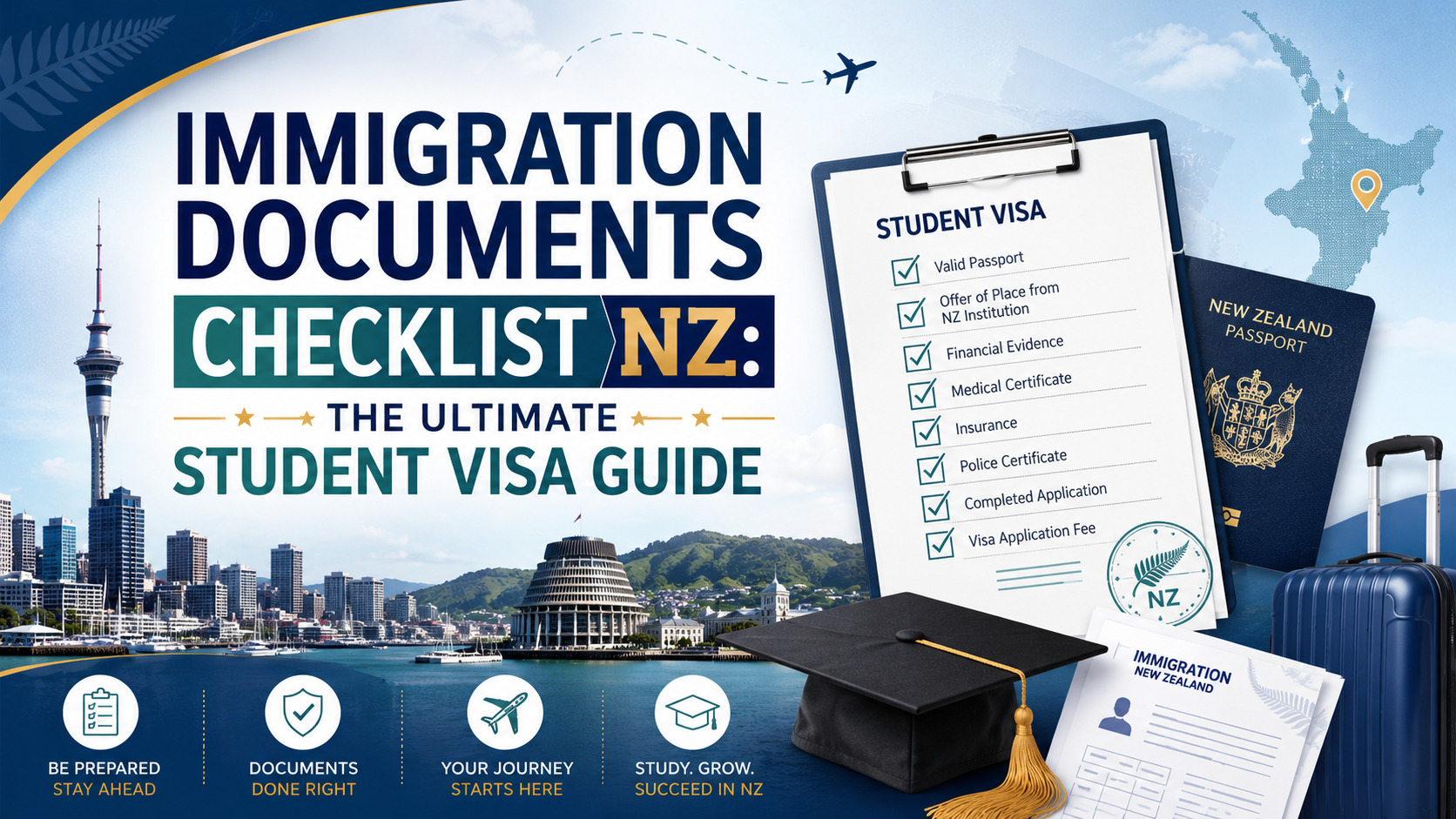
Immigration Documents Checklist NZ: The Ultimate Student Visa Guide

New Zealand, with its world-class education providers, stunning landscapes, and vibrant cities like Auckland and Wellington, remains a premier destination for international students. However, starting your New Zealand study visa documents journey requires meticulous preparation and a clear Immigration Documents Checklist NZ. To transition from an aspiring student to an enrolled scholar, navigating the complex immigration instructions of Immigration New Zealand (INZ) is essential. A single missing document or minor error can lead to a further information request, a stressful student visa interview, or even a declined application. This comprehensive guide provides a detailed Immigration Documents Checklist NZ, ensuring your student visa application is complete, accurate, and positioned for success. Following the right Immigration Documents Checklist NZ also helps reduce delays and gives applicants greater confidence throughout the visa process.

1. Primary Identity and Academic Credentials

The foundation of any New Zealand student visa application lies in establishing your identity and demonstrating your academic readiness  .

Essential Identity Documents

Before you begin uploading files to the online application form, you must compile your primary travel and identity records as part of your Immigration Documents Checklist NZ. Your original passport or a certified attested passport copy is the most critical travel document. You must ensure your passport validity extends for at least three months beyond your intended stay in New Zealand. Additionally, your Immigration Documents Checklist NZ should include recent passport-sized photographs that meet INZ’s strict digital specifications. Preparing these identity documents early helps make your Immigration Documents Checklist NZ more complete, accurate, and ready for smooth visa submission.

Academic and Educational Certificates

Your academic history must demonstrate a clear progression of learning, particularly for positive profile students who possess a good academic record  . You must compile all educational certificates and academic transcripts from your previous studies  .

Qualification Level Required Academic Documents
Secondary School Class 10 certificate and Class 12 certificate showing subjects and grades  .
Tertiary Education Graduation certificate, postgraduate certificate, or diploma certificates  .
Specialized Programs Aviation course documents or marine course documents for technical fields  .

2. Institutional Enrollment and English Language Ability

To secure a student visa, you must first prove that you have been accepted by a recognized institution and possess the language skills to succeed  .

Securing the Offer of Place

Your visa journey officially begins when you receive a formal offer letter from one of the approved New Zealand education providers  . Whether it is a college offer letter or a university offer letter, this document must state the course entry requirement, tuition fee, and course duration  .

  • Offer Letter Processing Time: This varies by institution, so early application is highly recommended .
  • Approved Institutions: The provider must be a signatory to the Education Code of Practice 2021 to ensure international student welfare .
  • Tuition Fee Payment: Once your visa is approved in principle, you must submit the fee receipt as proof of payment before final visa issuance  .

Meeting the English Language Requirement

Demonstrating your English language ability is a core visa lodgement requirement  . Unless you qualify for an exemption—such as having completed prior studies in an English medium teaching environment—you must submit official test scores  .

  • IELTS Score: A common benchmark is a Bachelor IELTS requirement of overall 6.0 (with no band less than 5.5) and a Master IELTS requirement of overall 6.5 (with no band less than 6.0) .
  • TOEFL Score: Equivalent TOEFL score reports are also widely accepted by INZ and education providers .

3. Financial Documentation and Evidence of Funds

Proving you can support yourself financially is often the most scrutinized part of the immigration verification process  .

Demonstrating Living Expenses and Tuition Coverage

You must provide robust evidence of funds to cover your total study expenses, including tuition, living expenses, and travel cost  . Currently, INZ requires students to show they have at least NZD $20,000 per year for living costs, plus funds for a return air ticket cost  .

Acceptable Financial Instruments

INZ accepts a specific range of financial documents to verify your funding  . These must show a regular source of income and a clear source of income for any sponsors  .

  • Bank Statements: Provide active bank statements covering at least the last three to six months  .
  • Fixed Deposits & Savings: Submit certificates for fixed deposits, provident fund accounts, post office accounts, or national saving certificates  .
  • Education Loans: An official education loan sanction letter from a reputable bank is highly regarded  .
  • Guarantor Documents: If family members are funding your studies, you must submit a financial undertaking form, an affidavit of support, and parent income evidence  .

4. Health, Character, and Supporting Evidence

New Zealand maintains strict health and safety standards for all temporary entry visa applicants  .

Meeting Health Requirements

To protect public health, you must undergo a medical examination by approved medical panel doctors  .

  • Chest X-ray: A temporary entry X-ray certificate and radiologist report are required for TB screening if you are from a high-risk country  .
  • Medical Certificate: A full medical certificate and laboratory reports may be required depending on your course duration and country of origin  .

Character and Police Clearances

To satisfy character requirements, applicants aged 17 or older who plan to stay in New Zealand for more than 24 months must provide a police clearance certificate  . These certificates must be original, recently issued, and translated if not in English  .

Statement of Purpose and Bona Fide Intent

An immigration officer assessment focuses heavily on whether you are a bona fide applicant with a genuine temporary stay intent  . You must submit a statement of purpose (SOP), which can be a handwritten SOP  . Your SOP must detail your educational background, your course selection reason, your future study plan, and how this study aligns with your home country commitments  . Proving strong family ties, financial commitments, or employment commitments in your home country helps demonstrate your genuine intent to return after your studies  .

5. The Application Submission and Verification Process

Once your required documents checklist is complete, you can proceed with the formal submission  .

Submitting the Application

You will complete the student visa application form and the supplementary information form online, uploading all study abroad documents in a clear, digital format  . If you receive help from an education agent or adviser, you must declare this using the Student Visa Declaration Form .

  • Visa Application Fees: Pay the required fees via bank draft or online credit card payment .
  • Covering Letter: Include a professional covering letter summarizing your application and attached documents .
  • Work Experience: If you have gaps in your study, submit work experience records, including employment evidence, company address, and company phone number  .

The Verification Phase

During the processing timeframe, INZ will verify your documents  . They may contact your bank, employer, or school for immigration verification  . In some cases, an officer may request a telephonic interview to discuss your application .

  • Approved in Principle (AIP): Once your application is received in principle and assessed positively, you will receive an AIP letter  .
  • Final Visa Issuance: After submitting your tuition fee receipt, your final eVisa will be issued, detailing your student visa validity and student work rights (such as part-time work during study and full-time work during vacation)  .

6. Comparing Family and Temporary Visa Options

While a student visa is a popular pathway, it is important to understand how it fits within the broader spectrum of New Zealand visas  .

Student Visas vs. Other Temporary and Family Pathways

If you are traveling with family, or if your circumstances change (such as entering into an Age Gape Relationship), you may need to explore other family stream visas New Zealand options  .

Visa Type Primary Purpose Key Document Requirement Work Rights
Student Visa  Academic study  Offer of place, evidence of funds   Part-time during study 
Visitor Visa  Tourism or short study  Proof of onward travel, funds  No work rights 
Same Sex Partner Visa  Join a partner in NZ  Relationship evidence, shared life  Full work rights 

By carefully compiling your New Zealand study visa documents, ensuring all translated documents are certified, and applying at least three months in advance, you can navigate the visa processing time with confidence. With guidance from Auckland’s Leading Immigration Consultants, you can begin your educational adventure in New Zealand with greater clarity and peace of mind.

Age Gap Relationship Visa NZ: Navigating Partnership Visas and Scrutiny

Love knows no boundaries, and in modern society, relationships with significant age differences are increasingly common  . However, when it comes to New Zealand immigration, couples in an age gap relationship often face unique hurdles and intense scrutiny from Immigration New Zealand (INZ)   . While there is no legal maximum age difference under NZ immigration law, proving that a relationship is a genuine relationship and a stable relationship becomes significantly more challenging when a large age difference exists   . This comprehensive guide explores how to navigate the Age Gap Relationship Visa pathway, compile compelling relationship evidence, and overcome visa challenges to secure your future in New Zealand   .

1. The Legal Reality: Age Gaps and NZ Immigration Law

New Zealand’s immigration system is designed to be fair and non-discriminatory, yet certain relationship dynamics naturally attract closer inspection   .

No Legal Barrier, But High Scrutiny

Under INZ partnership visa instructions, there is no maximum age gap that legally disqualifies a couple applying for an Age Gap Relationship Visa NZ. The minimum age requirement is simply that both partners must be 18 or older, or 16–17 with parental consent.

Technically, an immigration decision cannot be legally based solely on the existence of an age gap. However, in practice, Age Gap Relationship Visa NZ applications may face heightened verification, as INZ officers often look closely for any sign that the relationship might be transactional or primarily for immigration purposes.

For this reason, couples preparing an Age Gap Relationship Visa NZ application should focus on strong relationship evidence, clear communication history, shared responsibilities, and proof that the partnership is genuine, stable, and built on real long-term commitment.

Real-World Precedents: The 40-Year Age Gap Case

The reality of these hard immigration cases is well-documented  . A famous NZ Herald article highlighted the battle of Balwinder Singh, a 24-year-old Indian national, and his 61-year-old New Zealander wife, Glyn Kessell-Singh  . Despite a 40-year age gap, the couple fought a three-year battle against INZ to prove their love is true  .

“This may have been a more challenging decision than many for Immigration NZ, because in our society, it is unusual for an older woman to marry a substantially younger man.” 

This landmark case, supported by professional representation, proved that when a relationship is genuine, even the most extreme age differences can secure visa approval  .

2. Navigating Cultural Sensitivities and Relationship Challenges

Age gap relationships, particularly those that are also cross-cultural relationships, require a deep understanding of both societal attitudes and immigration policies  .

Societal Attitudes and Gender Dynamics

Societal norms often influence how relationships are perceived . While society is generally more accepting of an older man with a younger partner, relationships involving an older woman younger man or a substantially younger partner often face greater skepticism . This societal bias can unconsciously affect how an immigration officer reviews a file, making it essential to present an airtight case that addresses these underlying doubts head-on .

Addressing Cross-Cultural Complexities

When an age gap is combined with different cultural backgrounds, the complexity multiplies . INZ will look closely at whether the couple shares a common language, understands each other’s cultural customs, and has integrated into each other’s families  . Proving that your relationship has overcome these cultural sensitivities is key to a successful partnership visa application  .

3. Compiling Compelling Relationship Evidence

The success of an Age Gap Relationship Visa application hinges entirely on the quality and depth of the relationship evidence provided  .

Shared Domestic Life and Financial Interdependence

INZ wants to see a documented paper trail of a long-term relationship and a shared daily life  . You must prove that you are living together and share financial responsibilities  .

Evidence Category Essential Documentation
Shared Residence Joint tenancy agreements, joint mortgages, utility bills (electricity, water, internet) addressed to both partners  .
Financial Integration Active joint bank accounts showing daily household transactions (groceries, rent), joint assets, or shared insurance policies  .
Public Recognition Letters of support from family, friends, and community leaders confirming the relationship is genuine and widely recognized  .

Documenting the Relationship History

For age gap couples, providing a detailed timeline of how the relationship developed is crucial  .

  • Development of Love: Provide a written narrative explaining how you met, what attracted you to each other, and how you navigated the age difference  .
  • Communication Records: Submit chat logs, emails, and social media conversations showing continuous, deep communication over a significant duration  .
  • Shared Activities: Include photographs together across different time periods, travel itineraries, and joint activity receipts.

4. Temporary vs. Residence Pathways: Managing the Journey

Navigating the New Zealand immigration visas process is a multi-stage journey, requiring strategic planning at every step  .

Temporary Visas: Visitor, Student, and Work Visas

For many couples, the journey begins with a temporary entry pathway, such as a visitor visa, student visa, or a work visa based on partnership  . These temporary visas allow the couple to live together in New Zealand and build the necessary cohabitation history  . During this phase, couples must be diligent in documenting their shared life, as any gaps in evidence can lead to major immigration problems later  .

Transitioning to a Residence Visa

The ultimate goal for most couples is a residence visa, which requires a minimum of 12 months of continuous cohabitation in New Zealand  .

  • 12 Months Cohabitation: You must prove you have lived together in a genuine and stable relationship for at least one full year at the time of application  .
  • No Room for Gaps: Any periods of separation must be fully explained with valid reasons, showing that the relationship was actively maintained during the separation  .
  • Indefinite Stay: Once approved, the residence visa grants the right to live, work, and study in New Zealand indefinitely .

5. Overcoming Rejections, Appeals, and Deportation Risks

Because of the intense scrutiny, age gap applications have a higher risk of being declined, making professional guidance essential  .

The Role of Independent Immigration Advice

If your relationship is deemed not genuine, INZ may decline your application, which can lead to severe consequences, including deportation or deportation liability  . To avoid these devastating outcomes, seeking independent immigration advice early in the process is highly recommended . A licensed immigration adviser or immigration lawyer can identify potential red flags in your application and help you address them before submission .

Appeals and the Immigration and Protection Tribunal

If your application is declined, you have legal avenues to challenge the decision .

  • Reconsideration: For temporary visas, you can request a formal reconsideration of the decision .
  • Appeals: For residence visas, you can lodge an appeal with the Immigration and Protection Tribunal (IPT) .
  • Specialist Legal Help: An Auckland immigration lawyer, such as the specialists at Laurent Law, can represent you before the tribunal, presenting your case with the legal precision required for hard immigration cases .

6. Comparing Family Stream Visas New Zealand Options

New Zealand offers several family visas New Zealand options to support diverse family structures   .

Partnership Visas vs. Other Family Pathways

While partnership visas are designed for romantic unions—including a same sex partner or couples with large age gaps—other family visas support parents and children   .

Visa Category Primary Focus Key Requirement Pathway
Partnership Visa  Spouses, civil union, and de facto partners  Genuine and stable relationship, cohabitation   Temporary Work Visa ➔ Residence Visa  
Same Sex Partner Visa  LGBTQ+ couples  Equal standards, same sex partner recognition   Temporary Work Visa ➔ Residence Visa  
Parent Resident Visa  Parents of NZ citizens/residents  Sponsoring child’s income, annual quota  Direct Residence 

By understanding these family visas options, compiling robust evidence, and seeking independent immigration advice, age gap couples can successfully navigate the immigration process and secure their future together in New Zealand.

Same Sex Partner Visa NZ: A Comprehensive Guide to Equality and Partnership Visas

New Zealand is globally recognized for its progressive stance on human rights, marriage equality, and social inclusivity. Under the country’s immigration framework, Same Sex Partner Visa NZ applications are assessed with absolute equality, ensuring that a same sex partner enjoys the exact same legal rights, processing standards, and pathways to residency as opposite-sex couples. Immigration New Zealand (INZ) operates under strict immigration instructions that forbid discrimination based on gender or sexual orientation. Whether you are in a legal marriage, a civil union, or a de facto relationship, the path to securing a visa based on partnership is open and equitable. This comprehensive guide provides a detailed roadmap for same-sex couples navigating the Same Sex Partner Visa NZ process, from eligibility and evidence requirements to partnership assessment and residency options. For couples planning their future together, understanding Same Sex Partner Visa NZ requirements can make the application journey clearer, fairer, and more confident.

1. The Legal Framework: Absolute Equality in NZ Immigration

New Zealand’s commitment to equality is deeply embedded in its legislative and immigration structures, providing a safe and welcoming environment for LGBTQ+ couples  .

Equal Recognition Under INZ Instructions

When assessing Same Sex Partner Visa NZ applications, an immigration officer is bound by immigration instructions to treat all couples equally, regardless of whether they are opposite or same sex. The gender composition of the relationship is never a factor in determining eligibility. The core focus of the assessment is purely whether the couple is living together in a genuine and stable partnership. For this reason, Same Sex Partner Visa NZ applicants must provide strong evidence that clearly shows shared residence, commitment, emotional connection, and an ongoing relationship. With proper documentation, the Same Sex Partner Visa NZ pathway gives same-sex couples a fair and equal opportunity to build their future in New Zealand.

Recognized Relationship Types

New Zealand law recognizes three distinct relationship structures for immigration purposes, offering flexibility to couples from different cultural or legal backgrounds .

  • Legal Marriage: Same-sex marriage has been fully legal in New Zealand since 2013 . Couples married in New Zealand or in any jurisdiction that legally recognizes same-sex marriage can use their marriage certificate as primary evidence .
  • Civil Union: A civil union certificate from New Zealand or an equivalent overseas civil union is fully recognized .
  • De Facto Relationship: For couples who are not legally married, a de facto relationship is fully recognized  . This is particularly crucial for same-sex couples from countries where marriage equality is not yet legally established  .

2. Proving Your Shared Life: The Core Evidence Standards

To secure a partnership visa, couples must move beyond love letters and provide a comprehensive paper trail demonstrating a shared daily life  .

Shared Residence and Cohabitation Evidence

The most critical requirement for any partnership visa is proving that you are living together in a shared home  . INZ requires concrete cohabitation evidence to verify that you share a domestic life  .

Evidence Category Acceptable Documents and Proof
Housing & Tenancy Tenancy agreements, a rent book, a joint mortgage, or property deeds listing both names  .
Utility Accounts Joint utilities accounts or individual bills (electricity, water, internet) addressed to both partners at the shared residence  .
Official Correspondence Correspondence at same address, including postmarked envelopes, letters from government agencies, or bank statements  .

Financial Interdependence and Shared Income

A credible relationship must demonstrate financial integration  . Couples should show that they share financial responsibilities and are not merely flatmates  .

  • Joint Bank Accounts: Maintain active joint bank accounts showing regular transactions for daily living expenses, such as groceries, rent, and utility bills  .
  • Money Transfers: Document regular money transfers between individual accounts, indicating mutual financial support  .
  • Assets Owned Together: Provide proof of joint ownership of major assets, such as vehicles, household appliances, or shared insurance policies  .

3. Qualitative Evidence and Public Recognition

While financial and housing documents form the backbone of an application, INZ also looks for qualitative proof of a committed, long-term relationship  .

Social and Public Recognition

A genuine relationship is one that is recognized by family, friends, and the wider community  .

  • Family Recognition: Submit birth certificates of children (if applicable) or letters of support from family members acknowledging the relationship  .
  • Public Recognition: Provide photographs together at social events, family gatherings, and holidays, showing a consistent duration of relationship .
  • Community Support: Include letters from friends, employers, or community leaders testifying to the stable nature of your partnership .

Evidence of Communication and Shared Activities

For periods when you were not physically cohabiting, you must demonstrate how the relationship was maintained  .

  • Communication Records: Provide evidence of communication, including emails, social media conversations, and chat logs showing regular contact  .
  • Shared Travel: Submit shared travel itineraries, hotel bookings, and tickets from shared activities or concerts that you attended together  .
  • Personal Correspondence: Include cards and letters exchanged during special occasions or periods of separation  .

4. Temporary vs. Residence Partnership Visas

The New Zealand partnership pathway typically involves two stages, moving from a temporary work visa to permanent residency  .

Temporary Partnership Visas

For couples who have been living together for less than 12 months, the temporary visa (Partner of a New Zealander Work Visa) is the standard starting point  . This visa allows the applicant to live and work in New Zealand while building the necessary cohabitation history required for residency  . The supporting partner must formally sponsor the application and meet character and financial requirements  .

Residence Partnership Visas

To qualify for a residence visa based on partnership, the couple must demonstrate a minimum 12 months living together in a genuine and stable partnership .


  • Continuous Cohabitation: The 12-month period must be continuous, though brief periods of separation are permitted if there are valid reasons for separation (such as work commitments or family emergencies)  .
  • Maintaining the Bond: You must provide evidence that the relationship was actively maintained during any separation through communication logs and financial support.
  • Pathway to Permanent Residence: Once approved, the residence visa allows the partner to live, work, and study indefinitely, with a path to a Permanent Resident Visa after two years .

5. Verification, Interviews, and Fraud Prevention

Because partnership visas grant significant rights, INZ subjects partnership application files to rigorous verification to prevent immigration fraud  .

The Verification Process

An immigration officer may conduct a thorough verification of information to ensure the relationship is not for immigration purposes  . This process can include:

  • Interviews: Conducting an interview applicant and partner separately to cross-reference details of their shared life  .
  • Home Visits: Making an unannounced visit to the couple at their registered address to verify they are actively cohabiting  .
  • Previous Relationships: Checking divorce documents or records of previous relationships to ensure both partners are legally free to enter the current partnership  .

Dealing with Declines and Appeals

Providing false and misleading information or entering into fraudulent relationships will result in a declined visa application and potential deportation  . If an application is declined, couples have legal recourse  .

  • Temporary Visa Reconsideration: For temporary visas, applicants can request a formal reconsideration of the decision  .
  • Residence Visa Appeal: For residence visas, couples can lodge a formal appeal with the Immigration and Protection Tribunal (IPT)  .

6. Comparing Family Stream Visas New Zealand Options

New Zealand offers a range of family reunification pathways, each with its own strict eligibility criteria  .

Partnership Visas vs. Parent and Skilled Pathways

While partnership visas focus on romantic unions, other pathways support different family dynamics, such as parents or skilled migrants  . Understanding how these visas compare is essential for comprehensive immigration planning  .

Visa Category Primary Focus Key Eligibility Criteria Duration & Rights
Partnership Visa  Spouses, civil union, and de facto partners  Genuine and stable relationship, cohabitation   Indefinite (Residence) or 1-3 years (Work)  
Parent Resident Visa  Parents of NZ citizens/residents  parents resident visa NZ eligibility, adult child sponsor  Indefinite; live, work, and study 
Arranged Marriage Visa  Traditional arranged matches  arranged marriage proof nz, cultural tradition  3-month visitor visa; transitions to partnership  

By understanding these distinctions, compiling robust evidence of partnership, and demonstrating a degree of commitment to a shared life, same-sex couples can confidently navigate the New Zealand immigration system and secure their future together  .

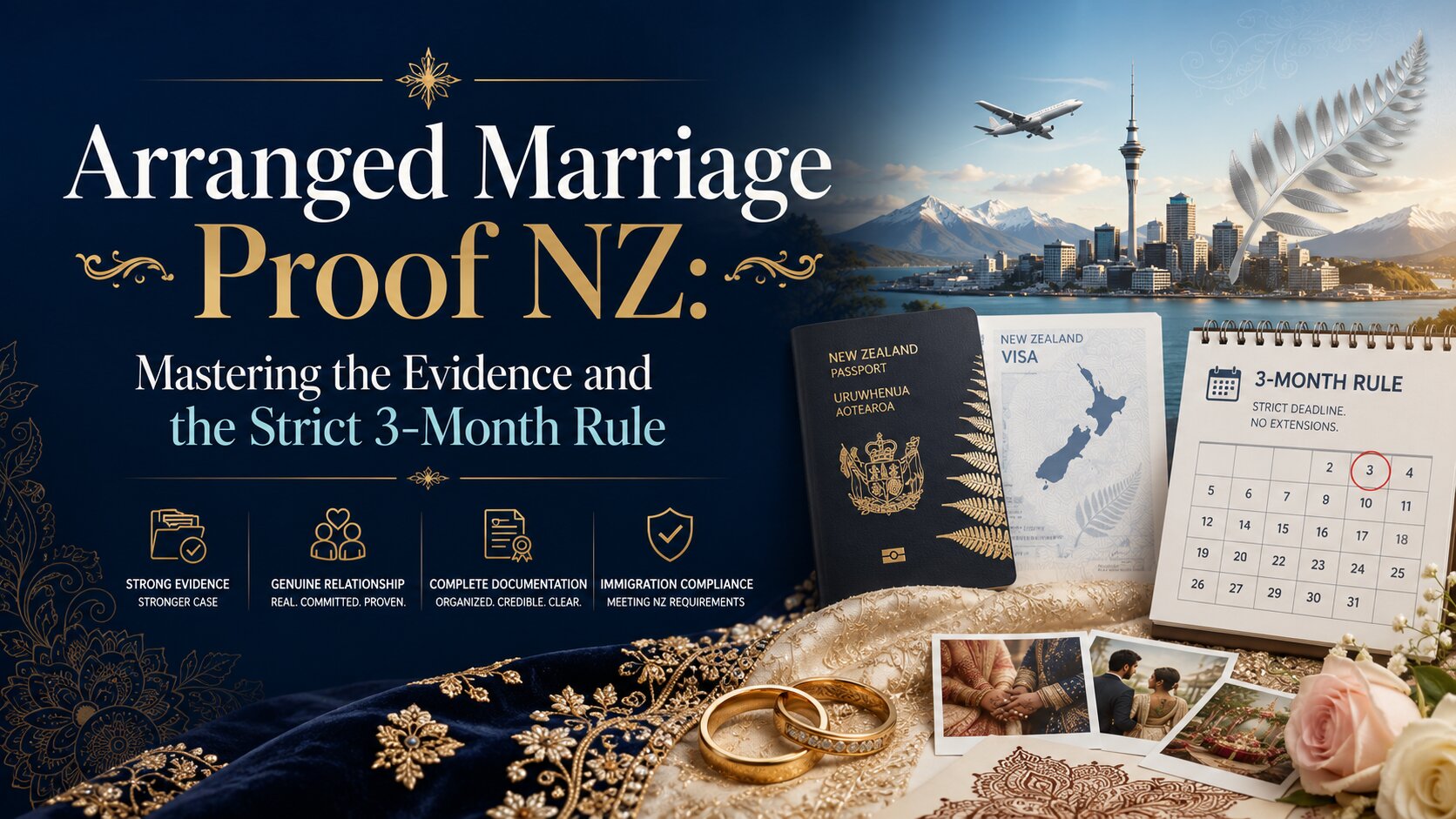
Arranged Marriage Proof NZ: Mastering the Evidence and the Strict 3-Month Rule

For many in the South Asian community, marriage is more than just a union between two individuals; it is the coming together of families, cultural traditions, and shared values. Immigration New Zealand (INZ) recognizes this cultural cornerstone through the Culturally Arranged Marriage Visitor Visa (CAMV), which provides a beautiful pathway to start your new life in Aotearoa. However, while the Culturally Arranged Marriage Visa offers a legitimate entry point, it comes with a notoriously strict timeline: the 3-month rule. Understanding Arranged Marriage Proof NZ early can help couples prepare the right documents, organize family evidence, and avoid delays. A well-planned Arranged Marriage Proof NZ approach also supports your case by showing cultural authenticity, genuine relationship development, and clear compliance with INZ expectations. That is why building strong Arranged Marriage Proof NZ evidence before and after arrival is essential for a smoother visa journey.

Navigating this narrow window to get married, establish a shared domestic life, and secure your next visa can feel like a race against the clock. This guide explores how to build a robust Arranged Marriage Proof NZ portfolio, manage the compressed timeline, and successfully transition to a long-term partnership visa. A strong Arranged Marriage Proof NZ file should include cultural marriage evidence, communication records, family involvement, wedding documentation, and proof of genuine relationship development. By preparing early and organizing each document carefully, your Arranged Marriage Proof NZ strategy becomes stronger, clearer, and more aligned with Immigration New Zealand’s expectations.

1. Understanding the Strict Timeline: The 3-Month Rule

The Culturally Arranged Marriage Visitor Visa is a highly specialized pathway, but its parameters are incredibly tight, leaving no room for error  .

The 90-Day Window and Visa Duration

The NZ arranged marriage visa operates under a rigid strict timeline known as the 3-month rule  . The visa duration itself is a maximum three months (90 days)  . If you are planning to marry in New Zealand, you must complete your wedding within three months of arrival  . Conversely, if you were married overseas, you must apply for the CAMV within three months of wedding date . This compressed timeline means that from the moment you arrive, you must balance wedding celebrations with the collection of cohabitation evidence .

Visa Pathway Timeline Constraint Mandatory Action
Marrying in New Zealand Three months of arrival   Complete the wedding ceremony and obtain the marriage certificate  .
Married Overseas Three months of wedding date  Submit the CAMV application with full marriage arranged evidence .
Transition to Work Visa Within the maximum three months of visa validity  Lodge a Partnership Work Visa application to secure an interim visa .

Managing Immigration Stress

The pressure of planning a wedding while simultaneously preparing complex immigration paperwork can cause significant immigration stress for newlyweds . Understanding the visa timeline and front-loading your preparation is the only way to alleviate this burden and ensure your application is positioned for success .

2. Proving the Arrangement: Matchmaker and Cultural Evidence

Before INZ will recognize your marriage, you must prove that the match was genuinely arranged by a third party according to established cultural customs .

Documenting the Matchmaker and Family Involvement

Under INZ rules, a culturally arranged marriage must be arranged by someone other than the couple themselves, such as parents, relatives, or a traditional matchmaker . You must provide clear marriage arranged evidence that details this process .

  • Family Communications: Submit records of communication between parents discussing the potential match, including emails, letters, or messaging logs .
  • Matchmaker Records: Provide chat records and call histories with the matchmaker or go-between who facilitated the introduction .
  • Written Account: A detailed written statement from both partners and the matchmaker explaining how the arrangement was made, the cultural traditions followed, and the shared values that united the families .

Establishing Public Recognition

INZ requires qualitative evidence that your community recognizes the arrangement . This includes wedding pictures showing family involvement, engagement ceremony photos, and letters of support from family, friends, and community leaders . These family support letters and friends support letters must confirm that the marriage aligns with traditional practices and is widely recognized within the community .

3. Merging Lives Immediately: Building Cohabitation Evidence

Once the wedding is complete, the couple must immediately transition to building a documented paper trail of their shared domestic life in New Zealand .

Financial Interdependence and Shared Expenses

To transition from a CAMV to a Partnership Work Visa, you must prove you are living together in a genuine and stable relationship  . Merging your financial lives from day one is critical .

  • Joint Bank Account: Open a joint account immediately after the wedding and use it to pay for daily household expenses, such as groceries, rent, and utilities .
  • Financial Paper Trail: Maintain all bank statements showing consistent joint transactions.

Housing and Shared Utility Accounts

A shared address is the most scrutinized aspect of any partnership application  . You must provide physical evidence of your cohabitating relationship .

  • Tenancy Agreement: Ensure both names are listed on the lease agreement or tenancy agreement for your New Zealand home  . If the property is owned by one partner, a property deed or mortgage document should be supported by joint household bills  .
  • Shared Utilities: Put both names on all household bills, including electricity bills, internet bills, and water bills .

4. Transitioning to a Partnership Work Visa

Securing your temporary visitor visa is only the first step; the ultimate goal is to transition to a visa that allows you to live and work in New Zealand  .

The Transition Process

The transition from CAMV to a Partner of a New Zealander Work Visa must be executed before your 3-month visitor visa expires . The sooner you marry after arriving, the more time you have to build documented evidence of your shared domestic life .

The Role of the Interim Visa

If you lodge your work visa application while your CAMV is still valid, INZ will typically grant you an interim visa . This crucial document allows you to remain in New Zealand legally while immigration officers assess your partnership application, preventing a heartbreaking separation .

5. Overcoming Rejections and Missing Documents

Because of the compressed timeline, even a minor mistake can lead to a declined visa .

The Consequences of Partnership Visa Declined

A partnership visa declined notification due to insufficient evidence of living together is a common hurdle for CAMV holders . If your visa is declined, you may be forced to leave New Zealand, making your next visa application significantly more difficult . Common pitfalls include a lack of qualitative evidence, a missing document, or a missed deadline .

DIY Application Risks vs. Professional Support

Attempting a DIY application under such tight time constraints is highly risky . Working with a licensed immigration adviser or immigration adviser New Zealand ensures your evidence is presented logically and complies with all INZ regulations . These licensed immigration professionals specialize in managing the strict timeline and ensuring your application is positioned for success .

6. Comparing Family Stream Visas New Zealand Options

New Zealand offers various family stream visas to support family reunification and family union .

Arranged Marriage vs. Parent Boost Visitor Visa

While the CAMV focuses on partners, INZ also supports parents through pathways like the Parent Visitor Visa . Understanding the different requirements across these family stream visas is essential for comprehensive family planning .

Visa Category Target Applicant Core Financial Requirement Duration & Pathway
Culturally Arranged Marriage Visa  Offshore partner in an arranged match  NZD $1,000/month or sponsor support  3 months; transitions to Partnership Work Visa  
Parent Boost Visitor Visa  Parents of NZ citizens/residents  Personal funds of NZD $170,000 or sponsor income  Up to 5 years; temporary stay with no direct residence path 

By understanding these distinctions, achieving cultural marriage recognition nz, and meticulously gathering your partnership visa evidence, you can confidently build your new life together in your New Zealand home .

Cultural Marriage Recognition NZ: Navigating the Culturally Arranged Marriage Visitor Visa

For many communities worldwide, traditional arranged marriages represent a deeply respected pathway to family union and lifelong partnership. Recognizing this rich diversity, New Zealand’s immigration system offers a specialized pathway for couples embarking on this journey: the Culturally Arranged Marriage Visitor Visa. This unique visa allows individuals who have entered into a culturally arranged marriage to travel to New Zealand to join their partner, begin their shared life, and transition toward long-term residency. This comprehensive guide details the essential requirements, necessary documentation, and step-by-step processes to achieve Cultural Marriage Recognition NZ. Understanding Cultural Marriage Recognition NZ also helps applicants prepare stronger evidence, avoid common mistakes, and present their relationship in line with immigration expectations. With the right guidance, Cultural Marriage Recognition NZ becomes a clearer and more manageable process for couples planning their future together.

1. The Culturally Arranged Marriage Visitor Visa Framework

New Zealand’s family stream immigration policies are designed to accommodate diverse cultural customs while maintaining strict legal standards  .

Understanding the Arranged Marriage Visa

The New Zealand arranged marriage visa is a specialized visitor visa application that grants a 3-month visitor visa to the offshore partner . This temporary entry pathway is crucial because New Zealand’s standard partnership visas require couples to have lived together before applying  . Since traditional arranged marriages often prevent couples from cohabiting before the wedding, this visa serves as a legal bridge, allowing the partner to enter New Zealand to marry or begin living together immediately after an overseas wedding .

Visa Aspect Details and Requirements
Visa Duration Up to 3 months (single entry) 
Visa Cost From NZD $441 
Processing Time 80% of applications completed within 5 weeks 
Primary Purpose To marry in New Zealand or join a partner after being married overseas 

Legal Impediments and Cultural Definitions

To qualify for this visa, the marriage must meet specific legal and cultural definitions . There must be no legal impediments to marriage, meaning neither partner can be currently married to anyone else, and they cannot be close relatives . Furthermore, the union must be a traditional arranged marriage, meaning the match was arranged by someone other than the couple themselves, such as parents, relatives, or a cultural go-between or matchmaker .

2. Key Eligibility and Sponsor Requirements

A successful application relies heavily on meeting the strict criteria established for both the applicant and their New Zealand-based partner .

Eligible Supporting Partner Criteria

The sponsor in New Zealand must be an eligible supporting partner . This means they must be a New Zealand citizen partner or a New Zealand resident partner . If the partner holds residency based on being an Australian citizen or Australian permanent resident, they must be actively living in New Zealand . The sponsor must provide proof of their status, such as a New Zealand passport, New Zealand birth certificate, certificate of New Zealand citizenship, or a valid New Zealand residence visa .

Sponsor Character and Previous Support Limits

The supporting partner must meet strict good character requirements . They will not meet these standards if they have any convictions involving domestic violence or sexual offences . Under New Zealand law, a citizen or resident can only support one partner for residence in a 5-year period, and support a maximum of two partners in their lifetime . The sponsor must complete the official Form for Partners Supporting Partnership-Based Temporary Entry (INZ 1146) to formally pledge their support .

3. Financial, Health, and Character Requirements for the Applicant

To secure temporary entry, the applicant must demonstrate they meet New Zealand’s standard entry requirements regarding health, character, and financial self-sufficiency .

Health and Character Clearances

Applicants must meet good health requirements and good character requirements . While a medical certificate and chest X-ray are not always required for stays under six months, Immigration New Zealand (INZ) reserves the right to request a medical examination during processing . For character clearance, applicants aged 17 or older must provide police certificates from their country of citizenship and any country where they have lived for five or more years since turning 17, if their cumulative stay in New Zealand will exceed 24 months .

Financial Sufficiency and Sponsorship

Applicants must show they have enough money to live on during their 3-month stay . This requirement can be met by proving personal funds or having an acceptable sponsor complete a Sponsorship Form for Temporary Entry (INZ 1025) .

  • Self-Funding: The applicant must have at least NZD $1,000 a month, or NZD $400 a month with accommodation paid .
  • Financial Evidence: Acceptable proof includes bank statements, pay slips, an employment agreement, hotel vouchers, or rent receipts .
  • Onward Travel: The applicant must also hold a return ticket or show they have sufficient funds to purchase travel out of New Zealand at the end of their stay .

4. Compiling the NZ Culturally Arranged Marriage Visa Checklist

Proving a culturally arranged marriage requires a substantial amount of visa application evidence . INZ scrutinizes these applications to ensure the relationship is a recognised partnership with genuine intentions of being a long-term and exclusive relationship .

Documenting the Arranged Marriage Process

Applicants must compile a detailed NZ culturally arranged marriage visa checklist . The core of the application is the evidence of culturally arranged marriage, which must prove that the match followed an identified cultural tradition and was organized by a third party .

  • Matchmaker Communications: Submit records of communication between parents and records of communication with matchmaker or go-between, demonstrating how the introduction was initiated .
  • Written Account: Provide a comprehensive written account of how marriage was arranged, detailing the cultural customs followed, the involvement of family members, and the timeline of the arrangement .
  • Independent Confirmation: Include confirmation from an independent cultural or religious source verifying that the ceremony and arrangement align with the couple’s cultural customs .
  • Public Recognition: Provide invitations, engagement ceremony photos, and documents showing the arrangement has received public recognition .

General Application Documents

In addition to relationship-specific documents, the applicant must submit standard documents required for visa application . If applying on paper, a certified copy of the applicant’s passport or certificate of identity must be provided, along with an acceptable photo . Crucially, any translated documents must be accompanied by certified English translations if the original documents are not in English .

5. Transitioning to standard Partnership and Residence Visas

The Culturally Arranged Marriage Visitor Visa is a temporary gateway, and couples must act quickly once in New Zealand to secure their long-term future  .

Transitioning to a Partnership Visa

The ultimate goal of the culturally arranged marriage pathway is to transition to a partnership-based residence visa  . If the couple married overseas, they must apply within 3 months of wedding for the visitor visa . If they plan to marry in New Zealand, the wedding within 3 months of arrival is a mandatory visitor visa condition . Once married and living with your partner in New Zealand, the couple can apply for a Partnership Work Visa, which allows the partner to work while they build the necessary cohabitation history  .

The Path to Permanent Residency

To qualify for a permanent partnership visa (residence), the couple must meet the strict cohabitation requirements . Unlike the temporary arranged marriage visa, residency requires a minimum of 12 months of living together in New Zealand . This transition represents a shift from the arranged marriage framework to standard partnership rules, requiring joint leases, shared bank accounts, and evidence of a shared daily life .

6. Comparing Family Stream Visas New Zealand Options

New Zealand offers several family stream visas New Zealand options depending on a couple’s unique circumstances   .

Arranged Marriage vs. Long Distance Relationship Visa NZ

For couples who met online or have been in a long-distance relationship but were not brought together through traditional cultural arrangements, the long distance relationship visa nz pathway is the correct route . While both pathways aim for partnership-based residency, their entry requirements and evidence thresholds differ significantly  .

Feature Culturally Arranged Marriage Visa  Long Distance Relationship Visa (Standard Partnership) 
Pre-existing Cohabitation Not required  Required (typically at least 4-6 months for temporary work visas) 
Core Evidence Matchmaker communications, cultural custom documentation, parental involvement  Shared finances, joint tenancy, joint bank accounts, continuous communication 
Initial Visa Type 3-month Visitor Visa (single entry)  Partnership Work Visa or Visitor Visa (1-3 years) 
Wedding Requirement Must marry within 3 months of arrival (if marrying in NZ)  No marriage requirement (de facto relationships fully recognized) 

By understanding these distinctions and carefully compiling the arranged marriage visa documents NZ, couples can ensure a smooth transition, achieving both cultural marriage recognition and a secure legal status in New Zealand 

Navigating the Long Distance Relationship Visa NZ: A Comprehensive Guide to New Zealand Partnership Visas

For couples separated by oceans, the dream of reuniting and building a life together in New Zealand is a powerful motivator. However, navigating the Long Distance Relationship Visa NZ pathway requires a deep understanding of the strict guidelines set by Immigration New Zealand (INZ). Unlike many countries that grant visas based solely on marriage, New Zealand’s immigration system prioritizes a shared physical life.

This comprehensive Long Distance Relationship Visa NZ guide explores the complexities of the New Zealand Partnership Visa, the essential partnership evidence required, and the strategic steps couples must take to prove their commitment, even when miles apart. Understanding the Long Distance Relationship Visa NZ process can help applicants prepare stronger documents, explain separation clearly, and present a more genuine and stable relationship case.

1. Understanding the New Zealand Partnership Visa Framework

To successfully bring your partner to New Zealand, you must understand how INZ defines a partnership and the different visa options available to you .

Defining Partnership Under INZ Rules

Immigration New Zealand recognizes three types of relationships for partnership-based visas: a legal marriage, a civil union, or a de facto relationship . To qualify under any of these categories, you and your partner must be living together in a genuine and stable relationship .

Visa Category Key Requirement Main Purpose
Temporary Partnership Visa Living together (no minimum duration, but usually 6+ months for a 1-year visa)  Allows the partner to work or visit New Zealand while building relationship history 
Residence Partnership Visa Minimum 12 months living together  Grants permanent residency rights to live, work, and study indefinitely 

The “Living Together” Hurdle for Long-Distance Couples

The most challenging aspect of the Partner Visa New Zealand for long-distance couples is the “living together” requirement . INZ explicitly states that living together means sharing the same home . It does not include spending holidays together, staying in each other’s homes while maintaining separate residences, or living as flatmates . For couples in a long-distance relationship, this means a temporary visa (such as a visitor or work visa) is often a necessary stepping stone to establish a shared residence before applying for residency  .

2. Proving a Genuine and Stable Relationship

When assessing your application, an immigration officer must be convinced that your relationship is a credible relationship and not a fraudulent relationship created solely for immigration purposes .

Credibility and the Four-Fold Test

INZ evaluates partnership applications using a comprehensive four-fold test: credibility, genuineness, stability, and living together . You must provide robust partner visa documentation that addresses each of these areas .

  • Credibility: Your relationship history, timelines, and statements must be consistent and believable .
  • Genuineness: You must demonstrate a deep commitment to shared life and emotional connection .
  • Stability: You must show that your relationship is ongoing and likely to last .
  • Living Together: You must provide physical evidence of sharing a home .

Financial Interdependence and Shared Responsibilities

A key indicator of a genuine partnership is financial interdependence . Couples must show that they share financial responsibilities and make joint decisions . Excellent evidence of this includes:

  • Shared bank accounts that are used frequently for household expenses .
  • A joint tenancy agreement or rental receipts showing both names .
  • A joint mortgage or joint ownership of residential property .
  • Joint utility accounts, such as electricity, gas, or internet bills .

3. Gathering Relationship Evidence During Separation

For long-distance couples, documenting how the relationship maintained during separation is vital to securing a visa .

Communication and Shared Travel Evidence

When you are physically apart, you must prove that your relationship remains active and committed .

  • Communication Evidence: Provide logs of social media conversations, chat records, and video call histories . Rather than submitting thousands of pages, select representative samples from every few months to show consistent contact .
  • Shared Travel Evidence: Document your efforts to see each other . Submit flight itineraries, hotel bookings, passport stamps, and photos of your trips together .
  • Family Recognition: Provide cards, letters, or emails sent to you both as a couple, as well as letters of support from family and friends recognizing your partnership .

Explaining Periods of Separation

If you and your partner have spent significant time apart, you must provide a detailed explanation of the periods of separation . You should outline the genuine and compelling reasons for living apart—such as work commitments, study, or visa restrictions—and demonstrate how you kept in touch and supported each other during these times .

4. Transitioning to Permanent Residency: The 12-Month Milestone

Once you have successfully established a shared home in New Zealand, you can begin planning for your long-term future .

Partnership Resident Visa NZ Requirements

To qualify for a residence partnership visa, you must meet the partnership resident visa NZ requirements, which mandate a minimum of 12 months living together in New Zealand . You must provide continuous, dated evidence covering the entire 12-month period to prove your shared life has been stable and uninterrupted  .

The Skilled Migrant Category and Partnership

For some couples, one partner may qualify for residency independently through skilled employment . Under the skilled migrant visa NZ points system, applicants must claim a minimum of 6 points based on their qualification, income, or professional registration . If you are applying under this category, you can include your partner in your application, but you must still provide the same high level of partnership evidence to prove your relationship is genuine and stable  .

5. Overcoming Challenges: Rejections and Appeals

The partnership visa application process is highly scrutinized, and mistakes can lead to a devastating partnership visa declined notification  .

Common Rejection Grounds and the Work Visa Rejection Connection

The most common reason a partnership visa is declined is a lack of sufficient living together evidence . If INZ believes you have provided false or misleading information or suspect a fraudulent relationship, they will reject the application immediately . Furthermore, if the supporting partner has previously supported another partner for residency within the last 5 years, they will be deemed ineligible, leading to an automatic decline . If you have faced a previous work visa rejection or other visa refusal, this history must be fully disclosed, as failing to do so constitutes providing misleading information  .

Reconsideration and the Immigration and Protection Tribunal

If your temporary partnership visa is declined, you can apply for a visa reconsideration within 14 days, provided you are still lawfully in New Zealand . For residency visa declines, you have the right to appeal the decision to the Immigration and Protection Tribunal (IPT) . The IPT will assess whether INZ applied the immigration instructions correctly and consider any exceptional humanitarian circumstances .

6. The Supporting Partner’s Role and Professional Advice

The success of your application relies heavily on the eligibility and active involvement of your supporting partner .

Supporting Partner Obligations

Your New Zealand partner must meet strict character and eligibility requirements . They must complete the official support forms (INZ 1146 for temporary visas or INZ 1178 for residency) and provide proof of their citizenship or residency  . They must not have acted as a partner in more than one successful residence application previously, and they must not have supported a partner in the last 5 years  .

Securing Professional New Zealand Immigration Advice

Because of the high emotional and financial stakes involved in a Long Distance Relationship Visa NZ application, securing professional New Zealand immigration advice is highly recommended . A Licensed Immigration Adviser (LIA) or immigration lawyer can help you compile a robust portfolio of evidence, draft compelling relationship statements, and prepare you for a potential immigration officer interview . Investing in professional guidance is the best way to protect your relationship and ensure a successful reunion in New Zealand .

Understanding Work Visa Rejection Reasons NZ: Common Pitfalls and How to Avoid Them

Applying for a New Zealand work visa is an exciting step toward starting a new chapter of your career in a vibrant, welcoming country. However, the pathway to entering New Zealand is highly regulated, and a single mistake can derail your entire plan. Understanding the most common Work Visa Rejection Reasons NZ is crucial to preparing a strong, accurate, and well-supported visa application.

Many applicants face delays or refusals because they overlook important details such as incomplete documents, weak financial evidence, unclear travel intentions, incorrect visa category selection, or failure to meet health and character requirements. This guide breaks down the complex rules surrounding New Zealand entry requirements, visa conditions, health checks, character checks, and industry-specific pitfalls to help ensure you are allowed to enter New Zealand without unnecessary stress or delay.

By learning the major Work Visa Rejection Reasons NZ before applying, you can avoid common mistakes and present your case with greater confidence. A well-prepared application should clearly show your genuine intentions, valid job offer, supporting evidence, and compliance with immigration rules. Whether you are applying for the first time or reapplying after a refusal, understanding Work Visa Rejection Reasons NZ can help you make better decisions and reduce the risk of rejection.

1. Document and Identity Inconsistencies

The absolute foundation of any successful visa application is proving your identity beyond doubt . Immigration New Zealand (INZ) conducts rigorous checks on all travel documents before granting a visa or allowing you to board your flight .

Passport Requirements and eVisa Matching

Your passport is the most critical travel document you possess . To meet passport requirements, your passport must be valid for at least three months beyond your planned departure date . INZ will stop you from travelling to New Zealand if your passport is expired, damaged, or has been reported lost or stolen . Additionally, if you hold an eVisa, it must be electronically linked to the exact passport you use to travel . If you have been issued a new passport due to a lost or stolen passport or an expired passport, you must transfer your eVisa before you begin entering New Zealand .

Identity Confirmation and Biometrics

During the application and border control stages, immigration officers must perform a thorough identity confirmation . At the border, you may be asked to provide biometric data, such as a photo verification, fingerprints, or an iris scan . If there are any discrepancies in your records, or if you refuse to let an immigration officer take your biometrics, you will be refused entry .

2. False Information and Fraudulent Documentation

Honesty and accuracy are non-negotiable when dealing with immigration authorities . Providing incorrect details—whether intentionally or by accident—is one of the fastest ways to guarantee a visa rejection and a long-term travel ban .

Document Violation Consequences under INZ Rules
False Information Immediate visa decline, potential ban on future applications 
Misleading Information Application refused, loss of credibility with border agencies 
Forged Documents Criminal investigation, permanent travel refusal 
Fraudulent Documents Immediate deportation, reporting to international police networks 
Altered Identity Document Confiscation of passport, immediate detention at the border 

Immigration officers are highly trained to spot an altered identity document or a forged documents . Even if you hire an agent, you are ultimately responsible for the accuracy of your application . Providing a false traveller declaration or false information to any border agency will result in immediate travel refusal and severe legal penalties .

3. Failure to Meet Visa Conditions and Financial Requirements

Securing a visa is only half the battle; you must also demonstrate that you can, and will, abide by the New Zealand visa conditions throughout your stay .

Financial Evidence and Onward Travel

To be allowed to enter New Zealand, you must prove that you can support yourself financially . You must provide robust financial evidence showing you have enough money to live on while you are in the country . If you cannot show that you have made firm arrangements to leave New Zealand at the end of your stay—such as an onward ticket or sufficient funds to purchase one—you may be stopped at the border . Your onward travel arrangements must be to a country you have the right to enter another country .

Bona Fide Intentions and Changed Circumstances

Immigration officers must be satisfied that you have genuine intentions and a lawful reason to visit or work . If INZ suspects you are using a temporary visa to seek permanent residency unlawfully, they will decline your application under the “bona fide” rule . Furthermore, if you experience changed circumstances before you arrive—such as a withdrawn job offer—your work visa conditions are no longer met, and you will not be allowed to enter .

4. Health and Character Grounds for Rejection

New Zealand places a high priority on protecting its public health system and maintaining public safety . Consequently, health and character checks are exceptionally strict .

Health Requirements

To secure a work visa, you must meet the mandatory health requirements . Depending on your country of origin and length of stay, you may need to undergo a medical examination or provide a chest X-ray . If you have a medical condition that could impose significant costs or demands on New Zealand’s public health services, or if you pose a tuberculosis risk, your visa may be declined unless you are granted a medical waiver .

Character Requirements and Security Risks

You must be of good character to enter the country . INZ will decline your application if they believe you represent a New Zealand security risk or a threat to public order or public interest . Grounds for immediate rejection include:

  • Having a history of gang association or being linked to registered sex offenders .
  • Representing a criminal risk due to past convictions .
  • Having been deported from another country, excluded from another country, or removed from another country .

5. Industry-Specific Rejection Risks: Nursing and Teaching

While general requirements apply to everyone, certain highly regulated professions have additional, complex hurdles that frequently lead to visa rejections .

Nursing Jobs and Visa NZ Requirements

Healthcare is a high-demand sector, but securing a visa for nursing requires navigating strict professional regulations . To meet the nursing jobs and visa NZ requirements, applicants must hold a qualification recognized by the Nursing Council of New Zealand and obtain official professional registration before their work visa can be approved. Failing to complete this registration, or failing to meet the rigorous English language test scores required by the Nursing Council, is a primary reason nursing visa applications are declined, even if the applicant has a genuine job offer.

Teaching Jobs and Visa NZ Requirements

Similarly, education is heavily protected . To satisfy the teaching jobs and visa NZ requirements, overseas-trained teachers must have their qualifications assessed by the New Zealand Qualifications Authority (NZQA) through an International Qualification Assessment (IQA) . Additionally, they must register with the Teaching Council of Aotearoa New Zealand and obtain a practicing certificate . Many teaching visa applications are delayed or rejected because the applicant applied for the visa before completing the NZQA assessment or failed to meet the Teaching Council’s language competency standards .

6. Border Checks, Carrier Fines, and Professional Support

Even with an approved visa, your New Zealand work visa journey is not complete until you successfully pass through border control .

Border Entry Checks and Prohibited Substances

When arriving in New Zealand, you will face strict border entry checks . You must complete a New Zealand traveller declaration honestly . The New Zealand Customs Service, Biosecurity New Zealand, and the New Zealand Police work together to inspect baggage . Carrying controlled substances or prohibited substances without proper authorization, or failing to declare biosecurity risks (like food or biological items), will result in immediate fines, visa cancellation, and entry refusal .

Carrier Fines and Professional Immigration Advice

Airlines and other carriers are legally required to verify that you meet all entry requirements before allowing you to board . If an airline or carrier allows a passenger to board without a valid visa, NZeTA, or proper travel documents, they face heavy carrier fines . Because the rules are so complex, seeking professional immigration advice before you travel is highly recommended . If your visa is declined, you can contact the INZ Customer Service Centre for advice, but having professional support from the start is the best way to ensure a smooth transition, whether you are planning to transit through New Zealand or settle there permanently

The Ultimate Guide to Job Offer Requirements NZ

Securing a job offer in New Zealand is a monumental milestone that transforms the dream of working in New Zealand into a reality. However, obtaining an offer of employment is only the first step in your immigration journey. To successfully apply for a New Zealand work visa, the job offer must meet strict criteria set by Immigration New Zealand (INZ). Understanding the Job Offer Requirements NZ is critical to ensuring your temporary work visa or resident visa application is approved without delays.

The Job Offer Requirements NZ include important details such as mandatory contract clauses, employer obligations, fair pay standards, and proof that the role meets immigration rules. This comprehensive guide explains the Job Offer Requirements NZ, including employment documentation, visa pathways, and residency options, helping you navigate the New Zealand immigration system with greater confidence, accuracy, and preparation.

1. Mandatory Elements of a Valid New Zealand Job Offer

To support a work visa application, a New Zealand job offer cannot be a simple letter of intent; it must consist of a formal, written offer of employment and a detailed draft employment agreement . Under INZ requirements, the documentation must contain specific, legally binding details to protect both the worker and the integrity of the local labor market  .

Mandatory Element Required Details in Contract
Employer Information Official business name, physical address, and direct contact details 
Employee Information Full legal name and current residential address 
Job Title & Duties Clear job title and a comprehensive list of work responsibilities 
Place of Work The physical address where the employee will perform their duties 
Employment Type Explicit confirmation of full-time work (minimum 30 hours per week) 
Pay & Conditions Detailed wage rate, salary structure, holiday pay, and sick leave entitlements 

Every job offer must comply with New Zealand employment laws and pay an appropriate market rate, ensuring that foreign workers receive the same protections as local employees  .

2. Employer Requirements and the Labor Market Test

Before you can start work in New Zealand, your New Zealand employer must fulfill specific employer requirements . Under the current system, employers must be vetted before they can recruit globally .

Employer Accreditation

The vast majority of temporary work visas require the hiring business to be an accredited employer. Under the Job Offer Requirements NZ, the employer must prove that the business is financially viable, genuinely operating, and compliant with all employment and immigration laws. These Job Offer Requirements NZ help ensure that only reputable businesses can recruit overseas talent.

Meeting the Job Offer Requirements NZ also means the employer must provide a legitimate role, fair employment conditions, and clear documentation that supports the applicant’s New Zealand work visa process with confidence and accuracy.

The Approved Job Check and Advertising

To hire a migrant, the employer must first apply for a job check . A key part of this process is demonstrating that they have tried to advertise for the position locally to find suitable candidates within the local workforce . If no New Zealand citizens or residents are available and qualified, the employer receives a “job token,” which they pass to the migrant to begin their work visa application .

3. Salary Thresholds and Market Rate Standards

The Salary Threshold NZ Work Visa rules are central to the immigration system, ensuring that migrant workers are paid fairly and not used to undercut local wages .

The National Median Wage Benchmark

The national median wage is the primary benchmark used by INZ to assess work visa applications. As of March 9, 2026, the immigration median wage is set at NZD $35.00 per hour. Most standard work visa applications must meet or exceed this rate to be approved. Earning below this threshold is generally restricted to roles covered by specific Sector Agreements or wage exemptions.

Calculating the Pay Rate

Immigration New Zealand has strict rules for calculating hourly rates . For salaried roles, INZ divides the annual salary by 52 weeks, and then by the hours worked . If the contract specifies a range of hours, INZ divides the salary by the maximum number of hours to ensure the hourly rate never falls below the required threshold . Furthermore, the wage offered must match the industry pay rates and market rates for that specific role in New Zealand, even if the market rate is higher than the median wage  .

4. Essential Supporting Documents and Information

When submitting your work visa application, the job offer must be backed by a robust portfolio of necessary documents and supporting information to prevent a visa application delay  .

Proving Your Qualifications and Experience

You must provide clear employment evidence showing that you are qualified to perform the job offered . This includes submitting copies of your formal qualifications and detailed work references from previous employers . These references must be on official letterhead and specify your employment dates, job titles, and duties to prove you possess the required skills .

Health, Character, and Identity Documents

All applicants must meet health and character standards to secure a New Zealand visa . You must provide a valid passport, acceptable photos, and police certificates from any country you have lived in for 5 years or more since turning 17 . Depending on the duration of your stay, you may also need to undergo a medical examination or provide a chest X-ray .

5. Pathways to Permanent Residence and Skilled Migration

For many, temporary employment is the beginning of a journey toward securing permanent residency and eventually New Zealand citizenship .

The Skilled Migrant Category (SMC)

The Skilled Migrant Category is New Zealand’s premier points-based pathway for skilled migrant residence . To be eligible for residence under this category, you must have a skilled job offer in New Zealand that pays at least the median wage of NZD $35.00 per hour . The points system rewards factors such as New Zealand work experience, qualifications, and high salary levels .

Green List Occupations NZ Requirements

The Green List consists of high-demand roles that offer fast-tracked resident visa pathways .

  • Tier 1 (Straight to Residence): Allows migrants in highly skilled roles (such as engineers, doctors, and ICT specialists) to apply for a resident visa immediately upon securing a compliant job offer .
  • Tier 2 (Work to Residence): Allows migrants in roles like teachers and tradespeople to apply for residence after completing 24 months of onshore work on an AEWV .

Migrants must ensure they meet the specific green list occupations NZ requirements regarding qualifications and professional registration to qualify for these pathways .

6. Special Visa Categories and Professional Guidance

While the AEWV is the most common path, other visa options exist depending on your circumstances and migration goals .

Student Trainee Work Visa NZ Eligibility

For younger professionals and students, the Student and Trainee Work Visa offers a unique opportunity to gain practical experience . To meet the student trainee work visa NZ eligibility requirements, you must have an offer of practical work experience that is directly related to your field of study, and your overseas education provider must support the training . This visa is ideal for medical trainees, religious trainees, and apprentice jockeys looking to live in New Zealand temporarily .

Navigating the Journey with Professional Immigration Services

The New Zealand visa application process can be complex, and a single mistake can lead to a visa application delay or decline  . Seeking professional immigration advice from a Licensed Immigration Adviser (LIA) or an immigration lawyer can provide invaluable job search support and ensure your application is flawless  .

Many professional agencies offer a free eligibility assessment to help you identify your best visa pathways, whether you are pursuing a partnership visa, student visa, or business migration . Taking the time to book a consultation can clarify your options and set you on the right path to achieving your New Zealand dreams .

Get In Touch