The Ultimate Guide to the Salary Threshold NZ Work Visa

The Ultimate Guide to the Salary Threshold NZ Work Visa

The immigration landscape of New Zealand is heavily anchored to financial benchmarks, where wages and skills dictate the pathway for global talent. Navigating New Zealand work visas requires a clear understanding of the Salary Threshold NZ system, which acts as the gatekeeper for both temporary employment and permanent residency. In recent years, New Zealand work visa update policies have shifted the focus toward skilled migration, ensuring that foreign workers are paid fairly while protecting the local labor market. The Salary Threshold NZ rules also help employers align job offers with government wage standards and industry pay expectations. This comprehensive guide breaks down the complex wage requirements, the impact of the national median wage, and how Salary Threshold NZ policies shape your New Zealand work visa journey with greater clarity and confidence.

1. What is the Salary Threshold NZ and Why Does It Matter?

The Salary Threshold NZ is a set of minimum pay rates established by Immigration New Zealand (INZ) to regulate the entry and employment of migrant workers  . Rather than being a single fixed number, these salary requirements vary depending on the visa type, the industry, and the skill level of the occupation.

Wage Metric Rate (Effective March 2026) Purpose
Immigration Median Wage NZD $35.00 per hour Benchmark for most skilled work visas  
Adult Minimum Wage NZD $23.95 per hour Absolute legal floor for any employment  
High Income Threshold NZD $70.00 per hour Twice the median wage; exempts from certain skills checks    

These thresholds are designed to meet multiple objectives within the immigration system. First, the Salary Threshold NZ rules ensure fair pay and prevent the undercutting of local wages by overseas recruitment. Second, they establish clear salary benchmarks that distinguish high-skilled migrants from lower-skilled workers. Finally, the Salary Threshold NZ system aligns work visa applications with labor standards and fair labor standards across all business sectors. By understanding the Salary Threshold NZ requirements, applicants and employers can prepare stronger visa applications with clearer wage compliance and long-term immigration planning.

2. The Immigration Median Wage: The Core Benchmark

At the heart of New Zealand’s immigration policies is the immigration median wage  . This figure is updated annually based on data from Statistics New Zealand and serves as the primary benchmark for the Accredited Employer Work Visa (AEWV) and various skilled migration programs  .

The Recent Transition to NZD $35 Per Hour

On March 9, 2026, the immigration median wage officially increased to NZD $35 per hour (up from the previous threshold of NZD $33.56 per hour)   . This adjustment represents a significant shift for both employers and applicants, as any new work visa applications submitted after this date must meet the new NZD $35 per hour minimum to be considered for standard skilled roles.

How Pay Rates Are Calculated

Immigration authorities calculate your hourly rate based on your genuine job offer and employment agreement  . For salaried employees, the calculation divides the annual salary by 52 weeks, and then by the hours worked  . If your contract specifies a range of hours (e.g., 40 to 45 hours), INZ will divide your salary by the maximum number of hours (45 hours) to ensure you meet the minimum wage requirement under all circumstances  .

3. The Impact of Salary Thresholds on Visa Types 

Different visa types carry distinct salary requirements and visa requirements . Understanding where your role fits is essential for a successful visa application process  .

The Accredited Employer Work Visa (AEWV)

The AEWV is the primary temporary work visa in New Zealand  . To hire a migrant under this scheme, a business must first go through the employer accreditation NZ process to become an accredited employer  . Once accredited, the employer must prove that the role pays at least the immigration median wage of NZD $35 per hour, unless the role is covered by a specific sector agreement or wage exemption.

The Specific Purpose Work Visa NZ : Salary Threshold NZ

The Specific Purpose Work Visa NZ (SPWV) is designed for individuals coming to New Zealand for a specific, time-bound event or project  . Unlike the AEWV, the SPWV does not always require the employer to be accredited, but the applicant must still demonstrate that their remuneration meets industry pay rates and government standards for the specific expertise they are bringing to the country  .

Seasonal and Sector-Specific Visas

To support critical industries experiencing labor shortages, the government has established sector agreements with lower wage thresholds . Sectors such as the care workforce, tourism, hospitality, and seafood processing are permitted to pay below the standard median wage, provided they meet the specific minimum salary requirements negotiated for their industry .

4. How Wages Influence Visa Duration and Family Sponsorship

Your salary does not just determine whether you get a visa; it also directly impacts the conditions of your stay, including longer visa durations and your ability to support your family.

Salary Benchmarks and Visa Durations

Under current immigration policies, earning higher salary levels often unlocks more favorable visa conditions . For instance, workers who are paid at least the median wage are eligible for a maximum visa duration of up to 5 years . Conversely, those working in roles paid below the median wage under sector agreements are often restricted to shorter visa lengths (typically 2 to 3 years) and may face a mandatory period of time outside New Zealand before they can apply for a further work visa .

Family Sponsorship Rules

The ability to bring your family to New Zealand is closely tied to your income and job skill level  .

  • High-Skilled Roles (ANZSCO Levels 1-3): If you earn at least the median wage, you can support a partner visa (which may grant open work rights) and student or visitor visas for your dependent children  .
  • Lower-Skilled Roles (ANZSCO Levels 4-5): If you work in a lower-skilled role, you must meet specific, higher income thresholds or have your role listed on the Green List to sponsor your family  .
  • Combined Income: If both you and your partner hold AEWVs, you are permitted to combine your incomes to meet the minimum threshold required for family sponsorship of your dependent children  .

5. Skilled Migration and the Pathway to Permanent Residence

For many skilled migrants, the ultimate goal of their New Zealand work visa journey is securing permanent residence . The salary you earn plays a pivotal role in transitioning from temporary status to permanent immigration  .

The Skilled Migrant Category (SMC)

The Skilled Migrant Category is New Zealand’s flagship points-based residency options program. Under the simplified points system, applicants must have a skilled job offer that pays at least the median wage of NZD $35 per hour. If you are claiming points for your skilled work experience in New Zealand, you must prove to the immigration authorities that you met the applicable median wage threshold throughout the entire duration of that employment .

The Green List Pathway

The Green List is a fast-track residency program designed for highly skilled professionals in jobs in demand.

  • Tier 1 (Straight to Residence): Allows eligible applicants to apply for residency immediately upon securing a compliant job offer.
  • Tier 2 (Work to Residence): Requires the applicant to work in New Zealand for 2 years on an AEWV before applying for residency.

For Green List roles that do not have a specific, higher pay threshold listed, applicants must earn at least the median wage of NZD $35.00 an hour to qualify for residency  .

6. Economic Contributions and Market Rate Standards

The Salary Threshold NZ system is not just an administrative hurdle; it is a strategic tool used by the government to drive economic development and protect the local workforce .

Protecting Local Workers and Market Rates

A key requirement of the visa application process is the “market rate” check    . Even if a job offer meets the minimum wage requirement of NZD $35 per hour, INZ will decline the application if the offered wage is below the market rates for that specific occupation    . For example, if local software engineers typically earn between NZD $50 and NZD $60 per hour, an employer cannot offer an overseas worker NZD $35 per hour for the same role  . This ensures that foreign workers are not exploited as cheap labor and that local workers are not priced out of the market ].

Fostering Economic Contributions

By setting high salary requirements for overseas employment, New Zealand encourages businesses to invest in technology, training, and productivity improvements rather than relying on low-cost labor. Migrants who meet these higher thresholds make significant economic contributions through taxes and local spending, helping to fund public infrastructure and services. This balanced approach ensures that employment in overseas markets remains a win-win for both the migrant workers and the New Zealand economy.

The Ultimate Guide to the Accredited Employer Work Visa NZ

The Accredited Employer Work Visa (AEWV) is the primary Employer Work Visa NZ pathway for skilled migrants seeking to live and work in New Zealand. Designed to streamline recruitment for local businesses while protecting migrant workers, the Employer Work Visa NZ program connects global talent with verified employment opportunities. This comprehensive guide explores everything you need to know about securing an Employer Work Visa NZ, from employer accreditation steps to the final visa application, compliance rules, and pathway to permanent residency.

1. What is the Accredited Employer Work Visa (AEWV)?

The Accredited Employer Work Visa (AEWV) is a temporary work visa introduced by Immigration New Zealand (INZ) to ensure that only compliant businesses can hire overseas workers. This visa is designed to fill genuine skill shortages in the local labor market while ensuring that migrant workers are treated fairly and in accordance with New Zealand employment standards .

Key Feature Details
Visa Type Temporary Work Visa
Length of Stay Up to 5 years (depending on skill level and wage)
Cost From NZD $1,540
Processing Time 80% processed within 6 weeks
Path to Residency Yes (via Green List or Skilled Migrant Category)

To qualify for an AEWV, you must secure a full-time work offer (at least 30 hours per week) from an accredited employer. This system ensures that the employer has been vetted by the government before you can submit your visa application.

2. The Three-Step AEWV Application Process

The Accredited Employer Work Visa NZ requirements dictate a strict three-step gateway before a migrant can begin working in New Zealand . This system shifts much of the administrative burden onto the New Zealand employer before the worker ever applies.

Step 1: Employer Accreditation

Before hiring any migrant worker on an AEWV, a business must obtain employer accreditation. Immigration New Zealand checks that the business is financially viable, genuinely operating, and has no history of non-compliance with employment or immigration laws. Employers must also commit to completing activities such as providing settlement information to migrant workers and paying for all recruitment costs, as charging these to the worker is illegal under New Zealand law . Migrants can search the official accredited employer list to find approved companies .

Step 2: The Approved Job Check

Once accredited, the employer must apply for an approved job check for the specific role they wish to fill. The job check process ensures that the employer has advertised the job locally to check if any New Zealand citizens or residents are available to do the work. It also verifies that the proposed employment agreement and job description comply with local employment standards.

Step 3: The Migrant Visa Application

After the job check is approved, the employer will send the candidate a unique link to the online application form. The migrant then completes their individual visa application, submitting their personal credentials, qualifications, and employment history to prove they meet the work visa requirements.

3. Understanding the Job Offer and Employment Agreement

A genuine job offer is the foundation of any successful AEWV application. Immigration New Zealand has strict guidelines regarding what must be included in your contract to prevent exploitation and immigration scams.

Mandatory Employment Agreement Details

Your signed job offer and employment agreement must be comprehensive and include the following details:


  • The New Zealand employer’s official name, physical address, and contact details.
  • Your official job title and a detailed list of work responsibilities.
  • The specific address of your place of work.
  • Guaranteed pay and job conditions that comply with New Zealand employment law.
  • A minimum of 30 hours of work per week (constituting a full-time work offer).

Unlawful Clauses and Job Offer Scams

Your employment agreement cannot contain trial periods, unlawful deductions, or unacceptable bonding clauses that force you to repay recruitment costs if you leave the company. It is a serious offense under New Zealand law for employers or agents to charge recruitment fees to workers .

Warning on Job Offer Scams:

“Job offer scams are common globally. Immigration New Zealand will decline any AEWV application if they suspect the applicant or their agent has offered or promised money to an employer in exchange for a job offer.”

4. Minimum Skill and Qualification Requirements

To secure an AEWV, you must prove that you possess the necessary job skills and relevant job experience to perform the role. The minimum skill requirements are strictly enforced by INZ.

General Skill Requirements

Unless your role is exempt or on the Green List, you must meet the accredited employer work visa NZ requirements by showing you have:

  • At least 2 years of relevant job experience in the same industry, OR
  • A qualification at Level 4 or higher on the New Zealand Qualifications and Credentials Framework (NZQCF qualification).

If your qualification was obtained outside of New Zealand, you must apply for an International Qualification Assessment (IQA) from the New Zealand Qualifications Authority (NZQA) to verify that it is comparable to a Level 4 qualification or higher.

Skill Classification and ANZSCO

Immigration New Zealand uses the Australian and New Zealand Standard Classification of Occupations (ANZSCO skill level) system to classify jobs from Level 1 (most skilled) to Level 5 (least skilled). This system is gradually being replaced by the National Occupation List (NOL).

Skill Level Qualification / Experience Equivalent English Requirement
ANZSCO Levels 1-3 Bachelor’s Degree, Diploma, or 3+ years experience None (until June 2026 for Level 3) [1] [5]
ANZSCO Levels 4-5 Certificate or 1-2 years experience IELTS 4.0 or equivalent [1] [6]

5. English Language, Health, and Character Standards : 

In addition to professional skills, applicants must meet personal eligibility criteria to ensure they can successfully integrate into New Zealand society.

English Language Requirements

If your offered job falls under ANZSCO skill level 4 or 5, you must meet the English language requirements. You can prove your proficiency by holding citizenship or qualifications from an English-speaking country, or by passing an approved English language test [6].

Approved Test Minimum Score Required for AEWV
IELTS (General or Academic) Overall score of 4.0 or more
TOEFL iBT Overall score of 31 or more
PTE Academic Overall score of 29 or more
B2 First Overall score of 142 or more

Note: From June 1, 2026, minimum English language requirements will also be extended to ANZSCO and NOL skill level 3 occupations [6].

Health and Character Requirements

All applicants must meet health requirements and character requirements . This usually involves providing a chest X-ray and a general medical certificate to prove you have an acceptable standard of health . You must also provide police certificates from any country you have lived in for 12 months or more over the past 10 years to demonstrate good character.

6. Visa Conditions, Length of Stay, and Family Support

Understanding your visa conditions is crucial to maintaining your lawful status while you work in New Zealand.

Maximum Continuous Stay and Visa Length

The length of stay on an AEWV depends on your wage and skill level . For most skilled roles, the visa length can be up to 5 years. However, for ANZSCO level 4 and 5 roles, the maximum continuous stay is typically capped at 3 years. Once you reach your maximum stay, you must spend a specified time outside New Zealand before you can apply for a further AEWV.

Changing Employers and Varying Conditions

Your AEWV is tied to your specific accredited employer. If you wish to change employer, job title, or work location, you must apply for a Job Change or apply to vary visa conditions before starting your new role. Working for an unauthorized employer is a breach of your visa conditions and can lead to deportation.

Supporting Your Family

Depending on your skill level and salary, you may be eligible to support your family’s relocation. You can support a partner visa (which may grant open work rights) and a dependent children visa (allowing them to attend school on a student visa or stay on a visitor visa).

7. Pathways to Residency and Special Visa Options

For many, the AEWV is a stepping stone to a permanent life in New Zealand. The government offers streamlined pathways for highly skilled workers.

Green List Roles and Resident Pathways

If your profession is on the New Zealand Green List, you have a direct resident visa pathway.

  • Tier 1 Roles: Eligible for a “Straight to Residence” visa, allowing you to apply for residency immediately.
  • Tier 2 Roles: Eligible for a “Work to Residence” pathway, allowing you to apply for residency after 2 years of working in the role on an AEWV.

These pathways are designed for jobs in demand, such as healthcare professionals, engineers, and ICT specialists.

Sector Agreements and Wage Exemptions

To support key industries, the government has established sector agreements and wage exemptions. These agreements allow employers in sectors like care workforce, tourism, and seafood processing to hire migrants at rates below the standard median wage.

Seasonal Work Visa Alternatives

The AEWV is not suitable for short-term agricultural work . If you are looking for seasonal employment, you must look into seasonal work visa NZ requirements. Options like the Recognised Seasonal Employer (RSE) Limited Visa or the Peak Seasonal Visa (PSV) are specifically designed for planting, harvesting, and packing crops, and have different work visa requirements compared to the standard AEWV].

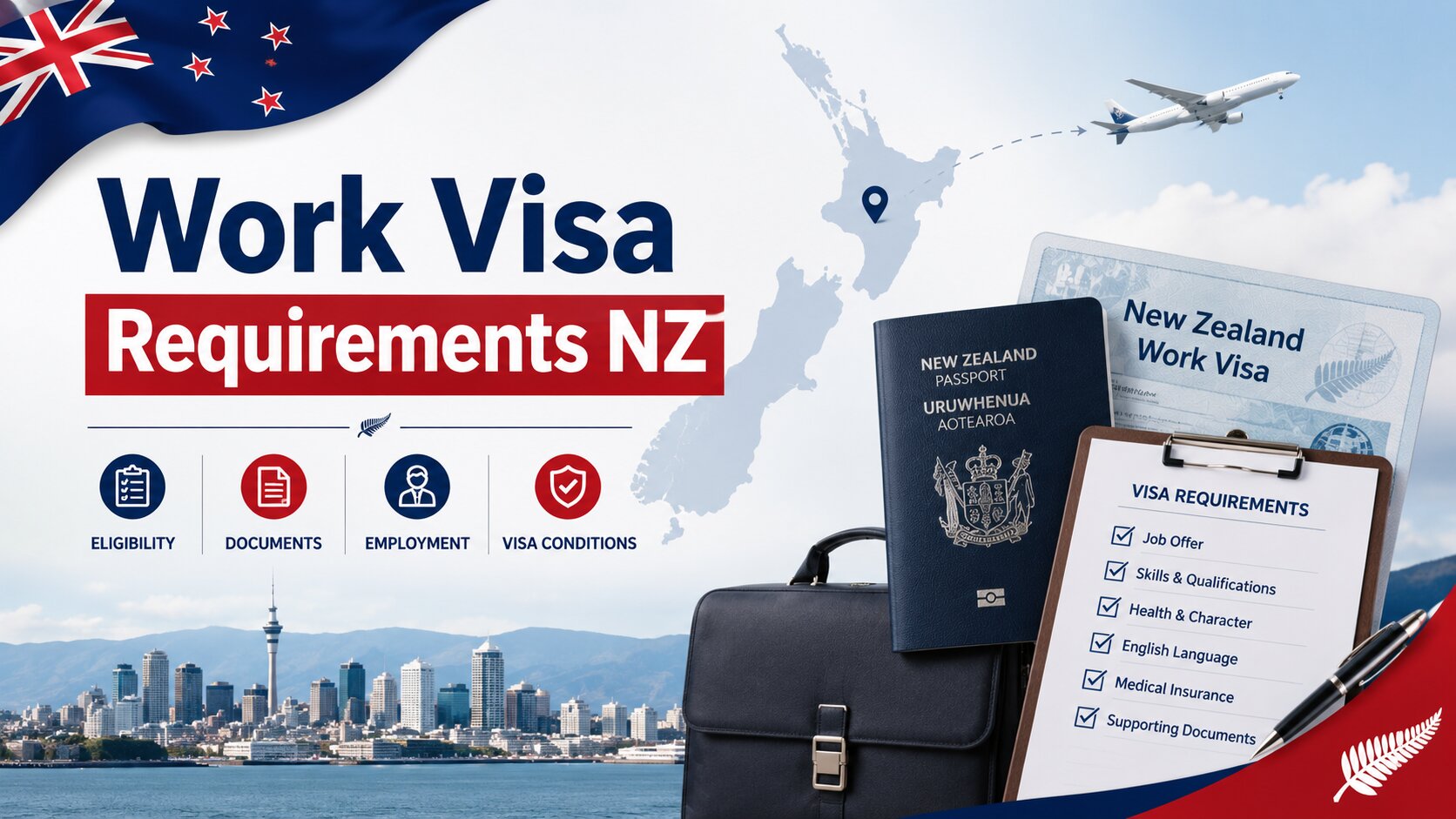
Work Visa Requirements NZ

Understanding Work Visa Requirements in New Zealand

Work Visa Requirements in New Zealand depend on the visa category, the job, the employer, the applicant’s qualifications and whether the visa is intended to be a short-term work option or part of a longer residency pathway. For most applicants, the starting point is to identify whether they are applying for an employer-sponsored visa, a graduate work visa, a family-linked work visa, or a residence category that relies on skilled employment. Immigration New Zealand assesses each pathway under its own instructions, so a strong application begins with matching the visa type to the applicant’s real circumstances rather than treating every work permit NZ search result as the same thing.

In practical terms, New Zealand work visa requirements usually involve four layers. The first is identity and personal eligibility, including health, character and genuine intentions. The second is employment or study background, such as a compliant job offer, relevant work experience, an eligible New Zealand qualification, or skilled employment. The third is evidence quality, because unsupported claims, incomplete employment documents and missing translations can create risk. The fourth is future planning, especially where a worker wants a pathway from a temporary entry visa into residence through the Skilled migrant visa, Green List occupations, Straight to Residence, Work to Residence, or another skilled residence option.

Immigration New Zealand states that an AEWV applicant must “have an offer of full-time work from an accredited employer”, meet skill or qualification requirements, and meet other requirements connected to the job’s skill level and visa category.

The important point is that a work visa is not simply permission to take any job in New Zealand. Many visas are tied to a specific employer, occupation, location or set of conditions. If your role, employer, location or family situation changes, you may need to apply for a Job Change, vary your visa conditions, or apply for a new visa before acting on that change.

Visa pathway Best suited to Core requirement Residence connection
Accredited Employer Work Visa (AEWV) Workers with a New Zealand job offer Full-time job offer from an accredited employer with required skill evidence Can lead to a resident visa depending on role, pay and pathway
Post Study Work Visa Recent New Zealand graduates Eligible New Zealand qualification, timely application and living funds Can lead to a resident visa if skilled employment later supports residence
Skilled Migrant Category Resident Visa Skilled workers seeking residence Accredited-employer job or job offer and 6 skilled resident points Direct residence category allowing indefinite stay
Green List residence pathways Workers in listed shortage roles Tier 1 or Tier 2 Green List role and specified qualifications, registration or experience May allow immediate residence or residence after 2 years

The Accredited Employer Work Visa (AEWV) explained

The Accredited Employer Work Visa (AEWV) is the central employer-led work visa for many migrant workers in New Zealand. Immigration New Zealand says it is for applicants who have a job offer from an AEWV-accredited employer, and the employer must send the applicant a link to the online application form.

At the time reviewed, the official page listed the AEWV as allowing a stay of up to 5 years based on the job offered, with 80% of applications processed within 6 weeks and a residence option marked “Yes”.

The AEWV is not an open work visa. It links the worker to the employer and job connected with the employer’s job token or unique application link. Immigration New Zealand explains that the visa lets a holder work for the accredited employer that has offered at least 30 hours of work per week, study for up to 3 months in any 12-month period or complete study required as part of employment, and stay for a period determined by the job, skill level, pay and application timing.

Employer accreditation, job check and job token

A compliant AEWV job offer must be current at the time of application, be for at least 30 hours per week, come from an employer accredited to hire migrants under the AEWV scheme, have an approved job check for the role, and be paid at least the market rate for the job.

This is why the phrase employer-sponsored visa should be understood carefully. The employer may support the role through accreditation and a job check, but the worker still has to prove their own identity, skill, health, character and genuine intention to work in New Zealand.

Immigration New Zealand also places emphasis on employment agreement quality. The employment agreement should show key details such as the employer’s name, address and phone number, the worker’s name and address, job title, work location, duties, required qualifications or experience, whether New Zealand registration is required, working hours, duration, acceptance timeframe, and pay and conditions that comply with New Zealand employment law.

The agreement cannot include unlawful deductions, a trial period, clauses that do not comply with employment law, or unacceptable bonding clauses that require repayment if the worker leaves within a certain timeframe.

Applicants should be cautious about job offer scams. Immigration New Zealand warns that job offer scams are common in India and South Asia and states that an AEWV application will be declined if the applicant or their agent has offered or promised money to the employer or the employer’s agent in exchange for a job offer.

A genuine job offer is therefore both an immigration requirement and a protection issue.

Experience, qualifications and English evidence

The minimum AEWV skill requirements usually require either 2 years or more of relevant job experience, or a qualification at level 4 or higher on the New Zealand Qualifications and Credentials Framework.

The experience or qualification must be in the same field or industry as the offered job, although Immigration New Zealand notes that a Bachelor’s degree or higher can be in any field or industry.

Evidence matters as much as eligibility. Immigration New Zealand states that job experience evidence must come from someone other than the applicant and can include certificates of employment, payslips, tax certificates and letters of reference supported by certificates, payslips or tax certificates.

A CV or resume alone is not sufficient.

Where an overseas qualification is relied on, applicants may need an International Qualification Assessment from the New Zealand Qualifications Authority, especially where the qualification is below a Bachelor’s degree and from outside New Zealand.

English may also be relevant. Immigration New Zealand states that AEWV applicants must show they can speak and understand English if the role is on the ANZSCO skill level 4 or 5 list and is not exempt.

This can be an overlooked requirement because applicants sometimes focus only on the job offer and forget that the job’s ANZSCO or National Occupation List classification can affect the evidential burden.

Post Study Work Visa and graduate eligibility

The Post Study Work Visa is different from the AEWV because it is based on New Zealand study rather than an accredited employer’s job offer. Immigration New Zealand describes it as a visa for people who want to work in New Zealand soon after completing study here, allowing eligible holders to stay and work for up to 3 years depending on what they studied.

This makes it an important bridge for graduates who need local work experience before moving into an AEWV, a Skilled migrant visa route, or another residence option.

Post study work visa NZ eligibility after study

The key phrase post study work visa NZ eligibility covers several requirements. Applicants must have recently finished studying in New Zealand for an approved qualification, apply no later than 3, 6 or 12 months after their student visa expires depending on what they studied and what visa they held, have at least NZD $5,000 for living expenses, and meet the other requirements of the visa.

Immigration New Zealand also states that applicants must have a degree level 7 or higher qualification, such as a level 8 Postgraduate Diploma, level 9 Master’s degree or level 10 Doctoral degree, or a non-degree level 7 or lower qualification that is on the eligible list and connected to the job they intend to take.

The evidence usually includes a copy of the qualification, an academic transcript, or a letter from the tertiary education provider confirming completion.

Degree level 7 or higher study must generally have been full-time for at least 30 weeks in New Zealand, while non-degree level 7 or lower study must be on the eligible qualifications list and completed for the full required duration.

Immigration New Zealand also notes that if the applicant did not complete the qualification recorded on their student visa, the Post Study Work Visa may not be approved.

Graduates should treat the Post Study Work Visa as a planning tool, not merely a deadline. The visa can support work experience, employer relationships and future residence eligibility, but it can generally only be held once.

Because this visa may support visas for a partner and dependent children, it can also be relevant to whole-family planning where the partner may apply for a work visa and children may apply for student visas to study as domestic students.

Residence pathways linked to work visas

A New Zealand work visa may be temporary, but it can still be part of a longer immigration strategy. The AEWV page itself records that the visa can lead to a resident visa, while the Post Study Work Visa page records that it can also lead to a resident visa.

The pathway is not automatic. Applicants must satisfy the specific residence category requirements, which may include skilled employment, points, age, English, pay thresholds, occupational registration, qualifications, or a Green List role.

Skilled migrant visa and six-point residence rules

The Skilled Migrant Category Resident Visa is a residence pathway for people who have a job or job offer from an accredited employer and qualify for 6 points for their skills and work in New Zealand.

Immigration New Zealand states that applicants must be 55 years or younger when applying, be working for or have a full-time job offer from an accredited employer, have 6 skilled resident points, speak and understand English, and meet the other requirements of the visa.

For the job to be considered skilled, it must be with an accredited employer, be full-time for at least 30 hours per week, and meet Immigration New Zealand’s specified pay and duration requirements.

The official Skilled Migrant Category page states that an ANZSCO Level 1 to 3 occupation must be paid at least NZD $35.00 an hour, while an ANZSCO Level 4 to 5 occupation must be paid at least NZD $52.50 an hour.

Applicants can claim 3 to 6 points from one skill category — occupational registration, qualifications or income — and up to 3 more points from skilled work experience in New Zealand if required.

Green List occupations and work-to-residence options

Green List occupations are roles New Zealand needs workers for. Immigration New Zealand says that if a role is listed and the applicant has the qualifications, registration or experience required, they may be able to apply for a residence visa immediately or after 2 years of working in New Zealand.

The official Green List page also explains that applicants can check whether their role is Tier 1 for a Straight to Residence Visa or Tier 2 for a Work to Residence Visa.

This is a key distinction for workers planning beyond a temporary visa. A Tier 1 role may connect to a faster Straight to Residence pathway, while a Tier 2 role may require work in New Zealand before residence can be pursued.

However, being in a Green List occupation is not enough by itself. Applicants must still meet the exact qualifications, registration or experience listed for that role, and they must also satisfy the requirements of the specific residence visa they apply for.

Visa documentation, family options and adviser support

Good visa documentation is the difference between a persuasive application and one that creates avoidable doubts. A work visa file should read like a coherent evidence bundle: identity documents confirm who the applicant is, employment evidence confirms the role and employer, qualification or experience evidence confirms skill, and health, character and translations confirm admissibility and document integrity. Immigration New Zealand regularly asks for proof that applicants are in good health, of good character and have genuine intentions, depending on the visa category and circumstances.

Core visa documentation checklist

A practical evidence checklist for Work Visa Requirements should include documents that are specific to the visa pathway. For an AEWV, Work Visa Requirements normally include the signed job offer, employment agreement, job description, evidence of work experience or qualifications, any occupational registration, passport details, photo, police certificates if required, medical or chest X-ray evidence if requested, and certified English translations where documents are not in English.

For a Post Study Work Visa, the core Work Visa Requirements include qualification evidence, academic transcripts or provider confirmation, proof of funds, and standard health, character, and identity evidence. Understanding these Work Visa Requirements early helps applicants prepare stronger, complete visa applications with fewer delays.

Applicants should prepare the following before lodging where relevant:

  • Confirm the visa category and whether the role is tied to an accredited employer, Green List occupation, graduate pathway or family-based work right.
  • Check whether the job is full-time, meets minimum hours, satisfies market-rate or pay-threshold rules, and aligns with ANZSCO or National Occupation List requirements.
  • Gather independently verifiable work experience evidence, because a CV alone is not enough for AEWV experience claims.
  • Arrange certified English translations for non-English documents and check whether any overseas qualification needs an International Qualification Assessment.
  • Review all dates carefully, especially student visa expiry dates, employment start dates, contract duration and any maximum continuous stay rule.

Partner work visa and dependent child visa planning

Family planning should be handled early because different visas treat family members differently. The AEWV does not include a partner or children in the same application, but Immigration New Zealand says an AEWV holder may be able to support a visitor or work visa for a partner and a visitor or student visa for dependent children.

The Post Study Work Visa page similarly states that eligible holders can support visas for a partner and dependent children, with a partner able to apply for a work visa and children able to apply for student visas to study as domestic students in New Zealand.

A partner work visa or dependent child visa should not be treated as a simple add-on. The family member must meet the requirements of their own visa category, and evidence of partnership, dependency, funds, schooling plans or health and character may be relevant. In residence pathways, the Skilled Migrant Category allows successful applicants to include a partner and dependent children aged 24 or younger, provided the family relationship and other requirements are satisfied.

Where the facts are complex, a licensed immigration adviser can help identify the correct pathway, spot evidence gaps and reduce the risk of submitting the wrong documents. This is particularly useful where the applicant has changed jobs, studied multiple qualifications, has an offshore qualification requiring NZQA assessment, or wants to move from a temporary work visa into a skilled residence pathway.

How to prepare a strong application and avoid refusal

The strongest applications are prepared backwards from the decision-maker’s checklist. Instead of asking, “What documents do I have?”, the applicant should ask, “What must Immigration New Zealand be satisfied about, and what evidence proves it?” This approach is especially important for work visas because the same document can serve several functions. An employment agreement may prove employer identity, work location, duties, pay, hours, duration and compliance with employment law, while payslips and tax records may prove both the existence and length of relevant experience.

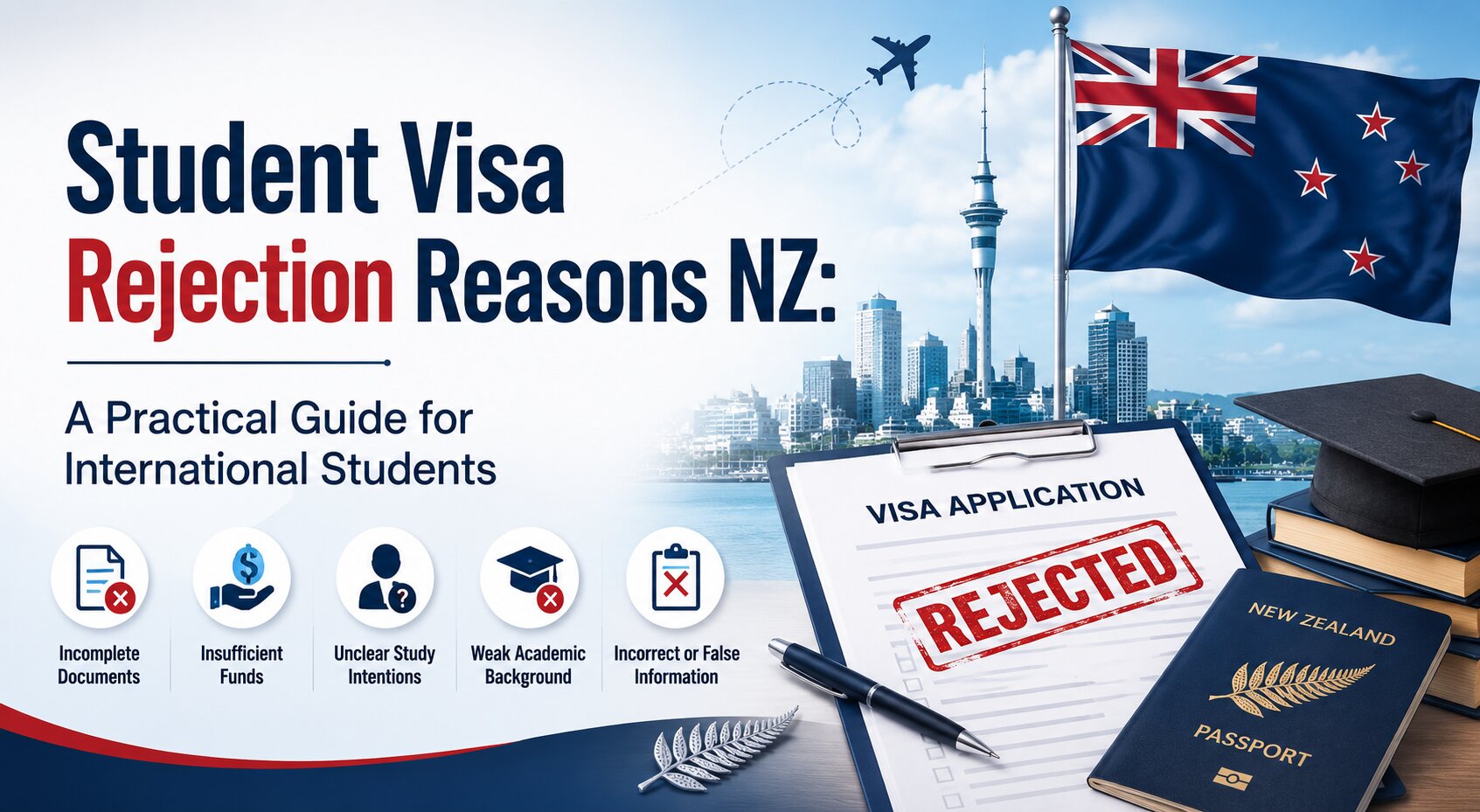
Common mistakes, including Student Visa Rejection Reasons

Many refusal risks are predictable. Applicants often submit incomplete job documents, assume a job title is enough without matching duties to ANZSCO or NOL classifications, provide reference letters without supporting payslips or tax records, overlook market-rate or pay-threshold rules, or miss a time limit after a student visa expires.

These errors overlap with broader Student Visa Rejection Reasons, such as weak evidence, unclear intentions, insufficient funds, inconsistent documents and failure to meet the precise instructions for the visa category.

A final pre-submission review should ask whether every eligibility claim is supported by documentary proof, whether all documents are current and translated where necessary, whether the employer is accredited where required, whether the job is genuinely full-time, whether family members need separate applications, and whether the chosen pathway supports the applicant’s longer-term goals. Work Visa Requirements are manageable when the visa category is chosen correctly, but they become risky when applicants rely on assumptions or generic advice rather than the official Immigration New Zealand criteria.

The best strategy is to build a staged plan. First, identify the correct work visa. Second, confirm the job, qualification or family basis for eligibility. Third, prepare the evidence bundle before applying. Fourth, map whether the visa is only a temporary entry visa or whether it supports a later residence option. Finally, seek professional advice if the facts are unusual, because a well-timed clarification can be far cheaper than correcting a declined application.

Student Visa Rejection Reasons NZ: A Practical Guide for International Students

Understanding Student Visa Rejection Reasons in New Zealand

Visa Rejection Reasons are rarely about one small error in isolation. In most Student Visa NZ cases, Immigration New Zealand, often referred to as INZ, assesses the full picture: whether the applicant is a genuine student, whether the study plan makes sense, whether the money is genuinely available, and whether the documentation supports the claims made in the Student Visa Application. A strong application for a New Zealand Student Visa is therefore not only about uploading forms; it is about presenting consistent, verifiable evidence that fits the applicant’s education, finances, immigration history, and future plans.

For International Students, a refusal can be stressful because it may affect enrolment dates, tuition fee planning, travel arrangements, and future immigration records. INZ publishes official visa criteria for the Fee Paying Student Visa, including requirements around an offer of place, tuition fees, living costs, onward travel, health, character, and genuine intentions to study.These criteria explain why Visa Documentation must be complete and why applicants should not treat the process as a basic checklist exercise.

Important note: Immigration New Zealand states that if false or misleading information is provided, or relevant information is withheld, a visa application may be declined.

Why INZ Refuses Some Student Visas

INZ may refuse a student visa when a visa officer is not satisfied that the applicant meets the relevant Visa Requirements. Common Visa Rejection Reasons include weak Evidence of Funds, unclear Genuine Source of Funds, missing Supporting Documents, doubts about Bona Fides, or a study plan that does not align with the applicant’s Academic Background and Career Plans. For Offshore Student Visa Applications, these concerns can be more significant because the applicant may not have a local New Zealand immigration record or direct access to New Zealand-based education support.

A refusal does not automatically mean the applicant can never Study in New Zealand, but the next application must address the exact concerns raised by INZ. Understanding the real Visa Rejection Reasons is important before reapplying. Applicants should carefully review the refusal letter and avoid submitting the same evidence without improvement.

Common Visa Rejection Reasons include insufficient financial proof, unclear study intentions, inconsistent documents, or weak supporting evidence. Proper Immigration Advice and accurate documentation can help applicants overcome previous Visa Rejection Reasons and improve approval chances.

The Role of Bona Fides and Genuine Student Assessment

Bona Fides means the applicant must show genuine intentions to study in New Zealand and comply with visa conditions. INZ’s official guidance on genuine intentions to study explains that officers may consider matters such as the applicant’s personal circumstances, study plans, previous immigration history, and whether the proposed study is reasonable in context.

This is why a Statement of Purpose (SOP) should be specific, honest, and connected to the applicant’s education history and future career direction.

A weak SOP often leads to Visa Denial because it may sound generic or copied from an Education Agents template. The SOP should explain why the student chose New Zealand, why the education provider and programme are appropriate, how the course links to past study or employment, and what the student intends to do after completing the programme. A genuine student narrative is particularly important when the applicant has a study gap, a change of field, previous Visa Refusal, or unclear financial support.

Financial Evidence and Source of Funds Problems

Financial concerns are among the most common Visa Rejection Reasons because INZ must be satisfied that a student can pay Tuition Fees, meet Living Costs, and leave New Zealand at the end of their stay if required. INZ’s student fund requirements state that students generally need NZD $20,000 per year for tertiary, English language, or other non-compulsory study, or NZD $1,667 per month for shorter study periods.

Applicants also need sufficient money for outward travel, either through a fully paid ticket or additional funds to buy one.

Financial evidence must be more than a bank balance on the day of application. INZ may look at the history of deposits, the source of money, whether the funds are genuinely available to the student, and whether the sponsor or guarantor can realistically provide the stated Financial Support. A sudden large deposit without supporting evidence can create doubts, even when the final balance looks high enough.

Refusal concern Why it matters to INZ Better application approach
Low balance or financial shortfall The student may not meet required living cost and travel funds criteria. Provide evidence that meets the required amount for the study duration and travel needs.
Unclear source of funds INZ may not be satisfied the money is genuine or available. Explain deposits with salary records, sale agreements, loan documents, tax records, or sponsor evidence.
Weak sponsor evidence The sponsor’s income or relationship may not support the claim. Include proof of relationship, income, employment, bank history, and a clear support letter.
Inconsistent tuition fee documents INZ may doubt enrolment or ability to study. Provide an offer of place, fee payment receipts if available, and clear education provider documents.
Missing outward travel funds The applicant may not meet temporary entry expectations. Show a fully paid ticket or extra funds for travel from New Zealand.

Evidence of Funds and Genuine Source of Funds

Strong Evidence of Funds should show both amount and credibility. INZ may ask for primary evidence such as bank statements, fixed-term deposit certificates, scholarship letters, education loan documents, or similar financial records.

Where there are large deposits, many smaller deposits, recently opened accounts, loans, or other unusual patterns, INZ may ask for secondary evidence to confirm the Genuine Source of Funds.

Applicants should not rely on borrowed money temporarily placed into an account unless the loan is genuine, documented, and available for study expenses. If parents, relatives, or other sponsors provide support, the application should explain their relationship to the student, income source, savings pattern, and responsibilities. This is also relevant when a student is part of a wider family plan involving a Family student Visa, dependent children, or other New Zealand Immigration pathways.

Tuition Fees, Living Costs, and Financial Support

A student visa application should clearly match the course duration, tuition fees, and living costs. If the course is longer than one year, the applicant should show how the first year is funded and how later study will be supported. If the applicant is relying on a loan, scholarship, sponsor, or family business income, the supporting evidence should be detailed enough for an immigration officer to verify the claim.

Some students focus only on the first semester’s tuition fees and overlook accommodation, food, transport, insurance, learning materials, and travel funds. This can weaken the overall application because the Immigration Process is designed to assess whether the student can realistically live and study in New Zealand. Financial planning should therefore be treated as part of the study plan, not as a separate afterthought.

Weak SOP, Study Plan, and Career Explanation

A weak Statement of Purpose (SOP) is one of the most avoidable Visa Application Mistakes. It can create doubt about whether the applicant is a Genuine Student, especially when the proposed programme does not clearly connect with prior study, employment, or future plans. INZ does not require every student to follow a perfectly linear path, but the applicant should explain the logic behind their chosen course and why the NZ Education System supports their goals.

The SOP should be written in the applicant’s own voice. It should not exaggerate career outcomes, promise unrealistic earnings, or imply that the student’s main purpose is migration rather than study. Students may have long-term goals, including a Post-Study Work Visa NZ, the skilled migrant visa NZ points system, or a work to residence visa NZ pathway, but the immediate purpose of a student visa must remain genuine study and compliance with student visa conditions.

Academic Background and Course Relevance

When academic history and course choice do not align, INZ may question the study pathway. For example, a student with a bachelor’s degree in commerce who applies for a low-level unrelated programme may need to provide a stronger explanation than a student progressing to a relevant postgraduate qualification. The application should explain how the course improves skills, supports employment goals, and fits the applicant’s background.

A clear study plan should also address gaps in education or employment. If the applicant has been working for several years, changing industry, or returning to study after a long break, the SOP should explain why now is the right time. Study Pathways NZ can be attractive, but the pathway must appear credible, affordable, and academically sensible.

Career Plans and Post-Study Work Visa NZ Expectations

Many applicants mention future work opportunities, but unrealistic Career Plans can create concerns. A student may discuss possible graduate outcomes or a Post-Study Work Visa NZ pathway, but they should avoid presenting post-study work as guaranteed. The application should focus on the chosen qualification, the skills it develops, and how those skills may support employment either in New Zealand or overseas.

This distinction matters because a student visa is a temporary entry visa. Long-term residence plans may be relevant to personal goals, but they should not undermine the applicant’s genuine intention to study and comply with visa conditions. A balanced explanation is more credible than a statement that appears to treat study only as a shortcut to residence.

Document Mistakes, False Information, and Previous Refusals

Incorrect, incomplete, or inconsistent documents are common Visa Rejection Reasons. INZ expects accurate and complete information when a person applies for a visa or submits an expression of interest.

If someone acting for the applicant provides false information, the applicant is still responsible for ensuring the application is accurate.

This is why students should check every form, date, document, translation, and declaration before submission.

Document issues can include mismatched names, unexplained study gaps, inconsistent employment dates, missing translations, unclear bank statements, weak relationship evidence for sponsors, or documents that do not match the information in the SOP. Even small inconsistencies may become serious if they affect credibility. A visa officer may not know whether an error is accidental or intentional, so applicants should correct problems before submission rather than hoping they will be overlooked.

Supporting Documents and Visa Documentation Errors

Good Supporting Documents should be relevant, readable, and consistent. Students should provide an offer of place from an education provider, passport details, proof of funds, tuition evidence where applicable, health and character documents if requested, and any documents needed to explain personal circumstances. If translations are required, they should meet INZ requirements.

Overloading the file with irrelevant papers can also cause confusion. A better approach is to organise documents logically and include a short cover letter explaining the application structure. This can help the visa officer understand how each document supports the applicant’s eligibility.

Previous Visa Refusals and Immigration History

Previous Visa Refusals must be handled carefully. A past refusal does not automatically prevent future Student Visa Approval, but the new application should directly address the previous concerns. If the earlier refusal involved financial evidence, the applicant should provide stronger source-of-funds documents. If it involved bona fides, the applicant should improve the SOP and study pathway explanation. If it involved false or misleading information, the applicant may need to explain the circumstances and why any character concerns should be waived.

Applicants should never hide previous refusals. INZ and other immigration authorities may share or verify information, and withholding relevant history can create a more serious problem than the original refusal. A transparent explanation is usually stronger than silence.

Processing Time, Visa Officer Concerns, and Application Quality

Student Visa Processing Time can vary depending on visa type, application volume, completeness, and whether INZ needs more information. Processing is often slower when the application raises credibility questions, financial doubts, or document inconsistencies. Applicants should therefore submit early and ensure the application is decision-ready before lodgement.

A Visa Officer assesses whether the evidence meets the relevant Immigration Regulations and instructions. The officer is not assessing marketing promises from an International Study Agency or general claims from Education Consultants; they are assessing the applicant’s evidence. This is why generic claims about Student Visa Success Rate, Student Visa Approval Rate, or guaranteed outcomes should be treated carefully. No ethical Immigration Consultant can guarantee approval because every case depends on individual facts and evidence.

How a Visa Officer Reads the Application

A visa officer may compare the SOP, bank evidence, academic records, employment history, immigration history, and sponsor documents as one complete file. If the evidence tells a consistent story, the application is easier to assess. If it contains contradictions, missing explanations, or unsupported claims, the officer may ask for more information or decline the application.

Applicants should review their file from the officer’s perspective. Does the course choice make sense? Are funds sufficient and genuinely available? Are documents authentic and complete? Does the applicant have a credible reason to Study Abroad NZ? Has every previous refusal or immigration issue been declared? These questions help identify weaknesses before INZ does.

Education Agents, Licensed Immigration Advisors, and Support

Many students receive help from Education Agents, Student Visa Support providers, or Visa Application Support services. However, New Zealand law requires anyone giving New Zealand immigration advice to be licensed by the Immigration Advisers Authority unless they are exempt.

The Immigration Advisers Authority also notes that this rule applies to people giving New Zealand immigration advice from anywhere in the world.

Students should understand the difference between education placement support and regulated immigration advice. Course selection and admission support can be useful, but advice about Student Visa Guidelines, refusal risk, immigration strategy, or how to answer INZ concerns may be immigration advice. Working with properly authorised professionals helps reduce risk, especially for complex cases involving previous refusals, weak finances, family applications, or unusual study histories.

Improving Student Visa Approval Chances After a Refusal

The best way to improve Student Visa Approval chances after a refusal is to respond to the decision reasons, not simply repeat the original application. The applicant should identify every concern raised by INZ and prepare stronger evidence for each one. If the refusal involved Bona Fides, the SOP should be rewritten with a clearer study and career explanation. If the refusal involved finances, the applicant should provide better evidence of funds and source of funds. If the refusal involved documents, the applicant should correct inconsistencies and provide missing proof.

Applicants should also be realistic. Some cases need more preparation time before a new application is lodged. For example, a student may need to build a clearer savings history, obtain better sponsor evidence, select a more appropriate course, or gather official documents. Rushing into another application can lead to another Visa Refusal, which may make future applications harder.

A careful application should bring together the student’s education history, financial support, genuine intentions, and compliance record. It should show that the applicant understands the purpose of a student visa and has planned responsibly for study, living expenses, and future decisions. Whether the student is applying independently, through Education Consultants, or with professional Immigration Advice, the goal is the same: a truthful, complete, and coherent application.

In practice, the most serious Visa Rejection Reasons are preventable. Students should avoid unsupported claims, unclear money trails, copied SOPs, incomplete forms, hidden refusals, and unrealistic migration promises. A strong application does not need to be complicated, but it must be credible. For Overseas Students who want to build a future through the New Zealand Student Visa system, careful preparation is the most reliable route to a better decision.

Dependent Family Student Visa NZ: Requirements, Eligibility, and Family Pathways

A Family Student Visa NZ pathway is often essential when parents move to New Zealand on a qualifying Temporary Visa and want their children to continue schooling with certainty. For many families, this means understanding the Dependent Child Student Visa, the evidence required by Immigration New Zealand, and the practical obligations that apply after a child begins Primary School Study NZ or Secondary School Study NZ. A Family Student Visa NZ application also requires parents to provide proof of relationship, financial support, and eligibility under current immigration policies. The rules are especially important for a Student Visa Holder, Work Visa Holder, or other Parent Visa Holder who needs to prove that a child is eligible, dependent, and genuinely coming to study. Understanding the Family Student Visa NZ process early helps families avoid delays, missing documents, and unnecessary visa complications during relocation.

This guide explains the core Student Visa Requirements, Visa Eligibility, the Visa Application Process, the role of Visa Sponsorship, and the Supporting Documents families usually prepare. It also connects dependent child schooling with wider Family Immigration NZ, New Zealand Family Migration, and future planning, including the work to residence visa NZ pathway where a parent later transitions from temporary work to residence. The article is written for families who need clear Immigration Advice before lodging an onshore or offshore student visa NZ application.

Understanding the Family Student Visa NZ Pathway

The Family Student Visa NZ concept usually refers to a child’s ability to study in New Zealand because their parent holds a visa that allows family support. The most direct option is the Dependent Child Student Visa, which is intended for Dependent Children who need to study at a primary or secondary school. A Family Student Visa NZ application may require proof of dependency, financial support, and evidence that the child genuinely intends to study in New Zealand. Immigration New Zealand describes this visa as a route for dependent children to attend school where the parent has an appropriate work or student visa. Understanding the Family Student Visa NZ process early can help families prepare documents correctly, avoid delays, and ensure children continue their education smoothly after relocation.

A key point is that this is not a tertiary study visa. If a child wants to study at a tertiary provider, the New Zealand Government explains that they generally need to apply for a Fee Paying Student Visa instead. The dependent child route is therefore focused on school-age children, Schooling in New Zealand, and family unity during the parent’s temporary stay.

What the Dependent Child Student Visa Allows

The Dependent Child Student Visa allows a child to study at primary or secondary school in New Zealand, and its Visa Duration is normally linked to the parent’s visa. The New Zealand Government summarises the route as a visa for primary or secondary study, for the same length as the parent’s visa, for a dependent child aged 19 or under, where the parent has a student or work visa that allows support.

For parents, this creates a practical Student Visa Pathway that supports Bringing Children to New Zealand while maintaining Visa Compliance. A child may be treated as a domestic student in some circumstances, but families must not assume Domestic Student Status or Domestic Tuition Fees without checking the exact visa conditions, school rules, and education provider requirements. The Education Provider or school can explain enrolment steps, while Immigration New Zealand decides immigration eligibility.

How Family Visas NZ Connect to Parent Status

A dependent child visa does not stand alone from the parent’s situation. If the parent has a student visa, Immigration New Zealand states that the parent can support visitor visas for family and may be able to support partner work visas and student visas for dependent children, depending on the study. If the parent has a work visa, the ability to support family depends on the type of work visa and the conditions attached to it.

This is why Family Visas NZ planning starts with the parent’s Legal and immigration position. A New Zealand Student Visa may allow support only in specific circumstances, such as PhD study, an approved exchange student scheme, or an MFAT-funded scholarship. A work visa may allow support for children, but some work visa categories do not. Families should review the parent’s visa conditions before assuming that a Child Visa Application will be accepted.

Immigration New Zealand’s family guidance is clear that the ability to support a dependent child visa depends on the parent’s visa type and conditions, not simply on the parent’s wish to bring family members to New Zealand.

Eligibility Rules for Dependent Children

Eligibility is built around age, dependency, relationship, and the parent’s ability to support the application. A Dependent Child Visa NZ application must show that the child meets the Dependent Child Definition, that the parent can support the visa, and that the child satisfies health, character, and study requirements. These Immigration Eligibility Criteria should be assessed before paying school costs or booking flights.

The visa is available for children aged 19 or younger, and the child must be financially dependent on the parent or the parent’s partner. A child under 19 is not automatically eligible in every case; the evidence must still show relationship, dependency, and lawful support. Families should treat the process as a formal Temporary Entry Class Visa assessment rather than a routine school enrolment form.

Age, Dependency, and Single Child Requirement

The Age Requirements are central. Immigration New Zealand indicates that dependent children may be 17 or younger, or 18 or 19 if they do not have children of their own and remain financially dependent. This is often described in practical terms as the Child Under 19 requirement, but families should remember that dependency is just as important as age. For older teenagers, Dependent Student Status should be supported by consistent evidence that the child remains financially and practically reliant on the parent.

The Single Child Requirement means the applicant should not have a partner or children of their own when applying as a dependent child. Financial Dependency can be straightforward for younger children, but older teenagers may need stronger evidence. Immigration New Zealand may consider evidence such as school receipts, allowance records, large purchase receipts, or proof that parents pay for travel and living support. This form of Immigration Documentation helps show that the child is a genuine dependent family member rather than an independent adult applicant.

Parent Visa Holder and Sponsorship Requirements

The parent’s immigration position is the foundation of Visa Sponsorship Requirements. If a parent holds a qualifying student visa, they may support a dependent child student visa only where their study category permits it. Immigration New Zealand gives examples such as a PhD, a New Zealand Government approved exchange student scheme, or an eligible MFAT-funded scholarship.

If a parent holds a work visa, the rules depend on the work visa category. Immigration New Zealand states that many work visas allow support for student visas for children, but some do not, and some require extra conditions.For example, certain seasonal or restricted work visas cannot support family visas. A Work Visa Holder should check the conditions on their visa and any category-specific rules before starting a dependent child application. This is also relevant if the family is planning a New Zealand Residency Pathway or a later work to residence visa NZ pathway, because the temporary child visa must still match the current parent visa.

Documents Required for a Dependent Child Application

Strong documentation reduces avoidable delays and supports Visa Approval. A complete Child Visa Application normally includes identity evidence, relationship evidence, legal authority evidence where required, school information, health and character material, and financial support documents. The exact evidence depends on the child’s age, nationality, parent’s visa, and family circumstances.

Families should prepare documents before beginning the Visa Application Process. This is particularly important for an offshore student visa NZ application, where documents may need certified translation, overseas police or custody records, and additional time for verification. Where a family is already in New Zealand, Visa Extension NZ planning should start early so that the child’s status remains lawful while schooling continues.

Proof of Relationship and Guardianship Evidence

A child must prove the relationship to the supporting parent. Immigration New Zealand refers to documents such as a Birth Certificate, adoption papers, or other records confirming the parent-child relationship. Where family circumstances are more complex, additional Proof of Relationship may be required.

If separated parents, adoption arrangements, or guardianship orders are involved, families may need Legal Guardianship evidence, Custody Documents, or written permission from the other parent. Immigration New Zealand notes that for a child aged 15 or younger, the parent must show they have the legal right to take the child out of their home country, and separated or divorced parents may need documents proving sole decision-making authority, removal permission, custody rights, or consent. This requirement is designed to protect children and confirm that the application is lawful.

Health, Character, and School Documents

The child must meet Health Requirements and Character Requirements. Depending on the child’s country of residence, travel history, and intended stay, this may involve a Medical Examination or Chest X-ray Requirements. Older applicants may also need Police Certificates, although requirements vary with age and circumstances. Families should use Immigration New Zealand’s document prompts rather than assuming that a child is exempt.

Education evidence is also important. A child must be coming to study at an appropriate school, which means families should prepare school information, School Enrolment details, Student Visa Support letters where available, and evidence from an Approved Education Provider where required. For International Students NZ, schools may ask for additional material before confirming a place. The visa and school processes are connected, but they are not identical; a school can support enrolment, while Immigration New Zealand determines immigration status.

Requirement Area Typical Evidence Why It Matters
Identity and age Passport, birth certificate, legal name documents Confirms the child’s identity and age eligibility.
Relationship Birth certificate, adoption documents, guardianship evidence Proves the child is connected to the supporting parent.
Legal authority Custody documents, consent letters, court orders Shows the parent can lawfully bring the child to New Zealand.
Study plan School enrolment, education provider information Confirms the child will attend primary or secondary school and supports the Child Education Visa purpose.
Support Parent visa, sponsorship evidence, proof of funds Demonstrates Financial Support Requirements and lawful sponsorship.
Health and character Medicals, chest x-ray, police certificates where required Supports health and character checks under NZ Immigration Rules.

Financial Support, Schooling, and Visa Conditions

Financial planning is a major part of a Family Student Visa NZ application. The parent must be able to support the child, cover living costs, and meet any school-related costs that apply. Even where a child may qualify for domestic treatment, families should budget carefully for uniforms, activities, transport, insurance where relevant, and settlement costs associated with Living in New Zealand.

The goal is to show that the child will be supported without breaching Immigration Policies NZ or becoming financially vulnerable. The application should also be consistent with the wider Genuine Temporary Entrant purpose of a temporary school visa, even where the family later hopes to explore residence options. Proof of Funds, accommodation plans, and evidence of ongoing parental support can all help demonstrate that the family has planned responsibly.

Financial Support Requirements and Proof of Funds

Financial Support Requirements are assessed in the context of the parent’s visa, income, savings, accommodation, and family size. A parent may need to show that they can support the child’s stay and schooling. This is part of broader Family Sponsorship NZ, where the sponsor accepts responsibility for the dependent child’s practical needs.

Evidence may include bank statements, employment income, scholarship terms, work visa income, accommodation arrangements, and school cost estimates. A Student Visa Holder supporting a child should be particularly careful because only some student categories allow dependent child sponsorship. If the parent is a work visa holder, the specific category may affect whether they can support a student visa for the child.

School Enrolment and Domestic Student Status

For many families, the most urgent practical question is whether the child can enrol at a local school and whether Domestic Student Status applies. The Dependent Child Student Visa is designed for primary and secondary schooling, and government guidance states that this visa is for study at primary or secondary school.

However, families should confirm tuition treatment directly with the school and relevant education authorities because immigration eligibility and school funding rules can interact in detailed ways.

The New Zealand Education system includes state, state-integrated, and private schools for School-age Children NZ. Each school may have its own enrolment zone, documentation process, and international student procedures. If a child is treated as an international student, International Schooling fees may apply. If a child qualifies for domestic schooling, Domestic Tuition Fees may be available, but this should be confirmed before making assumptions.

Applying, Processing Time, and Compliance

The Visa Application Process should be planned as a sequence: confirm parent eligibility, gather documents, secure school information, complete the online form, pay the fee, respond to Immigration New Zealand requests, and wait for a decision. Families should not rely on informal advice from friends or social media because NZ Immigration Rules are category-specific and can change.

Immigration New Zealand lists a processing time benchmark for the Dependent Child Student Visa, showing that 80% of applications are processed within seven weeks, although individual cases can take longer depending on completeness, verification, health checks, or character checks. Families should therefore allow enough time for school start dates, travel, and any additional evidence requests.

Application Process and Processing Time

A well-prepared application begins with the parent’s visa. The parent should confirm whether their conditions allow support for a dependent child student visa. Next, the family should prepare identity, relationship, custody, schooling, health, character, and financial documents. If documents are not in English, translations may be required.

Visa Processing Time is not a guarantee. A complete application with clear evidence is easier to assess, while missing relationship evidence, unclear custody authority, or weak financial support can slow the process. If the child is outside New Zealand, an offshore student visa NZ application should also account for travel planning, passport validity, and any local document delays. If the child is already in New Zealand, families should seek timely advice before the current visa expires.

Visa Conditions and Compliance After Approval

After Visa Approval, the child and parent must follow the Visa Conditions. The child should attend the approved level of school, maintain lawful status, and avoid study or work activities not permitted by the visa. Parents should also monitor the parent visa expiry date because family visas usually align with the parent’s visa duration.

Compliance matters because a breach can affect future applications, including a renewed child visa, another New Zealand Student Visa, a Visitor Visa for Children, or a broader Family Support Visa. Families searching online for Rights For Student Visa information should remember that rights and conditions are printed in the visa grant and category rules. If circumstances change, such as a new school, a parent changing visa category, or a relationship change, families should check whether they need to update Immigration New Zealand or apply for a new visa.

Strategic Family Planning for Study in New Zealand

A dependent child student visa is more than a school document; it is part of a family migration plan. Parents may be studying, working, transitioning between visas, or considering residence. The child’s immigration status should fit that plan without creating gaps or unrealistic expectations.

Families should map the parent’s visa duration, the child’s school year, future Visa Extension NZ needs, and any possible New Zealand Residency Pathway. If the parent is a work visa holder, future options may include skilled employment or the work to residence visa NZ pathway, but the child’s temporary visa must still be maintained correctly while those plans develop.

Alternatives: Visitor Visa, Guardian Visitor Visa, and Other Family Options

Not every child needs or qualifies for a dependent child student visa. If a child will study for only a short period, a different visa may be more appropriate. The New Zealand Government notes that a student visa is generally needed for full-time study of more than three months, while shorter study can sometimes be possible on other visas depending on conditions.

Parents should also consider the Guardian Visitor Visa if a parent needs to live with and care for a child studying in New Zealand. In some circumstances, a child may need a Visitor Visa for Children rather than a student visa. The correct choice depends on age, length of study, parent visa status, school enrolment, and family objectives. Professional Immigration Advice can be useful where the family includes stepchildren, adopted children, shared custody, or multiple dependent family members.

When to Seek Immigration Advice

Families should consider a licensed adviser when the parent’s visa category is complex, the child is 18 or 19, custody arrangements are unclear, financial support is mixed between sponsors, or school timing is urgent. Advice is also useful where a parent is moving from study to work, from temporary work to residence, or where the family wants to coordinate school enrolment with a future residence plan.

A strong application is honest, complete, and consistent. It should clearly show the child’s age, dependency, relationship to the parent, lawful authority to travel, study purpose, financial support, and compliance history. For families who want to Study in New Zealand while keeping children together, the Dependent Child Student Visa can be a valuable pathway when it is matched carefully to the parent’s visa and the child’s schooling needs.

Work Rights for Students NZ: Student Visa Rules, Hours and Compliance

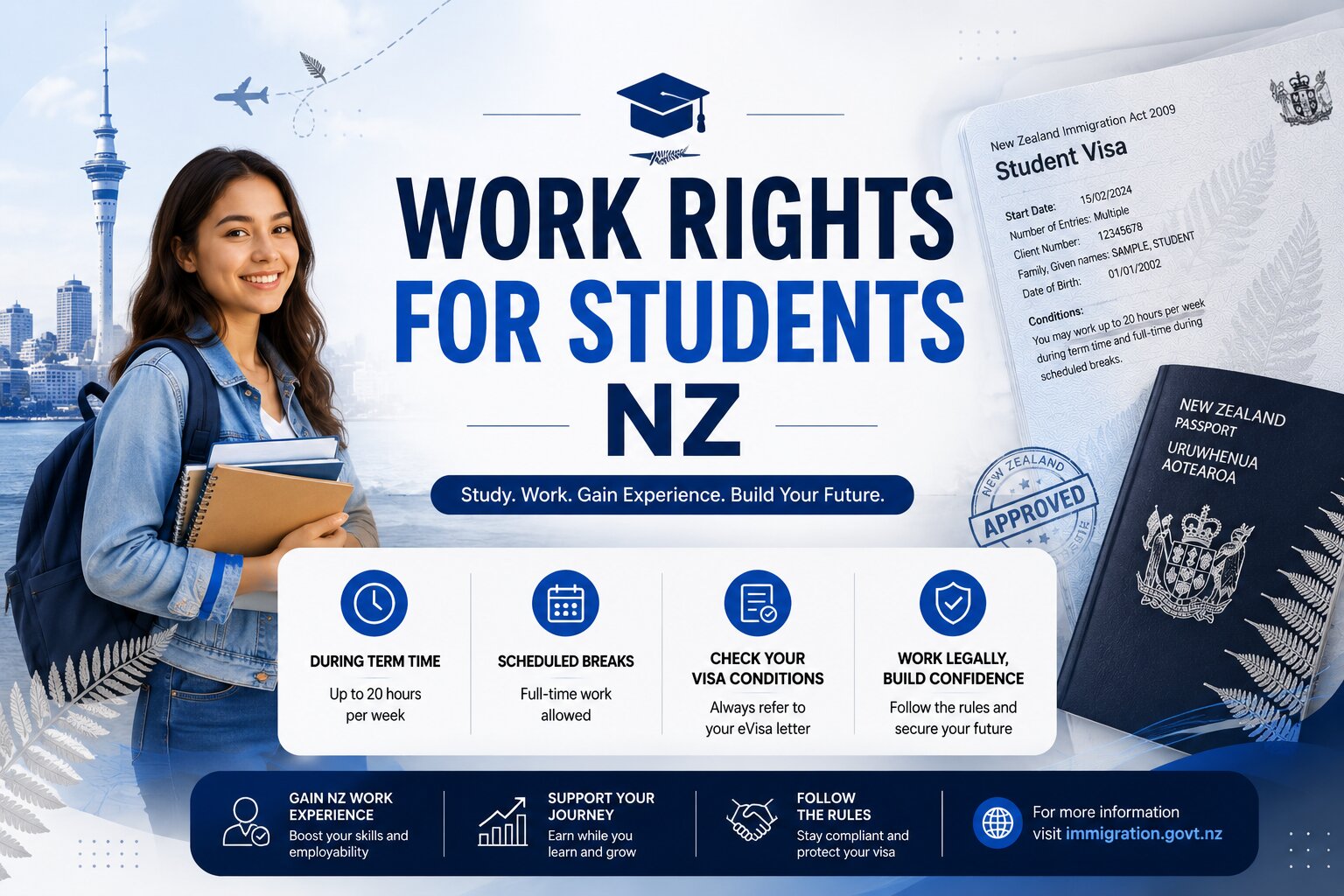
Work Rights for Students in New Zealand depend on the exact wording of a student’s visa conditions, not on informal advice from friends, employers, or education agents. Immigration New Zealand explains that a student visa may include conditions about studying, working and travelling, and students can check these conditions in their eVisa, their visa letter, or through the Visa Verification Service.1 For international students, this means that the first compliance step is always to read the visa grant information carefully before starting any student employment.

New Zealand is a popular study destination because it combines high-quality education, international education options, and practical work experience in New Zealand. However, work rights are not automatic for every New Zealand Student Visa. Some visas allow part-time work while studying; others may allow full-time work during scheduled breaks; and some visas do not allow work at all. The rules may differ for tertiary students, PhD students, students in a Masters research programme, English language students, secondary school students, and exchange students.

Student work rights are a visa condition. A student should not assume they can work simply because they are enrolled with an education provider; they must confirm the work conditions stated on the eVisa or visa letter before accepting employment

This guide explains how working on a student visa usually operates, how students can protect their legal status, and how pathways such as the Post Study Work Visa, Pathway Student Visa, Exchange Student Visa and foreign government supported student visa may fit into longer-term plans.

Student Visa Conditions and Legal Work Permission

Student Visa Conditions are the legal rules attached to a visa. They may cover the education provider, course, full-time study requirement, expiry date, travel permission, and work hours limit. Immigration New Zealand states that if a student visa allows work, the student must only work under the conditions specified in that visa, including how many hours they can work each week and when they can work.1

This point is important because New Zealand work rights for students are not one-size-fits-all. A Fee Paying Student Visa can allow full-time study on an approved course and, depending on conditions, part-time work up to 25 hours per week while studying and full-time work in holidays.2 A Pathway Student Visa can cover up to three consecutive courses and may include work rights if the student provides required course and holiday information and written permission where necessary.3 An Exchange Student Visa can also include work rights, but only according to age, study length, and the conditions granted.4

Checking the eVisa Letter and Visa Letter

The eVisa letter and visa letter are the practical starting points for a visa conditions check. Immigration New Zealand says students can find conditions in their eVisa, the letter sent when the visa was granted, or through the Visa Verification Service.1 These documents should be kept with employment records because an employer may ask to confirm whether the student can work.

Students should check whether the visa refers to part-time work rights, full-time work rights in scheduled study breaks, or no work permission. They should also check whether any practical experience requirement is part of the approved programme. Practical work required by a course may be treated differently from general paid employment, but it still needs to match the visa and course conditions.

When a Variation of Conditions Is Needed

A Variation of Conditions may be needed when the student wants to change a visa condition rather than apply for a new visa. Immigration New Zealand states that students can apply to change visa conditions to allow part-time work or full-time work during holidays if their current visa does not already allow this and they are eligible.1 The same page also states that a variation cannot change the visa expiry date, so students who need longer stay must apply for another temporary visa before the current visa expires.1

For a renew student visa NZ process, students should understand that Immigration New Zealand does not describe this as simply “renewing” the same visa. If the student wants to remain in New Zealand after the expiry date, they must apply for another temporary visa before the existing visa expires, and INZ recommends applying at least one month before expiry.1 Students who change education provider, move to a lower-level course, or need a much longer visa may need a new student visa rather than a variation.

Part-Time Work Rights During Study

Part-Time Work Rights are usually the most relevant rules for international students during an academic semester. Immigration New Zealand’s current student work guidance states that students may be able to work part-time up to 25 hours a week while studying, depending on the visa conditions and the type of study.5 This reflects the increase from 20 to 25 hours a week for eligible student visas from 3 November 2025, with separate variation options for some students whose older visa still states 20 hours.1

The work hours limit should be treated as a strict weekly cap. If a student works multiple jobs, the hours from all jobs count together. The employer may monitor one roster, but the student remains responsible for overall visa compliance. Students should keep copies of rosters, payslips, and employment agreements so they can show they stayed within their visa conditions if asked.

Tertiary Students, PhD Students and Masters Research Programme Rules

Tertiary students commonly hold work rights when their programme meets the relevant student visa requirements. The rules can be more favourable for some higher-level research students. Immigration New Zealand’s work-rights guidance distinguishes different student groups, including tertiary students, PhD students, and Masters research programme students, because the nature and level of the qualification can affect work permission.5

Students should not rely only on the name of the programme. The New Zealand Qualifications and Credentials Framework, often referred to as NZQCF, the education provider’s approval status, and the offer of place can all influence the assessment. Where the course includes a practical experience requirement, the education provider should confirm that the work experience is compulsory for the qualification.

English Language Students and Category 1 Education Provider Requirements

English language students may have work rights only where their programme and provider meet the rules. Terms such as Category 1 Education Provider, NZQA, IELTS Certificate, and English Language Test Result may become relevant because English language study is assessed differently from many tertiary qualifications. Students should make sure their offer of place clearly states the course duration, study load, and scheduled holidays.

This is also where study and work balance matters. A student visa is primarily for study in New Zealand, not for full-time labour-market participation. A student who repeatedly misses class, fails attendance requirements, or works beyond their conditions may create problems for a future Student Visa Application, Visa Extension, Post Study Work Visa, Work Visa, Skilled Migrant Category application, Resident Visa pathway, or other New Zealand immigration policy assessment.

Full-Time Work Rights and Scheduled Breaks

Full-Time Work Rights usually apply only in specific periods, such as scheduled study breaks or the Christmas and New Year holiday period, and only when the visa conditions allow them. Immigration New Zealand’s Fee Paying Student Visa page states that the visa can allow full-time work in holidays, depending on conditions.2 The Exchange Student Visa page similarly states that some exchange students may work part-time while studying or full-time in holidays, depending on age and study length.4

Scheduled breaks should be supported by education provider documents. For example, an offer of place may state the dates of the course and scheduled holidays. If the course is more than one academic year, Immigration New Zealand expects holiday information to be included in the offer of place or provided separately for some student visas.3 Students should retain these documents because an employer may not know whether a break is officially scheduled.

Secondary School Students, Age Limits and Permission

Secondary school students must be especially careful. Immigration New Zealand states that students aged 16 or 17 in years 12 or 13 of secondary school, or studying at a tertiary education provider under an exchange visa, may need written permission from parents or a legal guardian, the approved education provider, and the exchange programme organisation for work rights.4 Students aged 15 or younger cannot work on a student visa under the Exchange Student Visa rules.4

These rules matter for families planning a New Zealand study pathway. A younger student may hold a Visitor Visa, student visa, or dependent child visa depending on their circumstances, but work rights are not automatically attached to age, school enrolment, or living in New Zealand. The student’s visa letter remains the controlling document.

Practical Experience, Internships and Course Requirements

Some courses include practical experience as a compulsory part of the qualification. Immigration New Zealand states that where practical work experience is required, students must provide evidence that it is a requirement of their studies, such as a letter from the approved education provider or a course outline.4 Time spent on required practical experience may be treated separately from general paid-work hours, but students should still ensure that the practical placement is documented and consistent with the visa.

This distinction is important for internships, clinical placements, hospitality training, teaching practice, aviation training, and other vocational programmes. If the work is optional or mainly paid employment, it may count toward the work hours limit. If it is a compulsory course component, the evidence should be clear before the placement starts.

Visa Types That Affect Student Work Rights

Different student visa categories have different settings. A New Zealand Student Visa may be a Fee Paying Student Visa, Pathway Student Visa, Exchange Student Visa, Foreign Government Supported Student Visa, or another category. Each visa type has its own documents, eligibility rules, and work conditions. The phrase student visa requirements should therefore be read with the specific visa type in mind, not as a single universal checklist.

The Fee Paying Student Visa is the most common route for many international students who pay tuition fees directly, through family support, a loan, or a partial scholarship.2 The Pathway Student Visa is designed for students taking up to three courses in sequence on one visa.3 The Exchange Student Visa is for students accepted into an approved exchange scheme and applying from outside New Zealand.4 The Foreign Government Supported Student Visa is for students whose foreign government scholarship supports tuition and living costs under an education agreement with New Zealand.6

Exchange, Pathway and Foreign Government Supported Student Visa NZ

The exchange student visa NZ requirements include acceptance into an approved student exchange scheme, an offer of place from an approved education provider unless the student is coming through an exchange programme organisation, sufficient living funds or an acceptable sponsor, and being outside New Zealand when applying.4 The visa may allow part-time work up to 25 hours a week while studying or full-time work in holidays depending on the student’s age and course length.4

The pathway student visa NZ requirements include a pathway offer of place from an approved education provider, enough money for tuition and living costs or an acceptable sponsor, insurance, genuine reasons for coming, and evidence of course progress and attendance if the student already has a student visa.3 The foreign government supported student visa NZ category requires a government support letter, confirmation that tuition and living expenses will be paid by the government, and an offer of place from an approved education provider.6

Visa type Common work-rights context Key compliance point
Fee Paying Student Visa May allow 25 hours per week and holiday work Check the eVisa and course holiday dates
Pathway Student Visa May include work rights across linked courses Keep pathway offer and progress evidence
Exchange Student Visa Work depends on age, exchange type and study length Some younger students need written permission
Foreign Government Supported Student Visa May allow 25 hours per week and holiday work Government support must cover tuition and living expenses

Employment Compliance and Future Pathways

Work Rights for Students should be managed as part of a wider immigration plan. A student who breaches work restrictions may face visa problems, and this can affect future Visa Eligibility, Visa Processing, or an application for a Post Study Work Visa. Immigration New Zealand states that the Post Study Work Visa allows eligible graduates to work in New Zealand for up to three years depending on what they studied, and it can lead to a resident visa.7

Employment compliance also protects the student in the workplace. International students are employees when they work, which means they should understand employee rights, obtain an IRD Number from Inland Revenue, and sign a written Employment Agreement. If an employer asks a student to work more hours than allowed, the student should refuse and seek Immigration Advice from a licensed Immigration Adviser or appropriate official source.

IRD Number, Employment Agreement and Employee Rights

Before starting paid work, students should apply for an IRD Number, confirm tax obligations, and keep payslips. A written employment agreement helps define pay, hours, duties, leave, and workplace expectations. It also makes it easier to prove that work stayed within the allowed student work hours.

Students should be cautious about cash work, unpaid work that is really employment, and “trial” shifts that are not properly documented. Visa compliance is not separate from employment law; both matter. A student who wants to study abroad successfully in New Zealand should plan rosters around classes, assessments, attendance requirements, and health, rather than allowing employment to undermine the study purpose of the visa.

From Student Employment to Post Study Work Visa and Residence Options

Student employment can help with living in New Zealand, confidence, local references, and career awareness, but it should not be confused with a guaranteed residence pathway. A Post Study Work Visa may be available only where the student completes an eligible New Zealand qualification and applies within the required timeframe.7 After that, some graduates may later explore a Work Visa, Skilled Migrant Category pathway, or Resident Visa option if they meet the relevant criteria at that time.

The safest strategy is to align New Zealand study opportunities with educational qualifications, realistic employment goals, and lawful work conditions from the start. Students should review their visa conditions whenever they receive a new visa, change course, change provider, change work pattern, or prepare a new visa application. In this way, international students can benefit from the New Zealand education system while protecting their immigration record.

Conclusion: Staying Lawful While Working and Studying

Work Rights for Students in New Zealand are valuable, but they are conditional. A student must check the eVisa letter, understand the visa letter, respect the work hours limit, and confirm whether full-time work is allowed only during scheduled breaks. Understanding the Financial Requirements of Student Visa NZ is equally important, as students must prove they can support themselves while studying and working in New Zealand. Where conditions need to change, a Variation of Conditions may help, but it cannot extend the visa expiry date. For a longer stay, students must apply for another visa before the current one expires.

A strong Student Visa Application is built on accurate documents, a clear offer of place, genuine study intentions, and realistic plans for work and study balance. This is why a Study Visa New Zealand plan should match the student’s course, budget, work expectations, and long-term goals before lodgement. Whether the student is on a Fee Paying Student Visa, Exchange Student Visa, Pathway Student Visa, or Foreign Government Supported Student Visa, the safest approach is the same: read the conditions, keep evidence, work lawfully, and ask for professional support when unsure. With careful planning, students can gain meaningful work experience in New Zealand while maintaining compliance and protecting future immigration options.

Financial Requirements of Student Visa in NZ

A successful Student Visa NZ application depends on more than an offer of place and a valid passport. Immigration New Zealand must be satisfied that the applicant can pay tuition fees, meet living costs in New Zealand, cover outward travel funds, and provide financial evidence that is credible, verifiable and genuinely available. These student visa requirements apply across common study pathways, including tertiary study, English language study, compulsory education, a Fee Paying Student Visa, a Pathway Student Visa and, in a different way, an Exchange Student Visa.

For international students, the financial part of a New Zealand student visa is often the most document-heavy stage of the student visa application. The immigration officer assessment focuses not only on the amount of money shown, but also on whether the funds are stable, traceable and available for study duration requirements. A bank balance by itself may not be enough if the source of funds is unclear, if there are unexplained deposits, or if third-party financial support is not properly documented. This is why study visa requirements, international student requirements and student immigration policy should be read together rather than treated as separate checklists.

Immigration New Zealand states that student visa applicants need to show they have enough money to live on and cover their expenses while in New Zealand. This means applicants should prepare financial proof for immigration as a core part of their visa application evidence, not as a last-minute add-on.

Why proof of funds matters

Proof of funds shows that the student can study in New Zealand without breaching student visa conditions or becoming financially vulnerable. It also supports the wider immigration financial assessment, including genuine temporary entrant considerations, immigration compliance and the applicant’s ability to follow New Zealand visa policy. In practical terms, strong evidence of available funds reduces the risk of a financial shortfall during the course.

Financial credibility matters because Immigration New Zealand may look beyond the first page of a bank statement. The decision-maker may consider account history, income patterns, loan terms, sponsor responsibilities, prepaid accommodation, tuition fee payment and whether the student has realistic student support funds and student financial support for monthly living expenses. This is especially important for overseas student funding, study abroad funding and study abroad expenses where money is provided by family, a guarantor, an acceptable sponsor or a financial undertaking.

Who needs to show student maintenance funds

Most applicants for a temporary student visa must show student maintenance funds unless a specific scheme or visa category changes how the cost is treated. Fee-paying applicants must generally prove tuition fees and living expenses, while students on approved exchange schemes may not need to pay tuition fees because they can be treated as domestic students for that visa type.

However, even exchange applicants still need to show enough money for living expenses or have an acceptable sponsor.

The same logic applies to pathway student visa NZ requirements. A pathway applicant can study up to three courses one after another on one visa, but must show funds to pay tuition fees and living costs, and must have a valid pathway offer from an approved education provider.

For exchange student visa NZ requirements, the applicant must be outside New Zealand, accepted into an approved exchange student scheme and able to meet living cost or sponsorship requirements.

Living Costs in New Zealand and Minimum Fund Levels

Immigration New Zealand sets specific student fund requirements for living costs. For tertiary study, English language study and other non-compulsory education, the current amount is NZD 20,000 yearly funds if the course is one year or longer, or NZD 1,667 monthly funds if the study is shorter than one year.

These figures are central to study visa funding and should be calculated before submitting an online application.

For compulsory education, such as primary, intermediate or secondary school from Years 1 to 13, the annual requirement is NZD $17,000, or NZD $1,417 per month if the study is shorter than one year.

This distinction matters for dependent student support, school students and families comparing student accommodation costs, homestay service fees and other New Zealand study costs.

Study situation Minimum living funds Practical planning point
Tertiary, English language or other non-compulsory study for one year or more NZD $20,000 per year Use annual living costs plus tuition fees and travel funds as the base calculation.
Tertiary, English language or other non-compulsory study under one year NZD $1,667 per month Match the amount to the exact study duration requirements.
Compulsory education, Years 1 to 13, for one year or more NZD $17,000 per year Relevant to school students and some dependent child arrangements.
Compulsory education under one year NZD $1,417 per month Calculate by month and keep evidence clear.

Tertiary study, English language study and compulsory education

Tertiary study includes universities, institutes of technology and polytechnics, private training establishments and other recognised educational institutions within the New Zealand education system. English language study is usually treated as non-compulsory study, so the NZD $20,000 or NZD $1,667 threshold normally applies.

Applicants should also check whether the education provider is an approved education provider and whether the offer of place correctly records the course dates, holiday periods and tuition fees.

Compulsory education is treated differently because the expected annual living costs are lower under the immigration rules. However, a school applicant still needs adequate financial evidence documents, health and travel insurance if required, good character requirements where applicable, and clear immigration documents. Parents should also consider dependent student support, student accommodation verification and NZQA Code of Practice protections when planning school-level study.

Prepaid accommodation and homestay service deductions

Prepaid accommodation can reduce the amount of additional funds that must be shown. Immigration New Zealand notes that accommodation paid in advance, such as payment to a school for a homestay service, can be deducted from the required living funds. If there is a remaining shortfall, the applicant must provide evidence of the balance.

This is useful where student accommodation costs are paid directly to an education provider or approved homestay provider. However, applicants should keep receipts, confirmation letters and contract details because student accommodation verification should be easy for an immigration officer to understand. A claim that accommodation is prepaid without proof may not satisfy proof of sufficient funds.

Tuition Fees, Outward Travel Funds and Extra Costs

A Student Visa NZ applicant normally needs to show the ability to pay tuition fees, unless exempt or covered by a scholarship. For a Fee Paying Student Visa, Immigration New Zealand says the student must show they have paid tuition fees for one course or one year of study, whichever is shorter, or provide other accepted evidence such as provider confirmation or relevant loan documents.

For a Pathway Student Visa, tuition evidence must cover the first course or first year and also show the ability to pay for later pathway courses.

Tuition fee payment evidence can include receipts from the education provider, a letter confirming payment, confirmation that no fee is payable, scholarship evidence, or loan evidence where accepted. Applicants applying from outside New Zealand may be able to wait until approval in principle before paying tuition, but Immigration New Zealand warns that the application can take longer because final tuition evidence is needed before the visa is issued.

Tuition fee payment and approval in principle

Approval in principle can help some students avoid paying large tuition fees before Immigration New Zealand has assessed the main visa criteria. It does not remove the requirement to pay; it simply means the applicant may be asked to provide tuition fee evidence after the application is approved in principle and before final grant. This is particularly relevant for students managing international education funding, education loans or overseas study expenses.

Applicants should also check whether specialist courses create higher cost obligations. For example, aviation student fees may involve substantial training costs, equipment costs or staged payments. The same principle applies: the student visa approval process must show that tuition and living costs can be met in a credible way, and that the applicant is not relying on uncertain future income.

Outward travel funds and maternity health costs

Outward travel funds are separate from living costs. Immigration New Zealand requires evidence of outward travel, such as a fully paid ticket out of New Zealand, or enough extra money to buy a ticket.

The money for return travel funds should not be counted as part of the annual or monthly student maintenance requirements.

Pregnant applicants should also plan for maternity health costs. Immigration New Zealand states that pregnant student visa applicants must show NZD $9,000 for maternity health and medical costs, meaning maternity medical expenses must be budgeted separately unless maternity care is publicly funded in certain situations.

Because public healthcare eligibility can be limited for temporary visa holders, this is separate from student living expenses, tuition fees and travel funds, so it should be recorded as an additional line in the financial plan.

Acceptable Financial Evidence and Sponsor Options

The strongest financial evidence is consistent, complete and easy to verify. Immigration New Zealand accepts primary funds evidence such as bank statements with the account holder’s name and the last three months of transaction history, fixed-term deposit certificates held for at least three months, scholarship award letters, education loan documents and evidence of provident funds that can be withdrawn.

These documents help show genuine access to funds.

Secondary evidence may be requested if Immigration New Zealand needs to confirm the genuine source of money. Large deposits over NZD $2,000, many smaller deposits or newly opened accounts may need explanation with supporting documents, such as payslips, tax returns, employment letters, business registration documents or rental income evidence.

This is where student financial verification often becomes more detailed.

Bank statements for visa and primary funds evidence

Bank statements for visa purposes should show the account holder, account number, balance and transaction history. A single screenshot is usually weaker than an official statement because it may not show the history needed for immigration financial checks. If funds are held in fixed-term deposits, the certificate should show that the deposit has existed long enough to meet the requirement and can be accessed when needed.

Education loans should be presented carefully. Immigration New Zealand may consider loan sanction and disbursal letters, but the documents should explain security, moratorium period, interest payable and repayments where relevant.

This helps the officer understand whether the loan is genuine, whether money is available for the student and whether repayment obligations are realistic.

Acceptable sponsor, financial guarantor and third-party support

An acceptable sponsor can be an individual or organisation that accepts sponsor responsibilities. Individual sponsors must be New Zealand citizens or residents and a family member or friend, so a New Zealand citizen sponsor or resident sponsor must still prove both the relationship and the ability to support the applicant; organisation sponsors must be registered in New Zealand and show a clear connection between their activities and the reason for sponsorship.

Evidence of sponsorship may include recent bank statements, payslips, an employment agreement and proof of accommodation ownership or rent payments.

These financial sponsorship documents should be consistent with immigration sponsorship rules, and an approved financial sponsor must be able to show that the promised support is realistic.

A financial guarantor or third-party financial support arrangement is different from sponsorship. A guarantor or third party outside New Zealand may provide a Financial Undertaking for a Student, supported by evidence such as three months of bank statements or bank confirmation that sufficient funds are held.

Immigration New Zealand may assess the strength of the relationship and whether the guarantor can credibly support the student using money that is their own and not borrowed.

Funds Transfer Scheme and Visa Financial Assessment

The Funds Transfer Scheme is an Immigration New Zealand scheme run by ANZ Bank New Zealand Limited. It provides a secure fund transfer option for students from China, India, Nepal, the Philippines, Sri Lanka and Vietnam to transfer the funds they need to support themselves while in New Zealand.

It can be part of the evidence of financial support, but Immigration New Zealand also makes clear that using the scheme does not guarantee visa approval.

The scheme is useful because it can help demonstrate that money is accessible in New Zealand rather than simply shown overseas for application purposes. However, it is not a substitute for a complete student visa application. Applicants still need a valid offer of place, identity evidence, immigration health requirements, good character requirements, police certificate requirements if requested, a student visa declaration and all other visa processing requirements. Where policy interpretation is complex, the Immigration operational manual may be relevant, but students should rely on current official instructions and obtain licensed advice where needed.

International fund transfer and secure fund transfer planning

International fund transfer planning should begin early, especially where exchange rates, bank processing times or source-of-funds checks may delay payment. The Funds Transfer Scheme can provide structure, but students should wait for Immigration New Zealand’s instructions if told they need to use it. Transferring funds too late may affect the timing of visa application evidence and student visa approval.

Students should also keep documents that show where the transferred money came from. A secure fund transfer is strongest when it is supported by bank statements, income evidence, sponsor documents or loan records. This makes the financial support scheme easier to assess and aligns with Immigration New Zealand’s focus on genuine availability of funds.

Financial credibility and immigration officer assessment

Financial credibility is a combined assessment of amount, access, source and consistency. A student may technically meet the NZD $20,000 yearly funds threshold but still receive questions if the account history is weak or the source is unclear. Conversely, a well-prepared file with clear funds, a reliable sponsor, prepaid accommodation and realistic travel funding can support a smoother assessment.

Applicants should avoid common mistakes such as using unexplained cash deposits, relying on informal promises, omitting tuition fee payment evidence, failing to add outward travel funds or assuming that part-time work can fund the first year. Work rights may help with living flexibility, but they should not replace proof of funds at the visa stage. Visa eligibility requirements are assessed before arrival, and financial stability for students must be demonstrated upfront.

Student Visa NZ financial checklist and common mistakes

A practical financial checklist should connect the course, the education provider, the study duration and the evidence, while also confirming visa compliance, study permit funding and student visa support arrangements before lodgement. Start with the offer of place, identify whether the visa is a Fee Paying Student Visa, Pathway Student Visa or Exchange Student Visa, then calculate living funds, tuition fees, travel costs, accommodation and any special expenses. This approach keeps the Student Visa NZ file organised and supports immigration compliance.

Students should also consider whether they need immigration advice. A licensed immigration adviser can help with complex sponsorship, overseas student funding, financial undertaking documents, student visa sponsorship or previous visa issues. While many straightforward applications can be prepared independently, professional immigration advice may be useful where there are large unexplained deposits, previous refusals, complex family funding or uncertainty about New Zealand visa policy.

Fee Paying Student Visa and Pathway Student Visa funding

For a Fee Paying Student Visa, the main financial documents usually cover tuition fees, living costs, outward travel, insurance and the source of funds.

For pathway student visa NZ requirements, the financial plan must also cover the first course or first year plus credible evidence for the rest of the pathway.

This makes long-term planning especially important for students completing several courses on a single visa.

The Pathway Student Visa can support study in New Zealand across up to three linked courses, but it should not be treated as a shortcut around financial proof. Immigration New Zealand still expects clear evidence that the student can pay tuition and maintain themselves. If the student’s plan depends on future family income, scholarships or loans, those funding options should be documented in a way that supports financial credibility.

Exchange student visa NZ requirements and final preparation

For exchange student visa NZ requirements, the applicant must show acceptance into an approved student exchange scheme and generally be outside New Zealand when applying.

Tuition fees are different because exchange students on this visa do not need to pay tuition fees and are considered domestic students for that purpose, but they still need living cost support or an acceptable sponsor.

Study Abroad programmes are not approved exchange schemes and usually require a Fee Paying Student Visa instead.

Before lodgement, students should check that their documents are current, translated where required, complete and consistent with the online visa application. A strong final file should include the offer of place, financial evidence documents, proof of sufficient funds, tuition fee evidence, travel funding, insurance evidence where needed, health and character documents, and any sponsor or guarantor forms. When these documents align, the financial requirements for a New Zealand student visa become much easier to understand and assess.


Student Visa Requirements NZ

A Student Visa is the main immigration permission many learners need before they can Study in New Zealand for more than a short visit. Understanding Student Visa Requirements is essential for international learners, as the visa is not only a travel document. It is also a structured approval that connects your Offer of Place, course choice, Proof of Funds, health and character evidence, insurance, and study intentions into one application assessed by Immigration New Zealand. Because education, work rights and future migration planning often overlap, a well-prepared application should clearly meet Student Visa Requirements while demonstrating both academic purpose and practical readiness.

This Student Visa Guide explains the main NZ Student Visa Requirements for a New Zealand Student Visa, with emphasis on the Fee Paying Student Visa NZ, online lodgement, evidence, work conditions and future options. It is written for International Students in New Zealand, applicants planning Study Abroad New Zealand, families checking dependent child student visa NZ eligibility, and students considering NZ Study Opportunities 2026. It also explains why a Student Visa is different from a Partner Visa, even though family members may sometimes apply for visas based on their relationship to a student.1

Student Visa Requirements NZ: Who Can Apply

The official Fee Paying Student Visa is for students who are paying international tuition fees themselves or with support from family, a loan or a partial scholarship. Immigration New Zealand states that applicants must have an offer of place from an approved education provider, have enough money for tuition and living costs, declare acceptable insurance, and meet the other requirements of the visa.1 This category can allow study for up to 4 years, and the current official page shows a Student Visa Processing Time of 80% within 10 weeks.1

New Zealand Student Visa and eligibility basics

Student Visa Eligibility begins with a genuine study purpose. Applicants must be offered a place on a course by an approved education provider, be in good health and of good character, have a genuine reason for coming to New Zealand, and show they can leave New Zealand at the end of their stay.1 These requirements apply whether the applicant is choosing New Zealand Universities, private training establishments, schools, institutes of technology, polytechnics or other NZ Education Providers.
A strong application connects the course to the student’s background. For example, a learner choosing Vocational Programs New Zealand should explain how the programme fits previous study, employment history or realistic Graduate Career Pathways. Similarly, a university applicant should show how the qualification supports Overseas Career Growth, Career Opportunities in New Zealand where lawful, or longer-term Global Education Opportunities.

Fee Paying Student Visa NZ and approved providers

The Fee Paying Student Visa NZ route requires an Offer of Place from an approved education provider. Immigration New Zealand says offer evidence should include the course name, course duration, whether study is full-time or part-time, relevant distance-learning details and scheduled holiday dates for longer courses.1 A returning student may provide Confirmation of Enrolment where appropriate.1
The provider also needs to declare that the course is suitable and that the student has the academic capability and English ability to pass.1 This is why Course Selection Guidance and University Selection Assistance should be practical, not promotional. A course should match the student’s academic level, career plan, financial capacity and likely visa conditions. Recognised Educational Institutions that are signatories to the pastoral care code are important because international learners need both academic quality and appropriate support.1

Student Visa Application Process and Documents

The Student Visa Application Process is now primarily digital for the Fee Paying Student Visa. Immigration New Zealand notes that paper applications are no longer accepted for this visa and that applications must be submitted online.1 Students are also strongly encouraged to apply 3 months before their intended travel date, which gives time for evidence checking, medical or police requests, fee payment confirmation and possible follow-up questions.1

Online Visa Application NZ and document preparation

An Online Visa Application NZ should be organised before lodgement. Student Visa Documents usually include a valid passport, acceptable photo, Offer of Place or Confirmation of Enrolment, tuition fee evidence or scholarship evidence, living cost evidence, insurance declaration, health information, character documents where required, and evidence of genuine study intentions. Valid Passport Requirements matter because a visa may be issued only up to the passport expiry date if that date is earlier than the paid study period.1
Good Document Preparation Services or Student Visa Support Services should focus on accuracy. Academic Transcripts should be complete and consistent with the course level. Financial evidence should be clear, traceable and aligned with the required study period. If documents are not in English, the applicant should follow official translation instructions. The result is a cleaner Study Visa Approval Process, fewer avoidable questions, and a more credible pathway to Student Visa Approval.

Offer of Place, tuition fees and proof of funds

The Offer of Place is the academic anchor of the application, while Proof of Funds is the financial anchor. Immigration New Zealand says applicants must show they have paid tuition fees for one course or one year of study, whichever is shorter, unless exempt.1 Evidence may include provider receipts, confirmation that fees are not required, scholarship evidence or other accepted financial documents.1
For Tuition Fees New Zealand, students should budget beyond the first invoice. If the course runs for more than one year, Immigration New Zealand says a credible plan for funding later years can strengthen the application, even if the money for later years is not yet available.1 This is where Financial Planning for Students becomes a visa issue, not just a personal budgeting matter. A realistic plan can show that the applicant is likely to meet visa conditions and maintain lawful study.

English, Health, Character and Insurance Requirements

A Study Visa New Zealand application is not assessed only on admission. It also looks at personal eligibility. Applicants must satisfy health, character, financial and genuine intention requirements. Some students will need medical checks, and some will need police certificates depending on their circumstances, travel history and length of stay. These checks help Immigration New Zealand assess whether the applicant meets temporary entry requirements.1

English proficiency test, IELTS and TOEFL requirements

Many students ask whether a visa requires an English Proficiency Test, IELTS Requirements or TOEFL Requirements. In practice, English evidence is often driven by the education provider’s admission requirements, and the provider’s offer must include a declaration that it is satisfied the student has the English language ability and academic capability to pass the course.1 This means the visa file should align with the provider’s admission decision.
Students should still keep copies of IELTS, TOEFL, PTE, school results or other accepted English evidence where those documents were used for admission. International Education Consultants, an Education Consultancy NZ firm or a Student Visa Consultant should avoid overstating English results. The safer approach is to present genuine academic evidence, explain any study gaps, and connect the course to a realistic education plan.
Health insurance, police clearance and passport evidence should be treated as core Student Visa Documentation, not as an afterthought. Immigration New Zealand requires Fee Paying Student Visa applicants to declare that they will have insurance acceptable to their education provider.1 Health Insurance for Students is therefore a core compliance issue, not an optional extra. Students also need to consider public healthcare eligibility, medical checks, and the cost of unexpected treatment in New Zealand.
A Police Clearance Certificate may be required depending on the applicant’s situation, and health or character concerns can slow processing. Immigration Advice NZ from a licensed adviser may be helpful where there are previous refusals, complex travel histories, medical issues or criminal matters. In ordinary cases, accurate disclosure, consistent documents and a clear explanation are the foundation of sound Visa Application Support.

Study and Work Rights for International Students

A major reason students choose Study Destination New Zealand is the balance between High-Quality Education, a Safe and Welcoming Lifestyle, and limited work rights. The Fee Paying Student Visa can let students study full-time on an approved course, work part-time up to 25 hours a week while studying and full-time during holidays, depending on visa conditions.1 These conditions should be read carefully because not every student has identical work rights.
Topic
Practical meaning for students
Part-Time Work While Studying
Work may be allowed up to 25 hours per week if the visa conditions permit it.1
Full-Time Work During Breaks
Full-time work may be allowed during scheduled holidays, depending on the visa conditions.1
Student Visa Conditions
Conditions can include course, provider, work rights, insurance and expiry limits.
Work Experience for Students
Work should support, not replace, the main purpose of full-time study.

Part-time work while studying and full-time breaks

Work Rights for International Students should be treated as a permission attached to the visa, not a guarantee of employment. Students should check their eVisa and conditions before starting a job. Employers may ask for evidence of work rights, and students should keep records of hours worked to avoid breaching their Student Visa Conditions.
Study and Work in New Zealand can be valuable when managed carefully. Part-time work can help students gain confidence, local references and professional exposure, but it should not undermine attendance or academic progress. Immigration New Zealand says applicants who already hold a student visa may need to show they are passing their course and meeting attendance requirements.1 This makes academic performance part of future onshore student visa NZ extension planning.
Post-study work and skilled graduate pathways are important for students comparing International Student Visas NZ, Overseas Education and International Education NZ options. The Post-Study Work Visa New Zealand is a separate pathway for eligible graduates who want to work after completing study in New Zealand. Immigration New Zealand says this visa can allow a person to stay and work for up to 3 years, depending on what they studied, and the official page currently shows 80% of applications processed within 5 weeks.2
Students interested in Residency Pathways NZ, Future Residency Options, Skilled Graduate Pathways, Long-Term Residency Opportunities or broader NZ Immigration Pathways should plan early. Not every qualification leads to the same outcome, and post-study rights depend on qualification level, study length and other policy settings.2 Good Education and Immigration Services should help students understand the difference between a study decision, a work visa decision and a future residence strategy.

Student Visa Checklist, Family Options and Success Tips

A practical Student Visa Checklist should confirm the course, provider, funds, passport, health, character, insurance, academic history and genuine intention evidence before lodgement. Students should also prepare for arrival by researching Student Accommodation New Zealand, cost of living, transport, banking, healthcare access and Student Support Services. These details make the Overseas Student Experience more stable, strengthen International Student Support, and reduce pressure after arrival.

Dependent child student visa NZ eligibility and family visas

Families should not assume that every family member can be added to a student application. Immigration New Zealand states that partners and dependent children cannot be included in a Fee Paying Student Visa application, although they may be able to apply for visas based on their relationship to the student.1 A Partner Visa is therefore a separate application type and should be assessed on its own requirements.
For children, dependent child student visa NZ eligibility may be relevant. The official Dependent Child Student Visa is for dependent children aged 19 or younger who will study at primary or secondary school while the parent has an appropriate work or student visa.3 Immigration New Zealand currently shows this visa as valid for the same duration as the parent’s visa, with 80% processed within 7 weeks.3 If the supporting parent has a student visa, eligibility is limited to specific situations, such as a government-approved student exchange scheme, a PhD programme at a New Zealand university, or a Manaaki New Zealand Scholarship.3

Common student visa mistakes and approval tips

The most common Common Student Visa Mistakes include weak financial evidence, choosing a course that does not match the applicant’s history, ignoring insurance, submitting inconsistent academic records, relying on vague statements, and applying too close to the travel date. A stronger Student Visa Application Guide explains why the student chose New Zealand, why the course is suitable, how the study will be funded, and what the student plans to do after completion.
Student Visa Success Tips are usually practical rather than dramatic. Students should select credible Study Opportunities in NZ, compare Overseas Study Opportunities, keep evidence organised, avoid false documents, disclose previous visa issues, and seek help from a New Zealand Immigration Adviser where advice is needed. A good Student Visa Consultation should also explain Student Visa Assistance boundaries, because only licensed or exempt people can provide regulated immigration advice in New Zealand. Students using Education Abroad Services should check whether the service is giving education-only support or regulated immigration advice.
The wider New Zealand Education System offers many New Zealand Study Pathways, from schools and English language study to certificates, diplomas, degrees and postgraduate research. Top Universities in New Zealand and vocational providers can both create strong outcomes when the course is matched to the student’s goals. For Student Visa for Indian Students, or for applicants from any other country, the core rule is the same: the application must show genuine study, credible funds, suitable documents and compliance with immigration instructions.

Partner Visa Processing Timeline NZ

Understanding Partner Visa Processing in New Zealand is not only about counting weeks or months. It is also about understanding how Immigration New Zealand assesses a couple’s relationship status, whether the couple is in a marriage, civil union or de facto relationship, and whether the evidence supports a genuine, stable and ongoing partnership. Immigration New Zealand publishes estimated processing times, but those timeframes can change, and individual applications may move faster or slower depending on evidence quality, health checks, character checks, verification work and the visa category selected.1

For couples planning a shared life in Aotearoa New Zealand, the timeline can feel personal and urgent. A partner may be waiting offshore, a family may be arranging work and housing, or a couple may be deciding whether a temporary partner work visa or a residence pathway is more realistic. This guide explains Partner Visa Processing in practical New Zealand English, while also covering Marriage vs De Facto Relationships, De Facto Partner Rights, Married Couple Rights, Civil Union Rights, Relationship Property, and why Family Law NZ concepts should not be confused with immigration eligibility.

Partner Visa Processing Timeline NZ: What Applicants Should Expect

The official Partner Visa Processing timeline depends on the visa being applied for. Immigration New Zealand currently shows the Partner of a New Zealander Work Visa as processed for 80% of applications within 7 weeks, while the Partner of a New Zealander Resident Visa is shown as processed for 80% of applications within 7 months.These figures are useful for planning, but they are not a guaranteed decision date. They tell applicants what has happened for most recent applications in that category, not what must happen in every individual case.

Why processing times are estimates, not promises

Immigration New Zealand explains that applicants can check wait times for visitor, work, student, resident and other visa types, and that more detailed processing time information is published through its waiting-for-a-visa resources and Research and Statistics section. In practice, a partner application can take longer where the evidence is incomplete, the relationship history is complex, the couple has lived together in several countries, or third-party checks are required.

A strong application usually does not try to overload the case officer with irrelevant material. Instead, it explains the relationship clearly and supports that explanation with consistent documents. For example, if the couple claims they have been living together for 18 months, the evidence should show cohabitation across that period, not only a few recent photographs. If there were periods apart because of work, family obligations or visa limits, the couple should explain those gaps honestly and provide context.

“Immigration New Zealand states that relationship evidence for the Partner of a New Zealander Resident Visa should show how long the couple has been together, how long they have been living together, whether they share finances or other responsibilities, whether they spend time together, and whether other people recognise the relationship”

Temporary work route versus residence route

For many couples, the first timeline question is whether to apply for a temporary partner work visa or proceed directly to residence. The Partner of a New Zealander Work Visa can allow the applicant to work in New Zealand where they are supported by a New Zealand citizen or resident partner and are living together in a genuine and stable relationship. If the couple has lived together for less than 12 months, the visa may be granted for 1 year, with additional visas possible up to 3 years in total; if the couple has lived together for at least 12 months, the visa can be granted for up to 3 years.

By contrast, partnership resident visa NZ requirements are more demanding on relationship duration. For the Partner of a New Zealander Resident Visa, Immigration New Zealand says the applicant must be living with their partner in a genuine and stable relationship for at least 12 months when applying, and the partner must be a New Zealand citizen or resident who can support the application. This is why the advertised residence processing timeline is only one part of the plan. If a couple has not yet reached the required relationship duration, a temporary visa may be the more practical first step.

Relationship Evidence That Shapes Partner Visa Processing

A partner application is evidence-led. The legal label of the relationship matters, but the day-to-day reality of the relationship often matters more. Immigration New Zealand recognises partnership as people living together in a genuine and stable relationship, whether that relationship is a legal marriage, civil union or de facto relationship. This means Marriage vs de facto relationship NZ comparisons should be handled carefully. Marriage may provide a formal certificate, but it does not automatically prove that the couple is living together in a genuine and stable partnership.

Living together and cohabitation evidence

For immigration purposes, living together legal rights NZ discussions should be separated from the question of whether the couple has credible immigration evidence. Immigration New Zealand’s partnership guidance treats living together as sharing the same home, rather than merely visiting one another, staying in holiday accommodation or being flatmates with separate lives.4 This makes household evidence central to Partner Visa Processing.

Useful evidence may include tenancy agreements, property ownership documents, joint utility bills, shared-address mail, insurance records, travel records showing movement together, and correspondence showing how the couple maintained the relationship during any periods apart. Couples in a domestic relationship should also consider whether their evidence shows a shared home, shared routines, shared responsibilities and a shared life, rather than only a romantic connection.

Shared financial responsibilities and financial interdependence

Immigration New Zealand does not require every couple to organise money in the same way. Some couples keep separate bank accounts for cultural, professional or personal reasons. However, the evidence should still show shared financial responsibilities or other meaningful responsibilities where possible. This can include rent, mortgage payments, household bills, joint purchases, shared travel, care of children, shared pets, or agreed financial arrangements.

The strongest applications often show both financial contributions and non-financial contributions. One partner may pay the rent while the other manages childcare, cooking, household administration or care for a family member. Those non-financial contributions can still support the broader picture of relationship commitments, shared responsibilities and financial interdependence. In a long-term relationship, consistency across time usually matters more than one dramatic document.

Marriage vs De Facto Relationships in Immigration Context

The phrase De Facto vs Marriage Visa NZ can be misleading if it suggests that New Zealand has entirely separate “marriage visas” and “de facto visas”. In most partnership-based immigration settings, the core issue is whether the couple is in a genuine and stable partnership and whether they meet the requirements of the selected visa. The couple’s legal relationship status is relevant, but it is not the only factor.

Marriage in New Zealand, civil union and de facto relationship

Marriage in New Zealand is a legally recognised union between two people, regardless of sex, sexual orientation or gender identity. A civil union is also a formal legal relationship and generally carries the same rights and obligations under New Zealand law as marriage.A de facto relationship is different because it may exist without a ceremony or registration, but it can still receive legal recognition in many family and property contexts when the facts support it

For immigration, a marriage certificate or civil union certificate can help establish that a couple has made formal relationship commitments. However, a certificate does not replace evidence that the couple lives together and has an ongoing genuine and stable relationship. This is the key legal difference between marriage and de facto in partner visa practice: marriage may be easier to document formally, while a de facto relationship may require more evidence of daily life, cohabiting couples arrangements, shared responsibilities and recognition by others.

Legal relationship status and relationship duration

De facto relationship requirements are not identical in every area of New Zealand law. Immigration rules focus on the requirements of the visa category. By comparison, relationship property law often considers whether a marriage, civil union or de facto relationship has reached certain thresholds before equal property rules apply. This is why de facto relationship law New Zealand should not be treated as the same thing as immigration policy.

In partner visa applications, the couple should provide a coherent timeline. That timeline should cover when they met, when the relationship became committed, when they began living together, any periods of separation, major life events, and how family or friends recognised the relationship. A couple may be married but have limited living-together evidence, or unmarried but have years of strong relationship evidence. Both situations require careful explanation.

Relationship Property Issues That Do Not Replace Visa Evidence

Many couples searching for Partner Visa Processing also search for relationship property law NZ, property division after separation, relationship property claims or legal protection for couples NZ. These topics matter, but they answer a different question. Immigration New Zealand decides whether a visa applicant meets immigration instructions. The Family Court and New Zealand relationship property law deal with rights and obligations between partners, especially after relationship breakdown or relationship separation.

Property (Relationships) Act 1976 and relationship property division

The Property (Relationships) Act 1976 is the central statute governing division of relationship property in New Zealand. It can apply to married couples, civil union partners and de facto partners, although particular rules and thresholds can differ. Many people refer to this area as the Relationship Property Act, relationship property act NZ or a relationship property agreement issue, but the accurate starting point is the statute and the individual facts. The Ministry of Justice explains that the Family Court can make orders dividing relationship property when people have been married, in a civil union or in a de facto relationship.

The equal sharing principle is often discussed in relation to equal property division, shared property, joint assets, the shared home, property ownership and relationship property division. However, the fact that a couple might have relationship rights NZ under family law does not automatically prove that they meet immigration requirements. Likewise, a couple may meet immigration partnership requirements while still needing separate legal advice about asset protection, separate property, property settlement or relationship disputes.

Agreements, asset protection and relationship breakdown

Couples may choose to make a relationship agreement, contracting out agreement, separation agreement or prenuptial agreement to manage property expectations. These agreements may be relevant to Family Law, Relationship Law and Relationship Property Claims, but they should not be presented as a substitute for genuine partnership evidence. They can show planning and seriousness, but they are not the same as proof of living together.

This distinction is especially important for married vs unmarried couples NZ. A married couple may need immigration evidence just as much as a de facto couple. An unmarried couple may still have de facto partner rights NZ, De facto relationship rights New Zealand protections or possible relationship property claims if they satisfy the relevant legal tests, but those rights do not remove the need to meet visa instructions. In a civil union vs marriage NZ comparison, both formal statuses may provide strong evidence of commitment, yet both still require proof of living together for partnership-based immigration. For this reason, couples should obtain immigration advice for visa strategy and legal advice for property questions, especially where they need Legal Rights for Couples explained in both immigration and family law contexts.

Practical Steps to Keep Your Application Moving

Good preparation can reduce avoidable delays in Partner Visa Processing. Applicants should gather evidence before lodging, organise documents by date and category, explain gaps clearly, and make sure identity, health, character and translation requirements are complete. Immigration New Zealand can ask for more information if the case officer needs clarification, and late or inconsistent responses can slow the application.


A practical evidence pack will usually include a relationship timeline, proof of living together, shared financial documents, social evidence, family recognition, travel records, photographs with context, and statements from both partners. It should also explain unusual circumstances. For example, if the couple lived apart temporarily because one partner was completing a job contract, caring for parents, or waiting for a visa, that explanation should be supported by documents where possible.Preparing for a partner visa interview is also sensible, even where no interview is ultimately required. Both partners should be familiar with the relationship timeline, addresses, important dates, household arrangements, financial responsibilities and future plans. The goal is not to rehearse artificial answers. The goal is to ensure both partners can explain their real shared life accurately and consistently.


Some applicants compare partner routes with other pathways while they wait. For example, the specific purpose work visa NZ is a separate work category for people coming to New Zealand for a specific purpose or event, and Immigration New Zealand currently shows 80% of those applications processed within 3 weeks.That does not mean it is a substitute for a partnership visa. It has its own requirements, including evidence of the specific purpose or event, relevant qualifications or experience where required, and an ability to leave New Zealand at the end of the stay The safest approach is to choose the visa category that matches the facts. If the central reason for being in New Zealand is the relationship with a New Zealand citizen or resident partner, the partner visa route may be appropriate. If the central reason is a specific work project, a work category may be relevant. If residence is the goal, the couple should check whether they already meet the 12-month living-together requirement for the Partner of a New Zealander Resident Visa.Ultimately, Partner Visa Processing is smoother when the application tells one consistent story: who the couple are, how the relationship began, how it became committed, how they live together, how they share responsibilities, and why their future plans are credible. A strong application does not rely only on a marriage certificate, a few photos or general statements of love. It shows the ordinary, repeated evidence of a real domestic partnership.

De Facto vs Marriage Visa NZ: What Couples Need to Know

Understanding De Facto vs Marriage Visa NZ issues is important because New Zealand immigration and family law use similar relationship words, but they do not always ask the same question. A couple may be legally married, in a civil union, or in a de facto relationship, yet still need to prove their partnership carefully when applying for a visa. In a visa context, Immigration New Zealand focuses on whether the couple live together in a genuine and stable relationship, while wider New Zealand relationship property law considers how property may be divided if a qualifying relationship ends.

This article explains how marriage, civil union and de facto relationship evidence can affect a New Zealand partner visa pathway. It also clarifies why the Property (Relationships) Act 1976, the equal sharing principle, relationship property division, the Family Court, a separation agreement, a contracting out agreement and a prenuptial agreement may matter for couples planning a life in New Zealand. The aim is not to provide legal advice, but to help applicants understand the vocabulary, risks and evidence themes that often appear when immigration and relationship law overlap.

What De Facto vs Marriage Visa NZ Really Means

The phrase De Facto vs Marriage Visa NZ can be misleading if it suggests that New Zealand has one special visa for married people and another completely separate visa for de facto couples. In practice, partnership-based immigration assessment is broader. Immigration New Zealand defines partnership as two people who live together in a genuine and stable relationship in one of three forms: a legal marriage, a civil union, or a de facto relationship.

That means the legal label matters, but it is not the whole application. A marriage certificate may prove that a ceremony occurred and that the relationship has legal status. A civil union certificate may do similar work. A de facto couple may not have a certificate at all, but can still be recognised if their evidence shows they are living together as a couple in a genuine and stable relationship. The visa question is therefore less about which relationship label sounds strongest and more about whether the evidence satisfies the exact category being applied for.

Marriage, civil union and de facto relationship in visa language

For visa purposes, marriage, civil union and de facto relationship are all possible forms of partnership. Immigration New Zealand’s partnership evidence page expressly includes a legal marriage, a civil union and a de facto relationship within its definition of partnership.

This is helpful for couples who worry that an unmarried relationship will be automatically weaker. A well-documented de facto relationship can be compelling when it shows real cohabitation, shared life decisions, practical interdependence and recognition by family, friends or the community.

However, applicants should not assume that the existence of marriage alone removes the need for evidence. Immigration New Zealand still requires proof that the couple are living together in a genuine and stable relationship before it can approve a visa application based on partnership.

This distinction is crucial. A couple may be legally married but have lived apart for long periods, may not have combined household arrangements, or may have thin evidence of shared day-to-day life. In those cases, the marriage certificate is useful, but it does not replace the wider evidence file.

Relationship property law is different from visa eligibility

New Zealand relationship property law asks a different question from immigration law. The Ministry of Justice explains that the Family Court can make orders dividing relationship property when people have been married, in a civil union, or in a de facto relationship.

It also states that marriage is legally recognised as the union of two people regardless of sex, sexual orientation or gender identity, and that a civil union has the same rights and obligations under law as marriage.

The key point is that relationship property status and visa eligibility should not be treated as the same thing. Under the Property (Relationships) Act 1976, property consequences can arise when a qualifying relationship ends, especially where the relationship has lasted long enough or other statutory factors apply.

In contrast, a partner visa application turns on immigration instructions, supporting partner eligibility and proof of a genuine, stable partnership. A couple can therefore face two separate assessments: one about whether their relationship supports a visa, and another about how property might be treated if they later separate.

Professional note: A marriage certificate, civil union certificate or de facto history may support a partner visa application, but Immigration New Zealand still assesses the substance of the relationship. Couples should prepare evidence of living together, shared responsibilities and long-term commitment rather than relying only on legal status.

How Immigration New Zealand Assesses Partnership Evidence

Immigration New Zealand’s assessment is evidence-based. It looks at how long the couple have been together, how committed they are to a life together, whether they have children and how they care for them, whether other people recognise the relationship, and how they organise living and financial arrangements.

These indicators help an immigration officer decide whether the relationship is genuine and stable rather than merely formal or convenient.

This is where many applicants become confused. They may ask whether marriage is “better” than de facto status, when the more practical question is whether their evidence tells a consistent story. A de facto couple with strong cohabitation proof, shared finances, family recognition and clear future plans may present a stronger file than a married couple with little evidence beyond the certificate. Conversely, a recently married couple may still succeed if they can explain their history, provide credible documentation and meet the exact visa criteria.

Living together and cohabitation evidence

Immigration New Zealand says that living together means sharing the same home as your partner. It does not include spending time in each other’s homes while each person maintains a separate home, sharing accommodation while on holiday, or living as flatmates in the same house.

This definition is especially important for de facto couples because cohabitation is often the central evidence issue. It is also important for married couples who have spent time living apart for work, study, family or immigration reasons.

Useful evidence may include a joint tenancy agreement, joint ownership documents, home loan records, rental receipts, joint utility accounts, or individual mail sent to the same shared address. Immigration New Zealand notes that for some partnership applications, including the Partner of a New Zealander Resident Visa, evidence of living together must cover a 12-month period before the application is submitted.

Applicants should therefore organise documents chronologically, showing that both partners were at the same address across the required period rather than relying on one recent document.

Shared finances and non-financial contributions

Shared finances often help show that a couple has combined parts of their lives in a real and practical way. Immigration New Zealand lists joint bank accounts used frequently, joint ownership of assets, joint credit cards or hire purchase agreements, and mutually agreed financial arrangements as examples of evidence that may support a genuine and stable relationship.

In practice, the strongest financial evidence is usually active and ordinary. A bank account that receives income, pays rent, covers groceries or supports household bills usually says more than an account opened shortly before lodging an application.

At the same time, couples should remember that not every genuine relationship is financially identical. One partner may pay rent while the other pays food costs, provides childcare, manages household tasks, supports extended family, or contributes in other practical ways. These non-financial contributions can still help explain the relationship when they are documented and consistent with the couple’s circumstances. For example, evidence may include messages about household decisions, records of shared travel, letters from people who know the couple, children’s documents, photographs across time, and explanations of why responsibilities are divided in a particular way.

A well-prepared evidence file might include:

  • documents showing both partners at the same address over time;
  • financial records showing shared expenses, support or agreed responsibilities;
  • evidence that family, friends, employers or community members recognise the relationship;
  • communication records that demonstrate continuity during temporary separation;
  • documents about children, household duties, travel, assets or future plans;
  • a clear written timeline that explains major dates, moves, separations and commitments.

These examples are not a checklist that guarantees approval. They are practical ways to show the underlying reality that Immigration New Zealand is assessing: whether the relationship is genuine, stable and lived as a shared partnership.

Marriage, Civil Union and De Facto Relationship: Practical Differences

The practical difference between marriage, civil union and de facto status is often about the type of evidence available. Marriage and civil union usually produce formal certificates. A de facto relationship usually relies more heavily on factual proof of living together, shared life and public recognition. Yet all three relationship types may need supporting evidence, and all three may raise property consequences under New Zealand law if the relationship breaks down.

For couples planning a move to New Zealand, the decision to marry should not be made solely because they believe it will make a visa automatic. Marriage can simplify some documentary points, but it can also create expectations about property, obligations and future separation arrangements. Likewise, remaining de facto may suit the couple personally, but it does not remove the need to understand New Zealand law or to prepare strong immigration evidence.

When a marriage certificate helps

A marriage certificate can help by proving that a legal marriage took place. It may also support evidence that family and community recognise the couple. For some applicants, particularly those from countries where unmarried cohabitation is difficult to document, a certificate may be one of the clearest formal records available. Immigration New Zealand lists marriage or civil union certificates as examples of evidence that can help show a genuine and stable relationship.

However, a certificate is only one part of the story. A couple may still need to explain how they met, how long they have been together, whether they live together, how they share responsibilities, and why any periods of living apart occurred. This becomes particularly important if the couple married recently, have limited shared address evidence, or have cultural or immigration circumstances that made earlier cohabitation difficult. A marriage certificate supports the application best when it sits within a wider, coherent evidence file.

When de facto couples can still qualify

A de facto relationship can still qualify for partnership assessment where the couple can prove that they live together in a genuine and stable relationship.

The Ministry of Justice explains, in the relationship property context, that the court may look at many factors when deciding whether two people are in a de facto relationship, including relationship duration, the extent to which they share a home, their financial and property arrangements, their commitment to a shared life, care and support of children, household duties, and whether others know them as a couple.

Those factors are not identical to every immigration instruction, but they show the common practical themes that New Zealand decision-makers often consider when assessing whether a relationship is real. For visa applicants, de facto status is usually strongest where cohabitation evidence is clear, financial and household arrangements make sense, and the couple can explain their history consistently. If the couple has been temporarily separated, they should explain the reasons, duration, contact during the separation and continuing commitment, because Immigration New Zealand considers whether there were genuine and compelling reasons for time apart.

Property (Relationships) Act 1976 and Separation Risks

Couples often search for De Facto vs Marriage Visa NZ because they are thinking about immigration, but the same relationship can also have financial consequences. The Property (Relationships) Act 1976 is New Zealand’s main relationship property statute. Its long title and provisions concern how property of married couples, civil union couples and couples who have lived in a de facto relationship is divided when relationships end.

This means a partner visa strategy should not be separated from broader planning about assets, debts, homes and contributions.

The Ministry of Justice states that different rules apply for dividing property depending on whether a marriage or civil union has lasted less than three years or more than three years, and that if the couple lived as de facto partners before marriage or civil union, that time may be treated as part of the marriage or civil union.

It also notes that, in most cases, people who have lived together in a de facto relationship for at least three years are covered, unless there is a child involved or one partner has made a significant contribution to the relationship.

Equal sharing principle and relationship property division

The equal sharing principle is a central idea in New Zealand relationship property discussions. In broad terms, once a qualifying relationship is covered, relationship property is often approached on the basis that both partners have contributed to the relationship, even if their contributions were different. This matters because contributions may include income, asset acquisition, household management, childcare, emotional support, and other non-financial contributions that allowed the relationship or family unit to function.

Relationship property division can include difficult questions about the family home, bank accounts, debts, vehicles, investments, businesses, inheritances that have become mixed with relationship property, and property acquired before or during the relationship. If a dispute cannot be resolved privately, the Family Court may become involved in making orders about relationship property.

Couples who are entering a marriage, civil union or de facto relationship in New Zealand should therefore avoid assuming that immigration sponsorship is the only legal consequence of their commitment.

Agreements before or during the relationship

A contracting out agreement is a formal agreement that can allow partners to make their own arrangements about how property will be owned or divided, rather than relying entirely on the default rules. People often use the term prenuptial agreement for an agreement made before marriage, although in New Zealand the broader concept is usually discussed as contracting out of the Property (Relationships) Act 1976. A separation agreement may be relevant when a couple has already separated and wants to record how property, debts or practical arrangements will be handled.

These agreements should be approached carefully. They may require independent legal advice and proper execution to be effective. From an immigration perspective, couples should also avoid creating documents that make the relationship appear artificial or purely transactional. A sensible agreement can protect both people and clarify expectations, but it should align with the couple’s real circumstances. For example, a couple may genuinely share a home and finances while still agreeing that a pre-relationship business, inheritance or family property will remain separate.

Planning Your Visa Strategy Without Confusing Categories

A good partner visa strategy begins with the correct category, not with assumptions about which relationship label sounds more persuasive. A partner of a New Zealander pathway is different from a general visitor pathway, and both are different from family residence categories for parents. This distinction matters because people sometimes try to use unrelated phrases or categories interchangeably, such as New Zealand visitor visa requirements, parents category resident visa NZ eligibility, and partner visa interview preparation, even though each topic belongs to a different assessment framework.

For example, the Visitor Visa page says applicants must have plans to leave New Zealand at the end of their stay, have enough money or an acceptable sponsor, not plan to work in New Zealand except in limited remote work circumstances, and meet the other requirements of that visa.

Those New Zealand visitor visa requirements are not the same as proving a genuine and stable partnership for a partner visa. A visitor application may allow a partner and dependent children to be included in some circumstances, but it still remains a temporary entry category with its own purpose and conditions.

Similarly, parents category resident visa NZ eligibility is a separate topic. Immigration New Zealand’s Parent Resident Visa allows a parent, grandparent or legal guardian of a New Zealand citizen or resident to live in New Zealand, but applicants must usually have a sponsoring child who meets residence, presence and income requirements, submit an expression of interest and be invited to apply, meet health and character requirements, and meet English requirements or pay for lessons.

This category should not be confused with a partner visa, even though both involve family relationships.

A partner visa interview may arise when an officer needs to clarify relationship facts, test consistency, or understand issues such as living apart, financial arrangements, family knowledge or future plans. In many De Facto vs Marriage Visa NZ cases, applicants should prepare by reviewing their own evidence rather than memorising artificial answers. The most credible preparation is usually practical: know your relationship timeline, understand what documents were submitted, be ready to explain periods of separation, and answer honestly about everyday life. If one partner pays most expenses while the other provides domestic or caregiving support, say so clearly and explain the arrangement with supporting evidence. Understanding the legal and immigration differences in De Facto vs Marriage Visa NZ applications can also help couples avoid unnecessary confusion during interviews.

Couples can reduce risk by taking a structured approach before lodging the application. They should first identify the exact visa category, then check the latest Immigration New Zealand instructions, then organise partnership evidence in chronological order. They should also consider whether relationship property advice is needed, especially if one partner owns a home, business or significant pre-relationship assets. In many De Facto vs Marriage Visa NZ situations, strong documentation and consistent evidence often carry more weight than the relationship label itself. If the relationship later ends, immigration consequences and property consequences may both need attention, but they are not resolved through the same process.

Ultimately, the strongest answer to De Facto vs Marriage Visa NZ is that neither label is automatically enough. A marriage may provide formal proof, a civil union may provide equivalent legal recognition, and a de facto relationship may be fully valid where the evidence is strong. What matters most in any De Facto vs Marriage Visa NZ application is whether the couple can show a real shared life, meet the correct visa requirements and understand the wider legal consequences of committing to each other in New Zealand.

Get In Touch